Saint James of the Marches
1391 - November 28, 1476
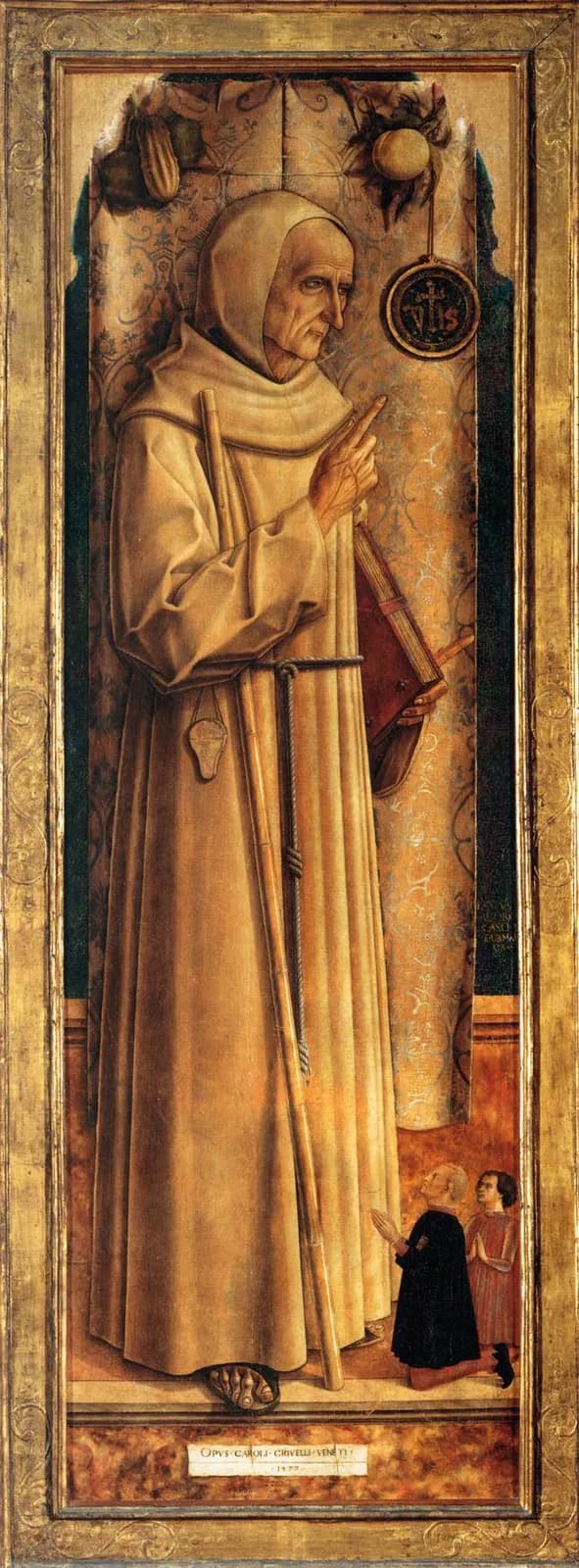
- Born
- 1391 at Monteprandone, in the March of Ancona, to a poor family named Gangala; Franciscan Media gives 1394 14
- Ordained
- June 13, 1420 1
- Known for
- Half a century of preaching in Italy and central Europe, and lending houses for the poor 124
- Canonized
- 1726, by Pope Benedict XIII; beatified by Urban VIII in 1624 1
Saint James of the Marches was a lawyer from a poor family in the March of Ancona who became a Franciscan in his twenties and then preached for half a century, from Umbria to Bosnia and Poland. 1 Vatican News remembers him as "a noted preacher, fiery, but with a severity tempered by mercy," who set up lending houses for the poor to fight usury. 2 He died at Naples on November 28, 1476, and that day is his feast. 12
From the law to the Portiuncula
He was born at Monteprandone, in the March of Ancona on Italy's Adriatic side, to a poor family named Gangala. 1 The 1910 Catholic Encyclopedia and Catholic Culture give the year as 1391; Franciscan Media gives 1394. 134 An uncle who was a priest started his schooling at Offida and then sent him to school at Ascoli. 1
At the University of Perugia he took a doctorate in civil law, according to the encyclopedia; Franciscan Media and Catholic Culture say doctorates in both canon and civil law. 134 He then spent a short time in Florence as tutor in a noble family and, in the encyclopedia's bare phrase, "as judge of sorcerers." 1 The older devotional life that Catholic Culture reprints says he felt himself being pulled into the worldliness of the city, turned to prayer, and thought of becoming a Carthusian. 3
What happened instead, in that account, is that he stopped to pray in the church of the Portiuncula while traveling near Assisi, and was so moved by the friars there that he asked for the habit on the spot. 3 The encyclopedia dates his reception into the Friars Minor in the Portiuncula chapel to July 26, 1416. 1 Vatican News says 1415, and the older life says only that he was twenty-one. 23 He made his novitiate at the hermitage of the Carceri near Assisi. 1
Fifty years a preacher
The sources name different teachers for his theology. The encyclopedia says he studied at Fiesole, near Florence, under Saint Bernardine of Siena. 1 Franciscan Media and Catholic Culture say he studied with Saint John of Capistrano. 34 He was ordained a priest on June 13, 1420, and began preaching in Tuscany, the Marches and Umbria. 1 The encyclopedia sums up what followed in one clause: "for half a century he carried on his spiritual labours." 1
His own life was severe. Franciscan Media says he fasted nine months of the year and slept three hours a night, and that Bernardine told him to moderate his penances. 4 The older life adds illnesses borne for thirty years without his ever missing Mass or the common office. 3
With Bernardine, John of Capistrano and Albert of Sarteano, he is counted one of the "four pillars" of the Observant movement, the reforming branch of the Franciscans, and all four were known above all as preachers. 4 Franciscan Media says he helped spread devotion to the Holy Name of Jesus. 4 The encyclopedia lists a treatise of his on the "Miracles of the Name of Jesus" among his writings, and the older life says he worked cures with the Holy Name written on a slip of paper. 13
Beyond the Alps
From 1427 the work took him out of Italy. The encyclopedia says he "preached penance, combated heretics, and was on legations in Germany, Austria, Sweden, Denmark, Bohemia, Poland, Hungary, and Bosnia," and that in Bosnia he was also commissary of the Friars Minor. 1 Vatican News says much of his career was spent as a papal envoy in eastern Europe, and Franciscan Media counts thirteen central and eastern European countries. 24 Franciscan Media also repeats an estimate of 250,000 conversions, and labels it one estimate. 4
He had a part in two efforts at reunion. At the time of the Council of Basel he worked for the reconciliation of the moderate Hussites with the Church, and at the Council of Ferrara-Florence for that of the Greeks. 1 He preached several crusades against the Turks, and when John of Capistrano died in 1456, James was sent to Hungary to succeed him. 1
The older life has stories from these years that the encyclopedia does not tell. At Buda, it says, he stopped a riot by holding up the crucifix, and the rioters carried him through the streets on their shoulders. At Prague a magician who came to dispute with him was struck mute. 3 It also says he traveled with no provisions but his confidence in God, and was glad of it when he found no lodging. 3
Lending houses and enemies
In Italy he preached in all the larger cities and founded several montes pietatis. 1 Franciscan Media explains the term: "literally, mountains of charity," nonprofit credit organizations that lent money against pawned objects at very low rates, set up to undercut ruinous interest. 4 Vatican News puts it simply: "To fight against usury, he established lending houses to assist the poor." 2 Catholic Culture goes so far as to call him one of the fathers of the modern pawnshop. 3
He also fought the Fraticelli, against whom he wrote a dialogue that was later printed. 1 That work made him enemies. The older life speaks of ambushes, poison, slander and stirred-up riots, and Franciscan Media says that twice assassins lost their nerve when they stood face to face with him. 34 The encyclopedia connects this to how he is usually painted, holding a chalice with a snake escaping from it: "an allusion to some endeavours of heretics to poison him or, less likely, to the controversy about the Precious Blood." 1
In 1460 Milan offered him its bishopric and he declined it. 1 The older life tells it more dramatically: chosen as archbishop, he fled. 3
Two quarrels inside the Church
The Observants were growing fast and were resented for it, and the encyclopedia points to a letter James wrote to John of Capistrano as evidence of how much he suffered on that account. 1 In 1455 Pope Callistus III made him an arbiter between the Observants and the Conventuals. His decision was published in a papal bull on February 2, 1456, and, the encyclopedia notes, it "pleased neither" side. 1
The second quarrel was his own doing. Preaching at Brescia on Easter Monday, 1462, he repeated the opinion of some theologians that the blood Christ shed in the Passion was not united to his divinity during the three days in the tomb. The Dominican inquisitor, James of Brescia, summoned him at once. He refused to appear and appealed to Rome. The question was argued before Pope Pius II and the cardinals at Christmas 1462, "but no decision was given." 1
Naples
He spent the last three years of his life at Naples. 1 The older life says the pope sent him there at the request of King Ferdinand, and credits him with the recovery of the king and of the Duke of Calabria from dangerous illness. 3 He died on November 28, 1476. 13 That same account calls him ninety years old with seventy years as a friar, figures that do not agree with the encyclopedia's dates, which would make him about eighty-five and sixty years a Franciscan. 13
He was buried in the Franciscan church of Santa Maria la Nova in Naples, where, the encyclopedia wrote in 1910, "his body is still to be seen." 1 Catholic Culture describes the body as incorrupt and reports that it was moved in 2001 to the sanctuary of Santa Maria delle Grazie and San Giacomo della Marca. 3 Urban VIII beatified him in 1624 and Benedict XIII canonized him in 1726. 1 His library and some of his manuscripts were still kept at Monteprandone when the encyclopedia was written; most of his many sermons had never been printed. 1
What is Saint James of the Marches the patron saint of?
The patronages the sources give him are places. The Catholic Encyclopedia says that "Naples venerates him as one of its patron saints," and Catholic Culture lists both Naples and his birthplace, Monteprandone. 13 None of the sources consulted for this page names him patron of a trade or a cause, though Catholic Culture's remark about pawnshops shows where one might have come from. 3
Saint James of the Marches's feast day
Praying with Saint James of the Marches
He had a doctorate, a post in Florence and a way out of the poverty he was born into, and he gave it up in a chapel near Assisi for a novitiate in a hermitage. 13 The training was not wasted. A man who understood contracts and interest was the one who set up lending houses where the poor could borrow without being ruined. 24
Vatican News describes his preaching as fiery, "but with a severity tempered by mercy." 2 Both halves are in the record. He was hard on himself to the point that Bernardine told him to ease off, and hard on error to the point that people tried to poison him. 14 The same man spent years on the slow work of reconciling Hussites and Greeks. 1
He was also wrong in public at least once, or at any rate summoned for it, and the ruling he gave between two branches of his own order satisfied nobody. 1 The encyclopedia records both without embarrassment, next to the miracles. He lived fourteen more years after Brescia, and the Church canonized him all the same. 1
Franciscan Media draws one plain point from him: the word needs "both prayerful preachers and cooperative listeners." 4 He spent fifty years trying to be the first kind. 1
Saint James of the Marches, pray for us.
Sources
- 1.Livarius Oliger, "St. James of the Marches," The Catholic Encyclopedia, vol. 8 (New York: Robert Appleton Company, 1910).
- 2."St. James of the Marches, Franciscan," Saint of the Day, 28 November, Vatican News.
- 3."St. James of the Marches," Liturgical Year, November 28, Catholic Culture; with a life excerpted from Paul Guérin, Les Petits Bollandistes (Paris, 1882), and John Gilmary Shea, Little Pictorial Lives of the Saints (New York, 1894).
- 4."Saint James of the Marche," Saint of the Day, November 28, Franciscan Media.
Saints to turn to next
Others in this collection who are turned to for some of the same things.