Saint John de Britto
March 1, 1647 - February 1693
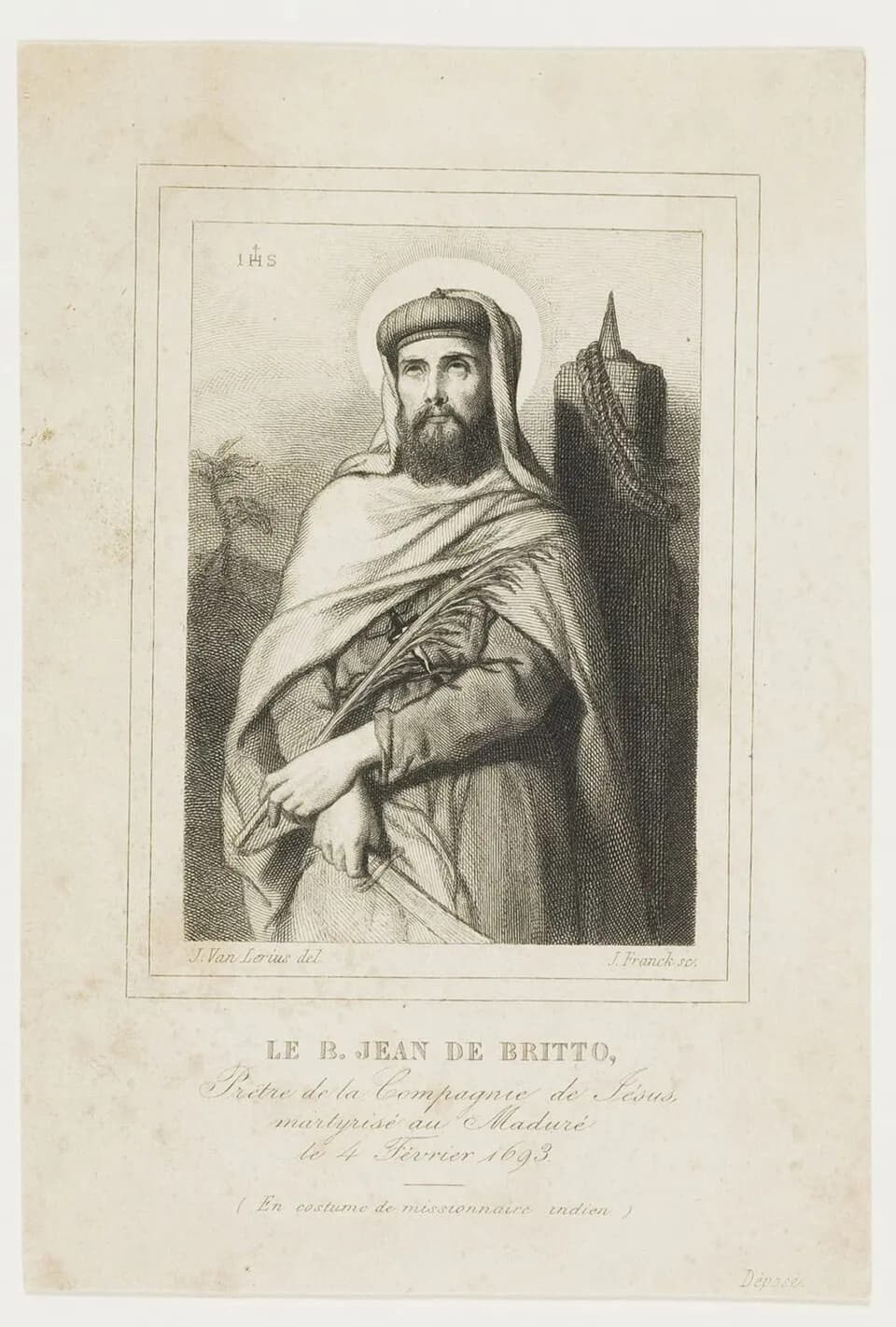
- Died
- Beheaded at Oriyur in February 1693; on the 4th by the Jesuit accounts and the Martyrology, the 11th by the encyclopedia 124
- Canonized
- June 22, 1947 3
Saint John de Britto was a Portuguese nobleman, raised at court beside a future king, who became a Jesuit at fifteen and spent most of twenty years as a missionary in southern India, living and dressing as an Indian ascetic. 12 He was beheaded at Oriyur in February 1693 after a prince he had converted sent away all his wives but one. 12 He was canonized on June 22, 1947, and his feast is February 4. 34
A boy in a cassock
He was born in Lisbon on March 1, 1647, and brought up at court. 1 The Jesuit accounts say he joined the royal household at nine as a companion to the young prince who became King Peter II, and the Singapore Jesuits add that his father was governor of Rio de Janeiro. 23
As a boy he nearly died of an illness, at eleven by the Singapore page, and his mother vowed that if he lived he would wear a Jesuit cassock for a year. 23 He recovered and, in the curia's phrase, "walked around court like a miniature Jesuit." 2 When the year was over he took the cassock off, but he had begun to want the real thing. 3
The king and the prince both tried to keep him. He entered the Jesuit novitiate in Lisbon anyway, on December 17, 1662, at fifteen. 12 He studied classics at Evora, moved to Coimbra when his health gave trouble, and there took up philosophy and an interest in Saint Francis Xavier and India. 23 In 1668 he wrote to the superior general asking to be sent east, and was told to finish theology first. 2
To India
He was ordained in February 1673 and sailed from Lisbon in the middle of March, over his mother's objection, according to the Singapore Jesuits. 23 He reached Goa that September. 12 There he studied more theology and was asked to stay on as a teacher. 2 The Singapore page gives his answer: "I came to India not to seek the laurels of science but martyrdom." 3
His mission was Madura, in the south. 12 Before starting, the encyclopedia says, he spent thirty days in the Spiritual Exercises of Saint Ignatius at Ambalacate, and early in 1674 he crossed the Ghats on foot to Colei in the Cauvery delta, where he perfected himself in the language. 1 He traveled north as far as Madras and Vellore, but his chief field was the delta, Tanjore, Madura, and Marava, the country between Madura and the sea. 1
The pandaraswami
The Jesuit accounts explain how he worked. Studying the caste system, he found that most Christians belonged to the lowest and most despised caste, and he judged that the faith would have no future there unless members of the higher castes were converted too. So he became a pandaraswami, an Indian ascetic, because ascetics were allowed to approach people of every caste. 23
He ate a little rice each day, slept on a mat, and set up a small retreat in the wilderness. 2 The sources dress him differently. The curia says he wore "a red cloak and turban"; the encyclopedia says his "dress was yellow cotton," that he gave up meat and wine, and that he "apparently entered the Kshatriyas, a noble caste." 12 In time he was accepted as a pandaraswami, and as he became known the conversions multiplied. 2
After eleven years he was made superior of the Madura mission. 2 By then he had enemies among the Brahmins, who resented his work and wanted him dead. 23
Prison, Lisbon and back
His first arrest is told two ways. The encyclopedia says he was imprisoned in Marava in 1684, freed by the king, and expelled from the country. 1 The Jesuit accounts say soldiers seized him and some catechists in 1686 and bound them in heavy chains, that he offered his neck when they threatened to kill him, and that he was released after a month. 23
He was then sent to Europe. The encyclopedia dates it to 1688 and gives the reason: he went as deputy to the triennial Congregation of Procurators. 1 Lisbon received him as a hero, and he toured the universities and colleges describing a missionary's life. 2 King Peter, his boyhood friend, saw how thin and worn he was and asked him to stay and tutor his two sons. 2 The encyclopedia adds that he refused the archbishopric of Cranganore. 1
He went back, in November 1690 by the curia's date and in 1691 by the encyclopedia's. 12 The raja of Marava had threatened his life four years earlier, and he traveled between mission stations at night to say Mass and baptize. 2
Oriyur
A convert brought about his death. A prince of Marava, whom the encyclopedia calls Teriadeven and the Jesuits Tadaya Theva, wanted to be baptized. 12 De Britto told him he could keep only one of his wives, and he agreed. One of the wives he dismissed was a niece of the raja. She complained to her uncle, and a general persecution began. 12
De Britto was arrested and taken to the capital, Ramnad, "the Brahmins clamouring for his death," in the encyclopedia's words. 1 The raja then sent him to Oriyur, some thirty miles north along the coast, a province governed by the raja's brother, with instructions that he be executed there. 12
He was led to a knoll above a river. 2 The Singapore Jesuits say that he knelt to pray, that the raja's order was read aloud, and that when the executioner hesitated he told him: "My friend, I have prayed to God. On my part, I have done what I should do. Now do your part. Carry out the order you have received." 3 He was beheaded with a scimitar. 23 His hands and feet were then cut off and the body was fixed to a stake. 3
The day is disputed. The text of both Jesuit pages and the Roman Martyrology say February 4, 1693. The encyclopedia says February 11, and so does the heading of the curia's own page. 124 The encyclopedia records that he was famous for miracles before and after his death and that Pius IX beatified him on August 21, 1853; the Singapore Jesuits give May 18, 1852, for the beatification, and June 22, 1947, for his canonization. 13
What is Saint John de Britto the patron saint of?
None of the sources consulted for this page names Saint John de Britto as patron of anything, and the page does not supply a patronage. 123 The Roman Martyrology remembers him as a Jesuit priest who brought many to the faith by living as the ascetics of that country lived, and who crowned that life with martyrdom. 4
Saint John de Britto's feast day
His feast is February 4. The Roman Martyrology lists him on that day, at Oriyur in the kingdom of Marava, and the Singapore Jesuits keep him on the same date. 34 It is the day the Jesuit accounts give for his death; the encyclopedia's date for the death, a week later, is not a feast in any source used here. 12
Praying with Saint John de Britto
He gave up a great deal twice. The first time he was fifteen and left a court where the king himself wanted him to stay. 2 The second time he was past forty, had already been in chains, and was offered a tutor's post beside his old friend and, by the encyclopedia's account, an archbishopric. 12 He chose the night roads of Marava. The curia says he "placed the needs in India above the comfort of the Portuguese court." 2
His way of preaching began with listening. He studied how the society around him was ordered before he decided how to live in it, and then he changed his food, his bed and his clothes so that no one would be barred from speaking to him. 2 The Martyrology singles this out as the thing to remember about him. 4
He did not bend the faith to keep a powerful friend. Telling a prince to send away his wives was dangerous, and he knew the raja already wanted him dead. 12 The demand cost the women their place too, and the sources do not say what became of them, apart from the one who went to her uncle. 12
The words the Singapore Jesuits record from the knoll at Oriyur are spoken to the man holding the sword, and they begin "My friend." 3 He had said in Goa twenty years earlier what he had come for. 3
Saint John de Britto, pray for us.
Sources
- 1.Henry Woods, "Blessed John de Britto," The Catholic Encyclopedia, vol. 8 (New York: Robert Appleton Company, 1910).
- 2."Saint John de Brito," Saints and Blessed, The Society of Jesus (Jesuit General Curia); originally collected and edited by Tom Rochford, SJ.
- 3."February 4th : St John de Britto, SJ," The Jesuits, Singapore.
- 4."San Giovanni de Britto, sacerdote," Santo del giorno, 4 febbraio, from the Roman Martyrology, Conferenza Episcopale Italiana (in Italian).
Saints to turn to next
Others in this collection who are turned to for some of the same things.