Saint John Climacus
c. 575 - after 650, or c. 525 - c. 606
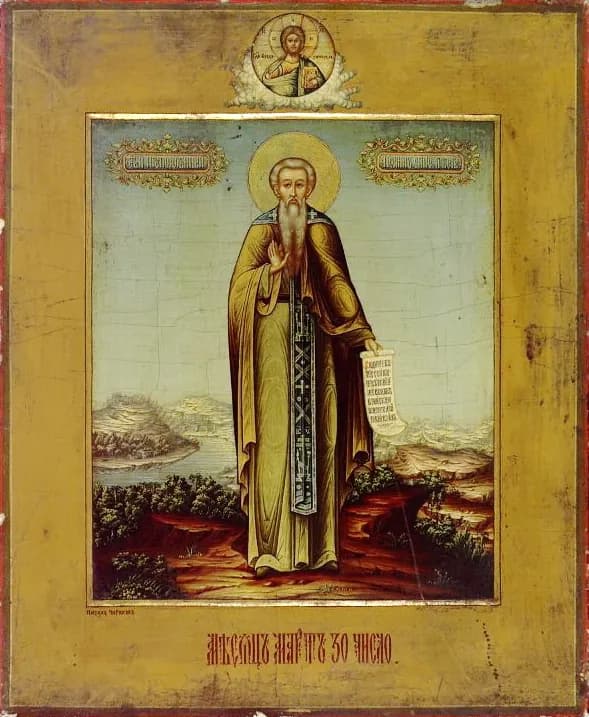
- Also called
- John Scholasticus; John the Sinaite 2
- Born
- About 575, according to Benedict XVI; about 525, in Syria, according to the Catholic Encyclopedia 12
- Died
- On Mount Sinai; after 650, according to Benedict XVI; March 30, probably 606, according to the Catholic Encyclopedia 12
- Feast day
- March 30 3
Saint John Climacus was a monk of Mount Sinai who spent decades as a hermit at the foot of the mountain and wrote The Ladder of Divine Ascent, a guide to the spiritual life in thirty steps from leaving the world to the perfection of love. 12 His surname comes from the book: klimax is Greek for ladder. 12 Benedict XVI called its account of the passions "the most important treatise of spiritual strategy that we possess." 1 His feast is kept on March 30. 3
Two sets of dates
Almost everything about his life comes from a short ancient biography written by a monk named Daniel of Raithu, and the two main sources here read its chronology very differently. 12 Benedict XVI, in 2009, has him born about 575 and dying after 650. 1 The Catholic Encyclopedia, in 1910, says he was born about 525, "doubtlessly in Syria," and died on Mount Sinai on March 30, "probably in 606, according the credited opinion," though others say 605. 2 Both sets of dates are given here.
Benedict places his life in the years when Byzantium faced the worst crisis in its history, with invasions sweeping away the structures of the empire. 1 Only the Church held, he says, "especially through the network of monasteries" in which men like John were at work. 1
Mount Sinai
The encyclopedia says his education fitted him for a life among scholars, but that while still young he left the world for solitude and went to Sinai, then famous for the holiness of its monks. 2 Benedict XVI says he was a monk there by sixteen and became the disciple of an elder, Abba Martyr; the encyclopedia calls the same teacher Martyrius. 12
After his teacher died, the encyclopedia says, John withdrew to a hermitage at the foot of the mountain to live a harder life. 2 Benedict XVI gives the place as Tola, about eight kilometers from what is now Saint Catherine's Monastery, and says he went there at about twenty. 1 The encyclopedia says he lived there "some twenty years"; Benedict says forty. 12 He spent the time, according to the encyclopedia, reading the lives of the saints, and became one of the most learned teachers of the Church. 2
He was not cut off from people. Benedict XVI says the solitude did not keep away those who came for spiritual direction, and that John visited several monasteries near Alexandria. 1 Far from being an escape from the world, he says, the hermitage led John to an ardent love for other people and for God. 1
Abbot of Sinai
Eventually the monks of the great monastery on the mountain asked him to lead them. 12 The encyclopedia dates this to 600, when he was about seventy-five, and says he governed with great wisdom. 2 His reputation reached Rome: Pope Gregory the Great, the encyclopedia says, wrote to ask for his prayers and sent money for the hospital at Sinai where pilgrims stayed. 2
The sources end the abbacy differently. The encyclopedia says that after four years he resigned and went back to his hermitage to prepare for death. 2 Benedict XVI says that several years before his death, missing the solitary life, he handed the community over to his brother, a monk of the same monastery. 1 Benedict sums up his life as lived "between two mountains, Sinai and Tabor." 1
The Ladder of Divine Ascent
He wrote the book at the request of another John, abbot of the monastery of Raithu near the Red Sea. 12 It is divided into thirty steps, which the encyclopedia says stand for the thirty years of Christ's hidden life. 2 The encyclopedia notes that it is written in short, sententious sayings, is sometimes obscure, and attracted commentaries very early. 2 It also records that some manuscripts give it the title "Spiritual Tables," and that it was translated into Latin, Spanish, Italian, modern Greek and French. 2 He left one other important work, the "Liber ad Pastorem." 2
Benedict XVI reads the thirty steps in three stages. 1 The first is renunciation of the world, which he says leads into a "return to true childhood in the spiritual sense," and from there to obedience and humility. 1 The second is the combat against the passions, each step naming one, diagnosing it and proposing its matching virtue. 1 Benedict stresses that for John the passions are not evil in themselves; they become evil through the wrong use of freedom, and once purified they can lead toward God. 1
The third stage, the last seven steps, is Christian perfection. 1 Of simplicity, humility and discernment, Benedict says John counted discernment the most important, and he quotes him: "After God, we ought to follow our conscience as a rule and guide in everything." 1 This leads to hesychia, an inner stillness, and to what John calls the prayer of the heart. 1
The name of Jesus and the last step
John describes prayer in two forms, Benedict XVI explains. 1 "Corporeal prayer" belongs to those who need the help of the body: stretching out the hands, groaning, beating the breast. 1 The prayer of the heart is spontaneous, a gift of God to those who have given themselves to the first kind. 1 Benedict notes that in John this prayer of the heart takes the name of the Jesus Prayer, a continual calling on the name of Jesus alone. 1 He quotes the Ladder: "May your remembrance of Jesus become one with your breathing, and you will then know the usefulness of hesychia." 1 In the end, Benedict says, the prayer becomes very simple, and the word "Jesus" becomes one with the breath. 1
The thirtieth step is given to faith, hope and charity. 1 John speaks of love for God in the language of eros and of fire, and Benedict says he was convinced that such love would carry the soul further than the hard struggle against the passions. 1 He also ties charity closely to hope: "Hope is the doorway of love.... The absence of hope destroys charity." 1 The book ends with God himself speaking from the top of the ladder, in the words of Saint Paul: "So faith, hope, love abide, these three; but the greatest of these is love." 1
What is Saint John Climacus the patron saint of?
Saint John Climacus's feast day
Praying with Saint John Climacus
Benedict XVI asked the obvious question himself: can a book written by a hermit 1,400 years ago say anything to people who will never see Sinai? 1 His answer was that monastic life shows "in capital letters what we write day after day in small letters," and that the Ladder is about baptism, which belongs to everyone. 1
What struck Benedict most was that the top of the ladder is where every Christian already begins: faith, hope and charity, "gifts of God to all the baptized." 1 The ascent does not lead away from those three into something rarer. It leads further into them. 1
The Jesus Prayer as John describes it asks for very little equipment: a name, said in time with breathing, until the two cannot be told apart. 1 He put discernment above simplicity and humility, and expected the person praying to look hard at their own motives. 1
His life was spent largely alone, and still it was full of other people, the disciples who came for direction, the monks who made him their abbot, the pilgrims in the Sinai hospital that a pope sent money to keep up. 12
Saint John Climacus, pray for us.
Sources
Saints to turn to next
Others in this collection who are turned to for some of the same things.