Saint John Cantius
1390 (disputed) - December 24, 1473
- Patron saint of
- Poland and Lithuania, the diocese of Bielsko-Żywiec and the Jagiellonian University 6; the Tennessee Register adds the university's students 9
Saint John Cantius was a priest who spent most of a long life teaching at the University of Kraków, and who was known to the poor of the city as the professor who would give them whatever he had. 12 He came from the small town of Kęty in southern Poland, took his degrees at Kraków and taught philosophy and theology there 137, and he was buried in the university church of St. Anne. 14 Vatican News sums up his life in a sentence: "With his pay he fed the poor, whom he sought in the city streets." 3
From Kęty to the Academy of Kraków
His name comes from his town. The encyclopedia spells it Kenty and places it near Oświęcim in the diocese of Kraków; Catholic Culture calls it Kanty, "whence his surname"; Vatican News uses the modern Polish name, Kęty. 136The 1910 Catholic Encyclopedia gives his parents' names as Stanislaus and Anne and calls them "pious country people." 1
The sources do not agree on when he was born. Franciscan Media and the Canons Regular of St. John Cantius give June 24, 1390, and Vatican News also has 1390. 237 John Godrycz, writing the encyclopedia article in 1910, gives "1412 (or 1403)," and a longer text on Catholic Culture's calendar page gives 1397. 16 The page leaves the question open.
After school at home he was sent to the Academy of Kraków, where, Godrycz says, "he soon impressed his professors and colleagues with his pleasant and amiable disposition." 1 The Canons Regular of St. John Cantius say he enrolled at about twenty-three and became a doctor of philosophy in 1418, then spent three more years preparing for the priesthood while teaching philosophy classes to support himself. 7
A parish he did not keep
According to the Canons Regular, his first post after ordination was as rector of the school kept by the Canons Regular of the Holy Sepulcher at Miechów, and he left it in 1429 to take a vacant place in the university's philosophy faculty. 7 At some point he was also made parish priest of Olkusz, in the same diocese, and the three accounts of that episode differ.
Godrycz says his superiors sent him there and that, "being afraid of the great responsibility of parish work, he very soon left the parish" and went back to teaching. 1 Franciscan Media tells a harder story: rivals had him ousted from his professorship, the parishioners at first did not care for him, and "in the end he won his people's hearts" before he returned to Kraków. 2 The Canons Regular's historian, Father Dennis Koliński, found that he held the parish together with a post as cantor at St. Florian's for only two months and resigned both. The Canons' account of that research calls his refusal to keep benefices he could not serve in person "highly unusual for the period," when it was common to hire another priest to do the work and keep the rest of the income. 8
Teacher, copyist and scholar
For the rest of his life he taught at the university, and the encyclopedia says he held the chair of Sacred Scripture "without interruption until his death." 1 The Canons Regular describe thirteen years of theological study fitted around teaching and administration, a doctorate in theology at the end of it, and, after the death of his teacher Benedykt Hesse, the direction of the theology faculty. 7 Vatican News adds that he was chosen as tutor to Polish princes. 3
In the evenings he copied books. The Canons Regular say twenty-six of his manuscript volumes survive, running to more than 18,000 pages, and that he favored Augustine and Aristotle. 78 At the end of each he wrote a short thanksgiving to God, the Virgin Mary and the saints. 8
John Paul II, himself a student of the same university, spoke of him there in 1997 at the six-hundredth anniversary of its theology faculty. He called the fifteenth century in Kraków "the century of saints," and said: "In those days Saint John of Kety studied and later taught here; his mortal remains rest in this same University Collegiate Church of Saint Ann." 4 Two years later, preaching in Kraków, he named him among "scholars of the calibre of Saint Jan Kanty, Piotr Wysz, Pawel Wlodkowic and others, who exercised great influence over the development of theological thought in the universal Church." 5
The poor of Kraków
What the sources most agree on is his charity. Godrycz, following the first biography by the Polish historian Michael Miechowita, says that "extreme humility and charity were conspicuous in his life" and that he gave the poor all the money and clothes he had, keeping only what he needed to live. 1 Franciscan Media adds that his goods and money were always at the disposal of the poor of Kraków, and that "time and again they took advantage of him." 2
Catholic Culture's calendar page passes on a detail of the same kind: that he often gave away his own clothes and shoes, and then let his cassock down so that it dragged along the ground and hid his bare feet. 6 The Canons Regular say he had a particular care for the university's poorer students and seems to have helped them with money as well as with their work, so that he came to be known as the Good Master. 78
He was hard on himself in the same proportion. He slept little, on the floor, ate sparingly, and took no meat after he became a doctor. 12 Catholic Culture gives the motto he wrote on the wall of his room, after the example of Augustine, against gossip: "Guard against causing trouble and slandering others, for it is difficult to right the evil done." 6
Pilgrimages, and a story about thieves
He went once to Jerusalem, hoping, the sources say, to be martyred by the Turks, and four times to Rome on foot. 12 Franciscan Media says he carried his own luggage, and that when people warned him to look after his health he pointed out that the desert fathers, for all their austerity, had lived remarkably long lives. 2
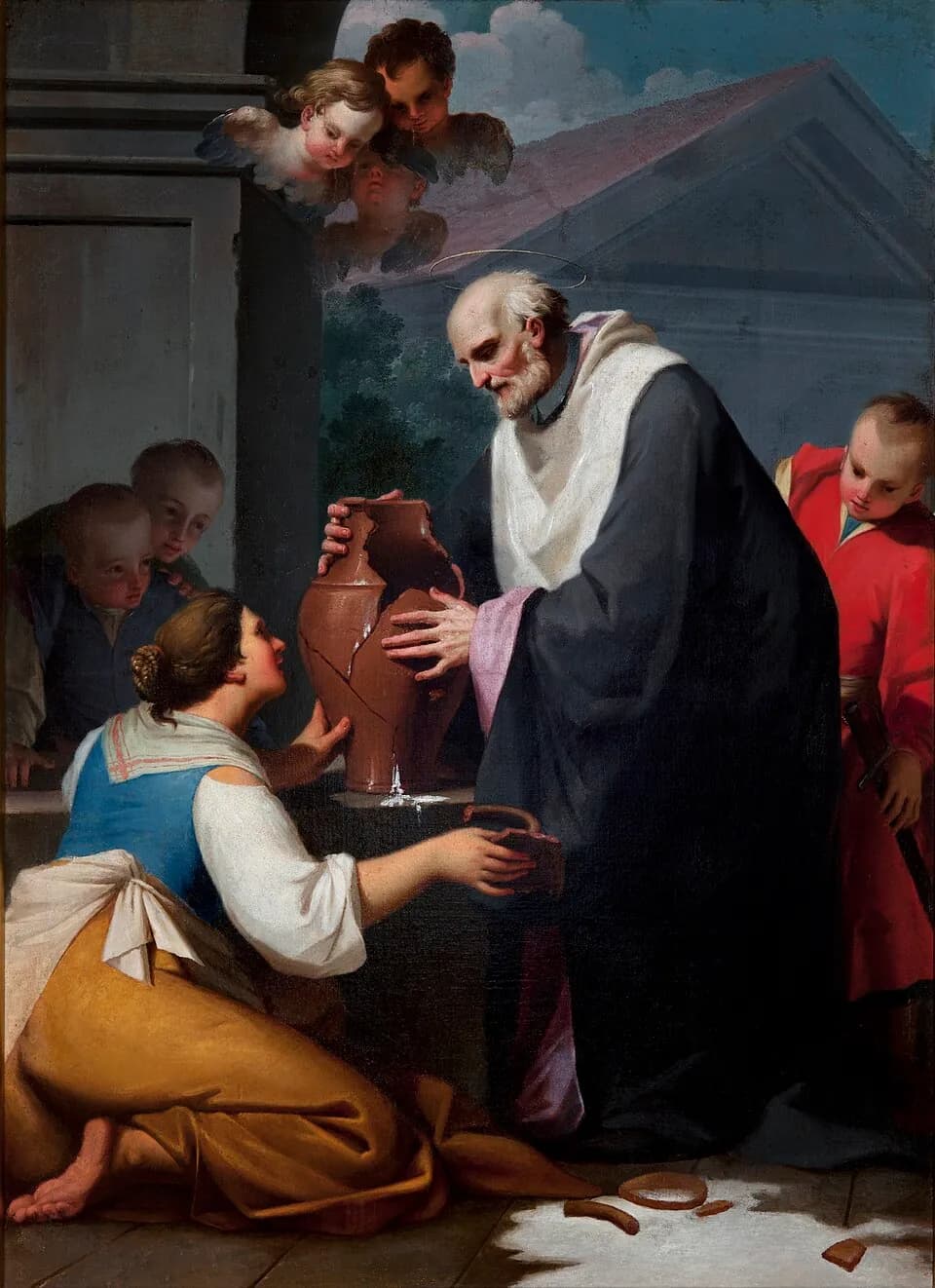
The best-known story told of him is about thieves, and Catholic Culture tells it this way: robbers stripped him of everything and asked if he had anything more. He said no. After they had gone he remembered gold coins sewn into his clothing, ran after them and offered those too, and the robbers, astonished, refused the money and gave back what they had taken. 6 The Tennessee Register, the newspaper of the Diocese of Nashville, says that "tradition" tells of his "converting the men who robbed him of his gold," and of his mending a servant girl's broken jug of milk. 9 The Canons Regular, whose Chicago church has the Miracle of the Jug over its high altar, treat it as a pious legend, possibly true and possibly allegorical. 8 That is how the page reports both.
Death and canonization
He died in Kraków on December 24, 1473; Vatican News says it was during the Mass of Christmas Eve. 23 He was buried in the church of St. Anne, and the encyclopedia says miracles were reported at his tomb after his death. 1 Pilgrims came to it from across Poland and beyond, according to the Canons Regular, though the cause for his beatification did not begin until about a hundred and fifty years later. 78 Pope Clement XIII canonized him in 1767. 18
What is Saint John Cantius the patron saint of?
Catholic Culture lists him as patron of Lithuania and Poland, of the diocese of Bielsko-Żywiec since 1992, and of the Jagiellonian University, and says he is honored as one of the principal patrons of Poland. 6 The Tennessee Register names Poland, Lithuania, the Jagiellonian University "and its students." 9 Neither the encyclopedia, Franciscan Media nor Vatican News states a patronage. 123
Saint John Cantius's feast day
His feast is December 23, as Franciscan Media, Vatican News and Catholic Culture all give it, and Catholic Culture lists it as an optional memorial. 236
Older sources give a different date. The 1910 Catholic Encyclopedia says "his feast is on 20 October," and the Canons Regular say October 20 was the day proclaimed when he was canonized. 17 None of the sources used says when the feast moved to December 23.
Praying with Saint John Cantius
Most of his life was spent in one place, doing one job. He studied at Kraków, taught there for decades, copied books there in the evenings, and was buried in its church. 147 The sources record no conversion story and no great crisis, only a parish he left after a short time and a professor's salary given away. 128
The sources do not make his charity sound easy. Franciscan Media says the poor took advantage of him time and again, and that he went on giving. 2 The encyclopedia says he kept only what was strictly necessary, and Catholic Culture says that near the end he gave away whatever he still had. 16
The story of the thieves is a legend, and the sources present it as one. 69 What it is told to show is a man for whom telling the truth mattered more than his money did. Koliński's reading of the Olkusz resignation, which is history and not legend, points in the same direction: he would not take pay for work he was not doing. 8
John Paul II, speaking in the church where he is buried, named him first among the people of the university who, in his words, "travelling the path of the search for truth, achieved the heights of holiness." 4 The prayer of his feast asks for the two things his life combined, knowledge of holy things and compassion to all. 6
Saint John Cantius, pray for us.
Sources
- 1.John Godrycz, "St. John Cantius," The Catholic Encyclopedia, Vol. 8 (New York: Robert Appleton Company, 1910).
- 2."Saint John of Kanty," Saint of the Day, Franciscan Media.
- 3."23 December," Saint of the Day, Vatican News.
- 4.Pope John Paul II, Address at the Meeting with the Rectors of Polish Universities, Collegiate Church of Saint Ann, Kraków, June 8, 1997.
- 5.Pope John Paul II, Homily, Kraków, June 15, 1999.
- 6."December 23: Optional Memorial of St. John of Kanty, Priest," Liturgical Year, Catholic Culture.
- 7."Meet St. John Cantius," Our Patron Saint, Canons Regular of St. John Cantius.
- 8."In the Footsteps of a Saint," Canons Regular of St. John Cantius, November 5, 2025.
- 9.Katie Peterson, "St. John of Kanty: Carrying the Treasure of Holy Baptism in His Soul," Tennessee Register, Diocese of Nashville, December 23, 2025.
Saints to turn to next
Others in this collection who are turned to for some of the same things.
- Saint Brigid of Kildare451 or 452 - February 1, 525Work and vocationStudy and teachingPoverty and simplicity
- Saint John Baptist de la SalleApril 30, 1651 - April 7, 1719Study and teachingWork and vocationPoverty and simplicity
- Saint John NeumannMarch 28, 1811 - January 5, 1860Study and teachingWork and vocationPoverty and simplicity
- Saint Thomas of Villanova1488 - September 8, 1555Poverty and simplicityWork and vocationStudy and teaching