Saints John and Paul
Roman martyrs of the fourth century
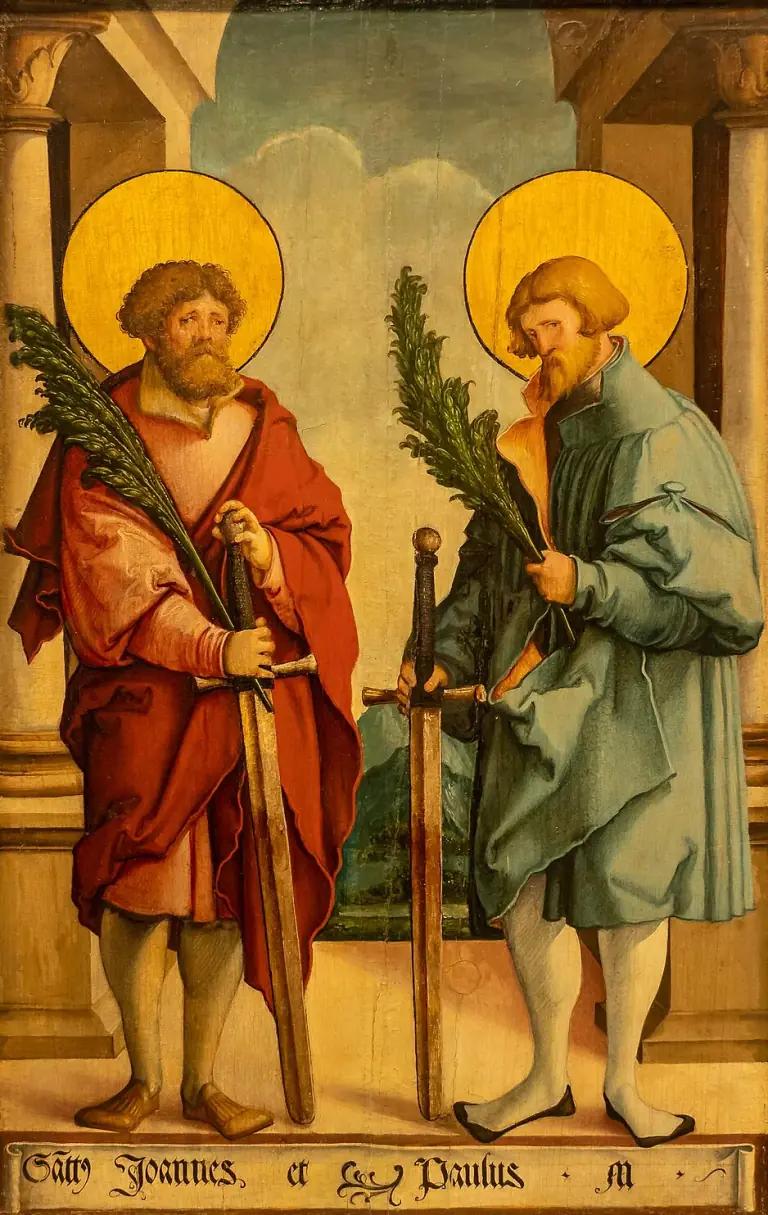
- Who they were
- Unknown; by their legend, eunuchs of Constantina 1, or her steward and secretary 5; officers in the army, says Butler 3
- Died
- At Rome; under Julian the Apostate (361-363), according to their Acts 1; "probably in 362," says Butler 3; some scholars prefer the reign of Diocletian 2
- Buried
- In a house on the Caelian Hill in Rome, under the present Basilica of Santi Giovanni e Paolo 124
- Patron saints against
- Thunderstorms, lightning and hail, and plague; invoked for or against rain and sunshine 2
Saints John and Paul are two martyrs of the early Roman Church who were buried inside the city, in a house on the Caelian Hill that was turned into a church in the fourth century and still stands beneath the Basilica of Santi Giovanni e Paolo. 12 Their tomb, the rooms around it and the frescoes on its walls can be seen today 2, and the 1910 Catholic Encyclopedia calls them "one of the most important early Christian memorials in Rome." 1 The story of how they died is another matter: their Acts place it under Julian the Apostate, and the same encyclopedia judges the Acts legendary. 1 Their feast is June 26 4, and their names are said in the Roman Canon of the Mass. 12
A house on the Caelian
The firmest facts about John and Paul are about a building. In the second half of the fourth century, J. P. Kirsch writes in the Catholic Encyclopedia, the Roman senator Byzantius and his son Pammachius made their house on the Caelian Hill into a Christian basilica. 1 Pammachius was "the pious friend of St. Jerome," and the church was called after him as well as after his father: the titulus Byzantii, or the titulus Pammachii. 1 In the fifth century its priests appear in an inscription and among the signatures of the Roman council of 499 as the presbyteri tituli Byzantii, the priests of the church of Byzantius. 1
Beneath that church the older rooms of the house were kept, and in them was the tomb of two Roman martyrs, John and Paul. It was "the object of veneration as early as the fifth century." 1 The Leonine Sacramentary, an early book of Roman Mass prayers, says in the preface for their feast that they rested within the city walls. 1 An early guide for pilgrims to the martyrs' tombs put their grave in the church on the Caelian. 1 Very early, then, the church of Byzantius and Pammachius came to be known by the two martyrs' names, as the titulus SS. Joannis et Pauli. 1
katolsk.no adds what the digging has shown. There were three Roman houses on the site to begin with; their owners fitted out a place of Christian worship on the ground floor, and the basilica was raised on top of it. 2 A new basilica was built on the old foundations in the fifth century, and the martyrs' relics still rest there. The church was rebuilt in the twelfth century, and in 1887 the house beneath it was excavated and opened to visitors. 2 Kirsch, writing in 1910, describes the rooms as decorated with important frescoes, and the original tomb, the confessio, as "covered with paintings of which the martyrs are the subject." 1
What is certain, and what is not
Kirsch draws the line carefully. "That the two saints are martyrs of the Roman Church, is historically certain," he writes. As to how and when their bodies came to rest in the house of Pammachius, "we only know that it certainly occurred in the fourth century." The year and the circumstances of their martyrdom are unknown. 1
The current Roman Martyrology, as the Italian bishops print it, is equally sparing. For June 26 it records only a commemoration at Rome of Saints John and Paul, to whose name the basilica on the Caelian is dedicated, along the Clivus Scauri, on the property of the senator Pammachius. 4 It says nothing about who they were or how they died. The older Martyrology of 1897 was more expansive, as the next section shows. 5
The legend of their death
Their Acts, which Kirsch calls "of a purely legendary character and without historical foundation," tell the story that later centuries knew. 1 In his summary the two were eunuchs of Constantina, the daughter of Constantine the Great. 1 The 1897 Martyrology makes them brothers: "The former was steward, the other secretary of the virgin Constantia, daughter of the emperor Constantine." 5 katolsk.no, retelling the legend at length, calls them brothers of high birth who served as army officers at Constantia's court, one as her steward and the other as her courier. 2 Butler has them simply as "officers in the army under Julian the Apostate." 3
According to katolsk.no's telling, Constantia left them a large fortune, and they used it above all for the poor. 2 When Julian came to the throne and set about restoring the old gods, he wanted them at his court in Rome, and they answered that they would not serve a man who had fallen away from Christ. He gave them ten days to change their minds; they spent the ten days giving their wealth away. 2
Then, in the Acts as Kirsch summarizes them, Julian had them beheaded secretly by Terentianus in their own house on the Caelian, where their church was later built and where they were buried. 1 katolsk.no adds that Terentianus came with soldiers and a statue of Jupiter for them to honor, that they said they would rather die than betray Christ, and that, fearing a riot, he killed them at night, buried them in the garden and spread the word that they had been sent into exile. 2 Butler names a different official: they died "probably in 362, under Apronianus, prefect of Rome, a great enemy of the Christians." 3
The date itself is the weak point. katolsk.no notes that scholars point to a historical fact: Julian's persecution took place in the East, where he lived, and not in Rome. For that reason they tend to place the martyrdom under Diocletian (284-305) instead. 2
Gallicanus
The Acts tie John and Paul to a third figure, Gallicanus, who in Kirsch's summary built a church at Ostia. 1 The 1897 Martyrology keeps him on June 25 as an ex-consul who had been "honored with a triumph" and "was dear to the emperor Constantine," converted "by the Saints John and Paul." 5 He retired to Ostia and gave himself to the care of the poor and the sick, and when Julian drove him out he went to Alexandria, where he was put to death for refusing to sacrifice. 5 In katolsk.no's version Gallicanus was a general fighting the Scythians in Thrace, the brothers told him that victory would be his only if he first became a Christian, and he did. 2
In the Mass and the calendar
Whatever the Acts are worth, the cult is old. Butler notes that John and Paul had a proper office and Mass in the sacramentaries that bear the names of Saint Gelasius and Saint Gregory the Great, and in the ancient Gallican liturgy. 3 According to katolsk.no, the Gelasian book for a time gave their feast a vigil and a fast, which Gregory the Great soon abolished, probably because of the nearness of the feasts of Saint John the Baptist on June 24 and Saints Peter and Paul on June 29, which had vigils and fasts of their own. 2 In England, Butler adds, the council of Oxford in 1222 ordered their feast kept with an obligation to hear Mass before work. 3
Since the basilica was built, Kirsch says, the two saints "have been greatly venerated, and their names have been inserted in the Canon of the Mass." 1 They are named in the Communicantes of the Roman Canon, now the first Eucharistic Prayer, and in the Litany of the Saints. 2 Their relics are also kept, katolsk.no says, in Venice, Fulda, Vienna, Avignon, Tours and Reichenau. The Dominican church in Venice that carries their names, where several doges are buried, was built by friars from the convent of Santi Giovanni e Paolo in Rome. 2 Their legend went into the Golden Legend, and Lorenzo de' Medici wrote a play about them. 2
What are Saints John and Paul the patron saints of?
Saints John and Paul's feast day
The feast of Saints John and Paul is June 26. 136 The current Roman Martyrology commemorates them on that day, and so did the Martyrology of 1897, which placed them "at Rome, on Mount Coelius." 45 katolsk.no says the feast has been kept on June 26 since the fifth century. 2
Their place in the calendar changed in 1969. The reform of that year took the feast out of the General Roman Calendar and left it to local and particular calendars, katolsk.no says, though they remain in the 2001 edition of the Roman Martyrology. 2 Vatican News still lists "Sts. John and Paul, Martyrs" on June 26. 6
Praying with Saints John and Paul
Almost nothing is known about these two men except that they died for Christ and were buried in a house in Rome. 1 On the strength of that alone, the Church has said their names in the Canon of the Mass since their basilica was built. 1
The legend, whatever its worth as history, remembers them by a choice. Given ten days to change their minds, they spent the time giving away what they had. 2 Butler, writing in the eighteenth century, read in it a refusal to be impressed by the powerful: "They saw many wicked men prosper in their impiety, but were not dazzled by their example." 3
Their grave was in a house, and the house became a church. Pammachius, Jerome's friend, gave his family's home for it, and the rooms where Christians first prayed over the martyrs are still under the floor of the basilica. 12 The current Martyrology, saying almost nothing else, says where they are. 4
Saints John and Paul, pray for us.
Sources
- 1.Johann Peter Kirsch, "Sts. John and Paul," The Catholic Encyclopedia, vol. 8 (New York: Robert Appleton Company, 1910).
- 2."De hellige Johannes og Paulus (d. 362)," Den katolske kirke, the saints database of the Catholic Church in Norway, katolsk.no (in Norwegian).
- 3.Alban Butler, "SS. John and Paul, MM.," June 26, The Lives of the Fathers, Martyrs, and Other Principal Saints, Vol. VI.
- 4.Roman Martyrology, entry for June 26, "Santi Giovanni e Paolo, martiri," Santo del giorno, Conferenza Episcopale Italiana (in Italian).
- 5.The Roman Martyrology, June 25 and June 26 (Baltimore: John Murphy Company, 1897), Internet Archive.
- 6."Sts. John and Paul, Martyrs," Saint of the Day, 26 June, Vatican News (Dicastery for Communication).
Saints to turn to next
Others in this collection who are turned to for some of the same things.