Saint Jean de Brébeuf
March 25, 1593 - March 16, 1649
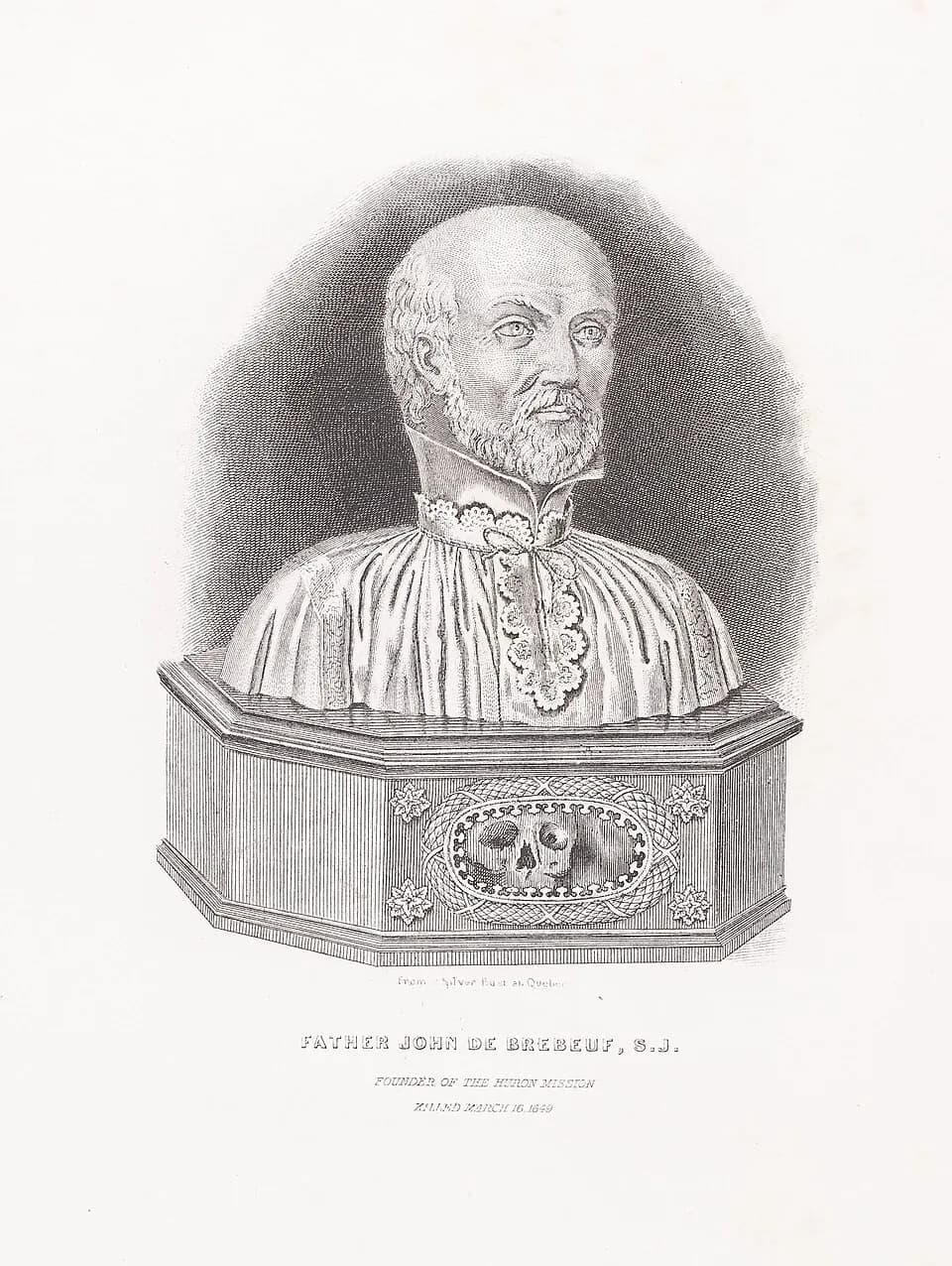
- Feast day
- October 19 in the United States, with the other North American Martyrs 235; September 26 in Canada, ranked a feast 6
- Born
- Condé-sur-Vire, Normandy, France, March 25, 1593 1
- Died
- St. Ignace, in the Huron country near Georgian Bay, March 16, 1649 1
- Religious order
- Society of Jesus, entered 1617 1
Saint Jean de Brébeuf was a French Jesuit who spent most of two decades among the Huron, or Wendat, people near Georgian Bay, learned their language well enough to write a catechism in it, and was killed by an Iroquois war party on March 16, 1649. 123 The Huron called him Echon. 37 John Paul II said that he "dreamed of a Church fully Catholic and fully Huron as well," and he is one of the eight North American Martyrs, whose feast is kept on October 19 in the United States and September 26 in Canada. 456
A Norman who asked to be a brother
He was born at Condé-sur-Vire in Normandy on March 25, 1593. 1 "His desire was to become a lay brother," the encyclopedia says, and the Jesuit profile adds that his superior talked him into studying for the priesthood. 17 He entered as a scholastic on November 8, 1617, by the encyclopedia's date, though it notes that Ragueneau, an early Jesuit chronicler, gives October 5. 1
Campbell, the encyclopedia's author, describes a man of "unusual physical strength" whose health nonetheless gave way completely at twenty-eight, so that he "never acquired any extensive theological knowledge." 1 He was ordained on February 19, 1622, taught at the Jesuit college in Rouen and became its treasurer. 7
Echon, 1625 to 1629
He reached Quebec on June 19, 1625, and the encyclopedia records that the Calvinist captain of the ship threatened to carry him back to France. 17 He spent his first winter living with the Montagnais on a hunting expedition that ran from October to March. 7
The next summer he went west with a party of Huron traders. The Jesuit profile says they at first refused him because he was too big for their canoes, and took him only on condition that he not move. 7 On the portages his strength impressed them, and they named him Echon, which Vatican News renders "he who carries a heavy load" and the Jesuit profile "the man who carries the load." 37 He arrived in the Huron country in late August 1626. 7 The encyclopedia names his first mission Ihonatiria; the Jesuit profile names the village Toanché. 17
He gave two years to the language, and the Jesuit profile says the only converts of the winter of 1628 were the dying, whom he baptized. 7 The encyclopedia is blunter: "Brébeuf met with no success." 1 He was called back to Quebec, by the encyclopedia's date on July 17, 1628, while the Jesuit profile has him bringing twenty canoes of grain to the blockaded town on July 17, 1629. 17 Champlain surrendered to the English on July 19, 1629, and the missionaries were sent home. 12
Back to Huronia
When the colony was restored to France he sailed again, on March 23, 1633, having made his solemn vows in the meantime. 1 The Huron would not take him west that year. In 1634 he got through with Antoine Daniel, a journey of thirty days. 1 The Jesuit profile says the Huron of the village welcomed him back, "delighted that he had kept his word to return." 7
The encyclopedia says he used to call his privations "only roses in comparison with what the end was to be." 1 When smallpox reached the Huron in 1636, some blamed the missionaries, and the Jesuit profile says a council of village chiefs at Ossossané decided he should die, and a council of the nation reached the same conclusion about all the Jesuits in March 1640. 7 Franciscan Media says simply that although medicine men blamed the Jesuits for the epidemic, he stayed. 2
In 1640 he and Pierre Chaumonot spent a winter of "incredible hardship" trying to reach the Neutrals north of Lake Erie, and came back without success. 1 He was then sent to Quebec, in 1642 by the encyclopedia's date and in June 1641 by the Jesuit profile's, and came back to Sainte-Marie, the mission's central station, in 1644. 17
The catechism, the dictionary and the carol
The sources agree that his gift was the language, and differ on what exactly he produced. Vatican News credits him with "the first dictionary" of the Wendat language and a catechism in Wendat; Franciscan Media, with "catechisms and a dictionary in Huron"; the Jesuit profile, with a Huron grammar, a translated catechism and a phrase book. 237 The Jesuit profile calls him "a master of the Indian language," and says he taught it to the other missionaries. 7
The Jesuits of Canada attribute to him Jesous Ahatonhia, a Christmas carol in Wendat that they call the first in the country's history, said to have been written in 1641 or 1642. They write about it "in the conditional tense," because music historians disagree: some credit Brébeuf, and others think it came out of the oral tradition of the Wendat Christians themselves. 8 Catholic Culture identifies it with the English carol known as "'Twas in the Moon of Wintertime" or "The Huron Carol." 9
March 16, 1649
The Iroquois Confederacy was at war with the Huron and, Vatican News says, saw the French missionaries as allies of their enemies. 3 In 1648 Antoine Daniel was killed and mission stations were burned. 12 On March 15, 1649, Brébeuf and Gabriel Lalemant left Sainte-Marie on their weekly round and spent the night at the village of St. Louis. 7 When the Iroquois attacked at dawn, the encyclopedia says the two priests "could have escaped but rejected the offer made to them and remained with their flock." 17
The sources do not agree on where he was taken. The encyclopedia says he was seized at St. Louis and dragged to St. Ignace, and the Jesuit profile also has him taken at St. Louis and driven to a nearby village. 17 Franciscan Media says he was captured at Sainte Marie, near Georgian Bay, and Vatican News places the capture in "the present-day province of Québec." 23 John Paul II, at Midland in 1984, said that Sainte-Marie had stood on that site. 4
Vatican News calls the ordeal "interminable," and Franciscan Media says it lasted four hours. 23 The encyclopedia, Vatican News and the Jesuit profile all record boiling water poured over his head in mockery of baptism. 137 The encyclopedia says that "through all the torture he never uttered a groan," and Vatican News gives a reason: he prayed to suffer without crying out because his captors valued courage and he did not want them to think Christians weak. When he died, Vatican News says, they ate his heart to share in his bravery. 13 Lalemant, according to Vatican News, had to watch him die first. 3
Afterward
The sources count his years differently. Franciscan Media says he came to Canada at 32 and "labored there for 24 years"; Vatican News says he worked among the Huron for twenty years; the Jesuit profile says that at his death he was 46 and "had spent 20 years in New France." 237
His remains were recovered, and in 1907 the encyclopedia reported that his head was "still kept as a relic at the Hôtel-Dieu, Quebec." 1 An ecclesiastical court sat for a year in 1904 to examine his cause, prompted, the encyclopedia says, by "the conviction that the reason of his death was not his association with the Hurons, but hatred of Christianity." 1 He was canonized in 1930 with seven companions, whom Franciscan Media calls "the first martyrs of the North American continent officially recognized by the Church." 12
What is Saint Jean de Brébeuf the patron saint of?
Canada. The Liturgical Calendar Proper to the Dioceses of Canada lists "Sts. Jean de Brébeuf, Isaac Jogues, Priests, and Companions, Martyrs" as "secondary patrons of Canada," after Saint Joseph, whom it names the principal patron. 6
Franciscan Media lists the eight martyrs together as patron saints of North America and of Norway, and gives no reason for Norway. 2
Saint Jean de Brébeuf's feast day
In the United States the feast of Saint Jean de Brébeuf is October 19, shared with Saint Isaac Jogues and their companions. The USCCB's proper calendar lists "Saints John de Brébeuf and Isaac Jogues, Priests, and Companions, Martyrs" on that day, and Vatican News and Franciscan Media keep the same date. 235
In Canada the same martyrs are kept on September 26, with the rank of feast, under the Liturgical Calendar Proper to the Dioceses of Canada. 6 March 16 is the date of his death, not of his feast. 17
Praying with Saint Jean de Brébeuf
Most of his years among the Huron did not look like success. The encyclopedia's verdict on the first mission is four words long, and the Jesuit profile counts twelve baptisms after a year's work from 1635, eight of them adults at the point of death. 17 Councils decided more than once that he should die. 7 Franciscan Media's word for what he did is that he "remained." 2
The work he left was in their language. John Paul II, speaking where Sainte-Marie had stood, remembered him in 1984 for a hope rather than for his death: "a Church fully Catholic and fully Huron as well." 4 Whether or not the carol is his, the Jesuits of Canada read it as the same instinct, to give the Wendat the Christmas story in words of their own. 8
The end is hard to read about. Vatican News says he had vowed in youth never to refuse martyrdom, and that he prayed for the strength not to cry out so that the men killing him would not think Christians weak. 3 That is a prayer made for the sake of the people doing the harm. It did not stop them.
Vatican News reads the eight deaths as "the small, suffering seed" from which the Church in North America sprang. 3 That reading came later. On the morning of March 16 he had the offer of escape and, the encyclopedia says, turned it down to stay with the people of St. Louis. 1
Saint Jean de Brébeuf, pray for us.
Sources
- 1.Thomas Campbell, "Jean de Brébeuf," The Catholic Encyclopedia, Vol. 2 (New York: Robert Appleton Company, 1907), with New Advent's editorial note on his canonization.
- 2."Saints Isaac Jogues, Jean de Brébeuf, and Companions," Saint of the Day, Franciscan Media.
- 3."Sts. John de Brébeuf and Isaac Jogues, priests and Companions, Jesuits, Canadian Martyrs," Saint of the Day, Vatican News, October 19.
- 4.John Paul II, Liturgy of the Word with the Canadian Indians, Martyrs' Shrine, Huronia (Midland, Ontario), September 15, 1984.
- 5."Proper Calendar for the Dioceses of the United States of America," United States Conference of Catholic Bishops.
- 6.Liturgical Calendar Proper to the Dioceses of Canada, approved by the Congregation for Divine Worship and the Discipline of the Sacraments, January 27, 2016 (updated April 1, 2025). Canadian Conference of Catholic Bishops.
- 7.Tom Rochford, SJ, ed., "Saint John de Brébeuf," Jesuit Saints and Blessed, Society of Jesus (jesuits.global).
- 8."Jesous Ahatonhia: the Wendat Christmas carol of Fr. Brébeuf," Jesuits of Canada, December 8, 2020.
- 9.Jennifer Gregory Miller, "Feast Day Highlights: The North American Martyrs," Catholic Culture, October 17, 2016.
Saints to turn to next
Others in this collection who are turned to for some of the same things.