Saint Isaac Jogues
January 10, 1607 - October 18, 1646
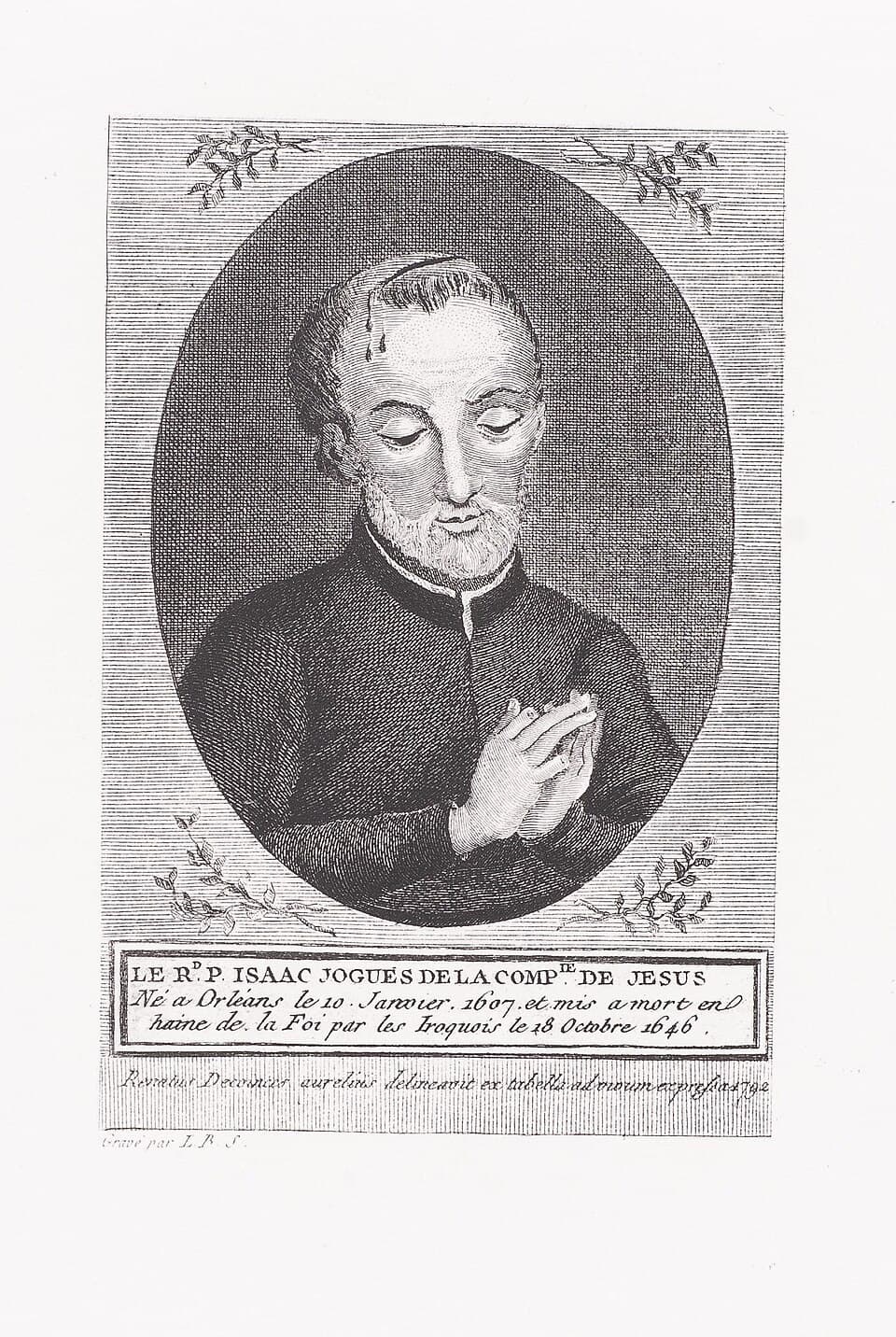
- Born
- Orléans, France, January 10, 1607 1
- Religious order
- Society of Jesus, entered 1624 1
- Patron saint of
- Franciscan Media lists the eight martyrs together as patrons of North America and Norway 2
Saint Isaac Jogues was a French Jesuit who was captured by a Mohawk war party in 1642, held as a slave at the village of Ossernenon in what is now upstate New York for thirteen months, and sent home to France with several of his fingers gone. 12 He went back. In October 1646 he was killed in the same village, struck with a tomahawk as he entered a cabin and then beheaded. 12 He was the first Catholic priest to set foot on Manhattan Island, and he is one of the eight North American Martyrs canonized in 1930. 12
A literature teacher sent to New France
He was born at Orléans on January 10, 1607, entered the Society of Jesus in 1624, and taught literature at Rouen. 1 Franciscan Media calls him "a man of learning and culture" who gave that career up for the missions. 2 In 1636 he sailed for Canada, arriving with Montmagny, the governor who succeeded Champlain, and joining the Jesuits who were working under Jean de Brébeuf. 12
He spent six years in the mission country around the Great Lakes, which the encyclopedia describes as "constant danger." 1 He worked with Charles Garnier among the Petun, and he and Charles Raymbault went as far as Sault Ste. Marie, and the encyclopedia has "little doubt" that they were the first Europeans to reach that outlet of Lake Superior. 1 It quotes the historian George Bancroft to the effect that they preached a thousand miles into the interior five years before John Eliot began preaching six miles from Boston Harbor. 1
Campbell, who wrote the 1910 article, calls him "a daring missionary" whose "character was of the most practical nature." 1 He already had plans for the peoples of Lake Superior and for the Sioux at the headwaters of the Mississippi. 1
Captured, 1642
Those plans ended on August 3, 1642, when he was taken prisoner near Three Rivers on his way back from Quebec. 1 Vatican News gives the context: the Iroquois Confederacy was at war with the Hurons, also called the Wendat, and saw the French missionaries as allies of their enemies. 3 With him was René Goupil, a lay brother whom Vatican News describes as deaf. 3
They were taken to Ossernenon, a Mohawk village on the Mohawk River about forty miles above present-day Albany, now Auriesville. 13 Franciscan Media summarizes what his own letters and journals record: he and his companions were led from village to village, beaten and tortured, and made to watch Huron converts mangled and killed. 2 Goupil was tomahawked for making the sign of the cross on the foreheads of some children, and Franciscan Media counts him the first of the Jesuit missionaries to be martyred. 2
Jogues lost several fingers. The three sources describe it differently: the encyclopedia says they were "eaten or burned off," Franciscan Media that they were "cut, chewed, or burnt off," and Vatican News that they were cut off "so that he could not celebrate Mass." 123 He was kept as a slave for thirteen months. 12
Fort Orange and Manhattan
The Dutch at Fort Orange, now Albany, had been trying to free him, and the encyclopedia is specific that they were Calvinists. 1 When he was about to be burned to death, they persuaded him to take refuge on a ship that carried him to New Amsterdam. 1 Franciscan Media calls it "an unexpected chance for escape," and Vatican News says he was ransomed. 23 All three accounts credit the Dutch.
That is how he became, in the encyclopedia's words, "the first Catholic priest who ever came to Manhattan Island." 1 He wrote a description of the colony as it then was, which was later included in New York's documentary history. 1
From there he was sent across the Atlantic in midwinter on a vessel of fifty tons. After two months at sea he landed on the coast of Brittany on Christmas morning, 1643, "in a state of absolute destitution," and made his way to the nearest Jesuit college. 1
The hands
France received him well. The encyclopedia says he was welcomed at the court of the Queen Regent, the mother of Louis XIV, and Franciscan Media says he was "welcomed home as a hero." 12
Church law did not allow a priest with hands in that condition to celebrate Mass, and he was given a special permission to do so. 13 The encyclopedia names the pope as Urban VII; Franciscan Media names him as Urban VIII. 12 Franciscan Media also gives the pope's reason: "It would be shameful that a martyr of Christ not be allowed to drink the Blood of Christ." 2 The encyclopedia adds that no similar concession was known to have been granted before. 1
He could have stayed, and Franciscan Media says as much. 2 In the early spring of 1644 he returned to Canada. 1
The peace of 1646
In 1646 he was sent to negotiate peace with the Iroquois, and he traveled the same route he had been carried along as a captive four years earlier. 1 On the way he named the lake then called Horicon the Lake of the Blessed Sacrament. It is now Lake George. 1
He reached Ossernenon on June 5, after three weeks on the road from the St. Lawrence. The encyclopedia says plainly that "he was well received by his former captors and the treaty of peace was made." 1 He left on June 16 and was back in Quebec on July 3. 1
He asked at once to be sent back to the Mohawk as a missionary. His superiors hesitated a good deal before they agreed. 1 On September 27 he set out for the third time, with Jean de Lalande, a layman who had offered his services to the Jesuits. 123
Ossernenon, October 1646
In the months he was away, sickness broke out in the village and a blight fell on the crops. 1 According to the encyclopedia the Mohawk blamed both on Jogues, "whom the Indians always regarded as a sorcerer," and sent warriors out to take him. 1 Word of the change reached his party. The Hurons and others traveling with him fled, all except Lalande, and Jogues kept going toward Ossernenon knowing what was waiting. 1
The warriors met him near Lake George, stripped him, cut him with knives, beat him, and brought him into the village. 1 On October 18, 1646, as he entered a cabin, he was struck with a tomahawk and then beheaded. 12 His head was set on the palisade and his body thrown into the Mohawk River. 1 Franciscan Media records that Lalande was killed the next day. 2
Vatican News adds two things that happened afterward. The man who killed Jogues later asked to be baptized. And Kateri Tekakwitha, the Mohawk woman who became the first Native American saint, was born at Ossernenon, Vatican News says, only ten years later. 3
The encyclopedia article ends with a preliminary court in Quebec taking testimony about his holiness and the cause of his death "in view of his possible canonization." 1 Pius XI canonized him on June 29, 1930, together with seven companions, who were, in Franciscan Media's words, "the first martyrs of the North American continent officially recognized by the Church." 12
What is Saint Isaac Jogues the patron saint of?
None of the three sources names a patronage for Isaac Jogues alone. Franciscan Media lists the eight martyrs together, Jogues, Brébeuf and their companions, as patron saints of North America and of Norway. 2 It gives no explanation for Norway, and neither the encyclopedia nor Vatican News mentions either patronage. Both are recorded here as Franciscan Media prints them.
Vatican News puts the same idea in different terms: the Church in North America, it says, acknowledges these eight men "as the small, suffering seed from which it sprang." 3
Saint Isaac Jogues's feast day
The feast of Saint Isaac Jogues is October 19, which he shares with Saint Jean de Brébeuf and the other North American Martyrs. 123 New Advent's note on the encyclopedia article calls it "their collective feast day," and Vatican News and Franciscan Media both keep it on that date. 123
He died on October 18, so the feast falls the day after his death. Of the others kept with him, René Goupil was killed in 1642, Antoine Daniel in 1648, and Brébeuf, Gabriel Lalemant, Charles Garnier and Noël Chabanel in 1649. 23
Praying with Saint Isaac Jogues
He went back knowing. He had spent thirteen months as a slave in that village, and his hands showed it. 12 When word came on the last journey that the mood had turned, the people with him left and he did not; the encyclopedia's phrase is "fully aware of the danger." 1 Whatever this is, it is not the courage of someone who has not yet been hurt.
The peace he went to make did not last. In June the same people received him well and agreed to a treaty, and by October there had been sickness and a failed harvest, and they killed him. 1 The war between the Iroquois and the Hurons went on, and within three years it had killed five more of the Jesuits kept with him on October 19. 23 Lalande, who stayed with him, died the next day. 2
In between, he was allowed to go on saying Mass with those hands, under a permission granted because a pope thought it would be shameful to refuse "a martyr of Christ." 2 He took what had been done to him to the altar, and then he asked to be sent back to the people who had done it. 1
Vatican News reads the deaths of the eight as a seed: the killer baptized, Kateri born in the same village ten years later. 3 That is a reading made afterward, by people who knew how things turned out. On October 18, 1646, what Jogues could see was that the peace had failed and that the man beside him would die too. He went into the cabin anyway. 1
Saint Isaac Jogues, pray for us.
Sources
- 1.Thomas Campbell, "St. Isaac Jogues," The Catholic Encyclopedia, Vol. 8 (New York: Robert Appleton Company, 1910), with New Advent's editorial note on his canonization and feast.
- 2."Saints Isaac Jogues, Jean de Brébeuf, and Companions," Saint of the Day, Franciscan Media.
- 3."Sts. John de Brébeuf and Isaac Jogues, priests and Companions, Jesuits, Canadian Martyrs," Saint of the Day, Vatican News, October 19.
Saints to turn to next
Others in this collection who are turned to for some of the same things.