Saint James of Nisibis
Died 338 or c. 350
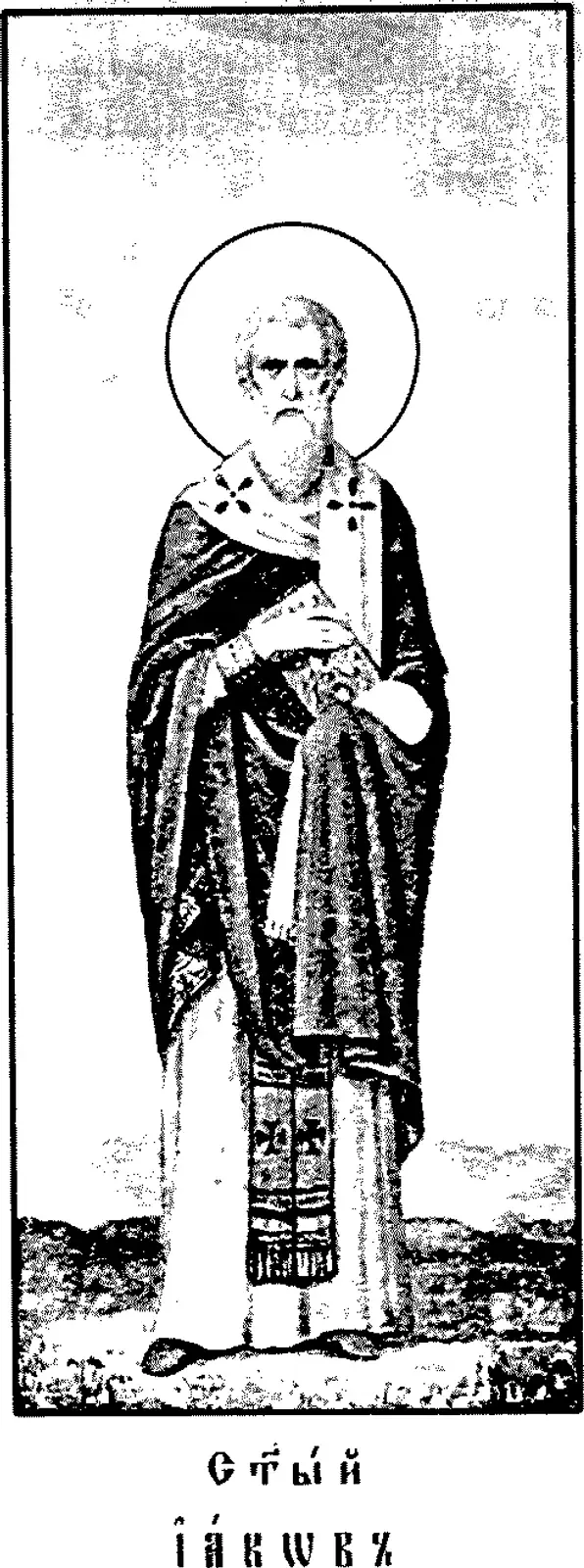
Saint James of Nisibis was a hermit of the Mesopotamian mountains who became bishop of Nisibis, on the frontier between Rome and Persia, and sat at the Council of Nicaea in 325. 135 Theodoret, writing in the next century, tells how the city held out against the Persian king Shapur while its bishop prayed in the church. 4 His feast is July 15. 25
A hermit in the mountains
Butler calls him a native of Nisibis, a city "called by the Greeks Antiochia Mygdoniæ" from the river that ran through it. 2 As a young man he went up into the highest mountains around it, sheltering in a cave in winter and living the rest of the year in the woods under the open sky. 12 He ate wild roots and herbs, raw, and had nothing to wear but a tunic and a cloak of coarse goat's hair. 12
People found him anyway and climbed the rocks to ask for his prayers. 12 Butler says he traveled into Persia to strengthen the young churches there, which were living under persecution. 2 Gennadius, writing in the fifth century, counts him among the confessors under the persecutor Maximinus. 3
Bishop of Nisibis
His reputation made him bishop of his city. 12 The current Roman Martyrology calls him its first bishop; the Norwegian bishops' database says he was the second, after a bishop named Babu, and was chosen about 309. 15 As bishop he kept the same fasts, food and clothing as on the mountain and added care for the poor, the widows and the orphans. 12 Butler adds that he built a great church in the city. 2
Butler tells a story from Theodoret's Religious History. A band of beggars laid one of their number on the road as if dead and asked the bishop for money to bury him. James gave it and prayed for the dead man's soul. When he had gone on, the others found their companion really dead; they ran after James, confessed, and begged him to give the man back his life, which he did. 21 In the Church History Theodoret says simply that James "raised the dead and restored them to life." 4
At Nicaea
Theodoret names him among the bishops at the Council of Nicaea, in a passage on the men there who "bore in their bodies the marks of the Lord Jesus Christ." 4 Gennadius says he was one of those who "overthrew the Arian perversity" at the council. 3 Butler adds the council of Antioch about 326, and a stay at Constantinople in 336, when he urged the people to seven days of fasting and prayer before Arius was to be received back into communion; on the eighth day Arius died suddenly. 21
Saint Ephrem the Syrian was his disciple. The Norwegian database says James baptized him and that Ephrem stayed beside him as long as he lived. 1 Theodoret calls Ephrem "the best writer among the Syrians." 4
The siege of Nisibis
Nisibis lay "on the confines of the realms of Persia and of Rome," Theodoret writes, and its bishop was "at once bishop, guardian, and commander in chief." 4 Shapur II of Persia besieged it, and the blockade went on for seventy days. 4 The Persians dammed the river Mygdonius above the town and released the water against the walls, which gave way. 4
They waited a day for the mud to dry, and when they attacked they found the wall built up again behind the breach. James had done it, Theodoret says, "without approaching the walls, but by beseeching the Lord of all within the church." 4 Shapur saw on the battlements a figure in purple and a crown, took it for the emperor, and was told the emperor was at Antioch; "their God is fighting for the Romans," he said, and threw a javelin into the sky. 4
Ephrem then begged James to go up on the wall and curse the enemy. He climbed a tower and asked only that gnats and mosquitoes be sent. They came in clouds, got into the trunks of the elephants and the nostrils of the horses, and the army broke and went home. 4 Butler has James refuse to pray for anyone's destruction and ask only that the city be delivered. 2
Which siege this was is disputed. Butler counts two in James's lifetime, in 338 and 350, and puts the dam and the gnats in the second. 2 The Norwegian database counts three, in 338, 346 and 350. 1 Butler notes that the Assemani brothers set the story in the first siege, saying Theodoret had run the two together. 2
Death, burial and the writings
Gennadius says he died in the reign of Constantius and, by order of Constantine, was buried inside the walls of Nisibis "for the protection evidently of the city." 3 Julian the Apostate later had the remains carried out, and a few months afterward the emperor Jovian handed the city over to Persia. 32 Butler says the people took the relics with them when they left, and that the Armenians record their arrival at Constantinople about 970. 2
Butler dates his death to 350, after the second siege, with most of the critics of his day. 2 The Assemani put it in 338, and the Norwegian database says that modern historians agree: he was alive at the first siege and died that year. 21
Gennadius lists twenty-six books by "James, surnamed the Wise," and Butler accepted eighteen discourses in Armenian as his. 32 The Norwegian database says that none of these is his: the works were by Aphrahat, "the Persian sage," who was confused with him very early, already in Gennadius's day. 1
What is Saint James of Nisibis the patron saint of?
Saint James of Nisibis's feast day
Saint James of Nisibis's feast day is July 15. The current Roman Martyrology enters him on that day as the first bishop of the city, who took part in the Council of Nicaea and defended his flock from the enemies of the faith. 5 Butler says the Latins keep his festival on July 15, the Greeks on January 13 and October 31, the Syrians on January 18, and the Armenians on a Saturday in December, after a five-day fast. 2
The 1908 New York edition of Butler prints his life under July 11, and the Norwegian database gives July 27 as his memorial. 21 This page follows the Martyrology.
Praying with Saint James of Nisibis
He went to the mountains to get away from people, and they climbed up after him. When they made him a bishop he kept the hermit's food and clothing and took on the poor. 12
In the siege Theodoret does not put him on the wall. He was in the church, praying, while the townspeople rebuilt what the water had broken. 4
Even asked to curse an army, he asked for gnats. 4 Butler goes further and has him refuse to pray for anyone's destruction at all. 2
Much of what was once said of him has been taken back: the writings belonged to someone else, and the dates are uncertain. 12 What remains is a bishop who stayed with a frontier city through a war. 34
Saint James of Nisibis, pray for us.
Sources
- 1."Den hellige Jakob av Nisibis (d. 338)," Den katolske kirke (Catholic Church in Norway), compiled by Per Einar Odden (in Norwegian).
- 2.Alban Butler, "St. James, Bishop of Nisibis, C.," in The Lives of the Fathers, Martyrs, and Other Principal Saints, Vol. VII, July (New York: P. J. Kenedy, 1908), Project Gutenberg eBook #49604.
- 3.Gennadius of Marseille, Lives of Illustrious Men, chapter 1, trans. Ernest Cushing Richardson, Nicene and Post-Nicene Fathers, Second Series, vol. 3 (1892), New Advent.
- 4.Theodoret, Ecclesiastical History, Book I, chapter 7, and Book II, chapter 26, trans. Blomfield Jackson, Nicene and Post-Nicene Fathers, Second Series, vol. 3 (1892), New Advent.
- 5.Roman Martyrology, entry for July 15, "San Giacomo, vescovo," Santo del giorno, Conferenza Episcopale Italiana (in Italian).
Saints to turn to next
Others in this collection who are turned to for some of the same things.