Saint James Intercisus
Died 421
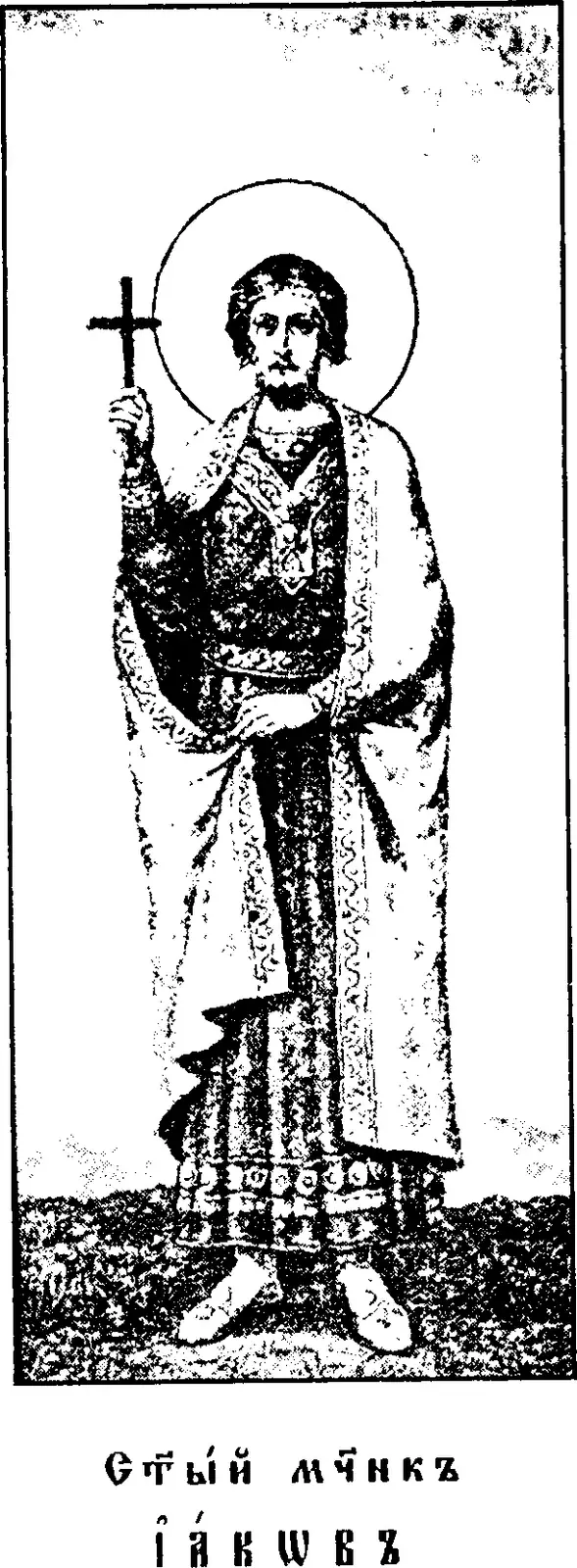
Saint James Intercisus was a Persian nobleman who renounced his faith to keep the favor of his king, and came back to it after his mother and his wife wrote to tell him they were done with him. 14 Under the next king, Bahram V, he was condemned to be cut apart joint by joint, which is what his Latin surname means, and died in 421 praising God at every cut. 12 His feast is November 27. 4
A favorite at court
He came from Beth Lapat, a royal city in Persia. 13 Butler describes him as a nobleman of the first rank, admired for his birth and his gifts, and loaded with honors by the king, "which were his most dangerous temptation." 1
The Church in Persia had known peace for some decades after the death of Shapur II, and King Yazdegerd I was for most of his reign well disposed to the Christians. 12 Toward the end of it, Butler and katolsk.no relate, a bishop named Abdas burned a fire temple and refused to rebuild it, and the king turned to persecution. 12
James did not have the courage to give up the king's friendship. Butler says he abandoned the worship of the true God rather than lose his favor; santiebeati says he apostatized to stay out of trouble. 13 Katolsk.no calls it the choice he would later be deeply ashamed of. 2
A letter from home
His mother and his wife, both Christians, grieved over his fall and prayed for him. 13 When Yazdegerd died they wrote to him. Katolsk.no names his parents and his wife; Butler and the Martyrology name his mother and his wife. 124 Butler gives the letter:
"We were informed long ago, that, for the sake of the king's favour and for worldly riches, you have forsaken the love of the immortal God. Think where that king now lies, on whose favour you set so high a value. Unhappy man! behold he is fallen to dust, which is the fate of all mortals." 1 They told him that if he persisted he would share that king's punishment, and ended: "As for our parts we will have no more commerce with you." 1
It was enough. He stopped going to court, avoided the company that would have drawn him back, and gave up his honors. 12 Santiebeati says he returned to the faith with more fervor than before, and was denounced when he was found reading the Scriptures. 3 Butler says his open condemnation of himself was carried to the new king. 1
Before Bahram
Bahram V, whom Butler calls Vararanes, sent for him. James said plainly that he was a Christian. 1 The king reminded him of everything his father had done for him, and James asked, "Where is he at present? What is now become of him?" 1
The king threatened him with a slow death. "Any kind of death is no more than a sleep," James answered. "Death," said the king, "is not a sleep: it is a terror to lords and kings." James replied that it terrified kings and all who despised God, "because the hope of the wicked shall perish." 1
Asked whether he was calling them wicked, men who worshiped the sun, moon, fire and water, he said: "I accuse you not, but I say that you give the incommunicable name of God to creatures." 1 Katolsk.no tells the same exchange. 2
The branches of the tree
The king's council decided that unless he renounced Christ he should be hung on the rack and his limbs cut off one after another. 12 The whole city came to watch. The Christians, Butler says, fell to the ground and prayed for his perseverance. 1
At the place of execution he asked for a moment, turned to the east, knelt and prayed. 1 The crowd, moved by his youth and his rank, begged him to pretend for now and return to his faith later. He answered that this death was very little to pay for eternal life, and told the executioners, "Why stand ye idle looking on? Why begin ye not your work?" 1
They cut off his right thumb. "O Saviour of Christians, receive a branch of the tree," he prayed. "It will putrefy, but will bud again, and, as I am assured, will be clothed with glory." 1 The judge overseeing the execution wept, and people in the crowd urged him to give his riches to the poor instead and stop there. He answered, "The vine dies in winter, yet revives in spring: and shall not the body when cut down sprout up again?" 1
At every finger he thanked God again. 1 When he was told after each hand to conform and save himself, he answered that no one who puts his hand to the plow and looks back is worthy of God. 1 When his fingers and toes were gone he said to the executioner: "Now the boughs are gone, cut down the trunk. Do not pity me; for my heart hath rejoiced in the Lord." 1 He went on praying while his feet, hands, arms and legs were cut away, until a guard struck off his head. 13
Butler dates his death to November 27, 421, the second year of Bahram's reign. 1 Katolsk.no counts his body in twenty-eight pieces. 2
His relics
The Christians offered a large sum for his remains and were refused. 12 They took them by stealth: twenty-eight pieces, by the Acts' count, put in a chest with the blood-soaked linen. 1 Butler says they buried them in a place the pagans did not know. 1
Santiebeati and katolsk.no tell a longer story. The king, learning that Christians honored martyrs' relics, ordered the remains burned and scattered, but the Christians carried them to Jerusalem, forty days' journey, and placed them in the monastery of the Iberians near the Tower of David. 23 When the monastery's founder, Peter the Iberian, was driven out after the Council of Chalcedon, he took them with him to Egypt. 23 Katolsk.no adds that relics later reached Braga in Portugal and that his head came to Rome around 1440. 2
How much is history
Butler built his account on what he called the "genuine Chaldaic Acts," published by Stephen Evodius Assemani, who could find only two sets of Acts from that persecution, this and Mahorsapor's. He warned that the Greek version used by later compilers had been interpolated. 1 Katolsk.no, working from the same tradition, says the passio plainly contains much legendary material. 2 The page tells the story as the Acts tell it, and leaves the reader to weigh it.
Butler adds that his triumph had been honored in every age in the churches of the Persians, Syrians, Copts, Greeks and Latins. 1
What is Saint James Intercisus the patron saint of?
Saint James Intercisus's feast day
Saint James Intercisus's feast day is November 27. The current Roman Martyrology enters him that day, in Persia, as a martyr who in the time of the emperor Theodosius the Younger had denied Christ out of deference to King Yazdegerd, but, sharply rebuked by his mother and his wife, repented and bravely confessed his faith before Bahram, the king's son and successor, who in anger sentenced him to be cut to pieces and finally beheaded. 4 Butler places his death on November 27, and katolsk.no and santiebeati keep the same day. 123
Praying with Saint James Intercisus
He is a martyr who first failed. He gave up his faith for a king's favor, and nothing in the sources softens it. 13 He came back because two women who loved him refused to pretend it did not matter. 1
Their letter asked one question: where is that king now? 1 He asked the same question of the next king, to his face. 1
At the end he did not speak of his body as something lost. He called each part a branch, and said the vine that dies in winter comes back in spring. 1 The Acts may have been embroidered in the telling, as katolsk.no says. 2 The shape of the story is a man who fell and was brought back by the people who would not stop praying for him. 1
Saint James Intercisus, pray for us.
Sources
- 1.Alban Butler, "Saint James surnamed Intercisus, M.," November 27, in The Lives of the Fathers, Martyrs, and Other Principal Saints, Vol. XI (Derby: Richardson and Son, 1842), Internet Archive.
- 2."Den hellige Jakob Intercisus («den Oppdelte») (d. 421)," Den katolske kirke, katolsk.no (in Norwegian).
- 3.Paola Cristofari, "San Giacomo l'Interciso (il Solitario)," with a notice from Avvenire, Santi, beati e testimoni, santiebeati.it (in Italian).
- 4.Roman Martyrology, entries for November 27, Santo del giorno, Conferenza Episcopale Italiana (in Italian).
Saints to turn to next
Others in this collection who are turned to for some of the same things.