Saint Ivo of Chartres
c. 1040 - December 23, 1116
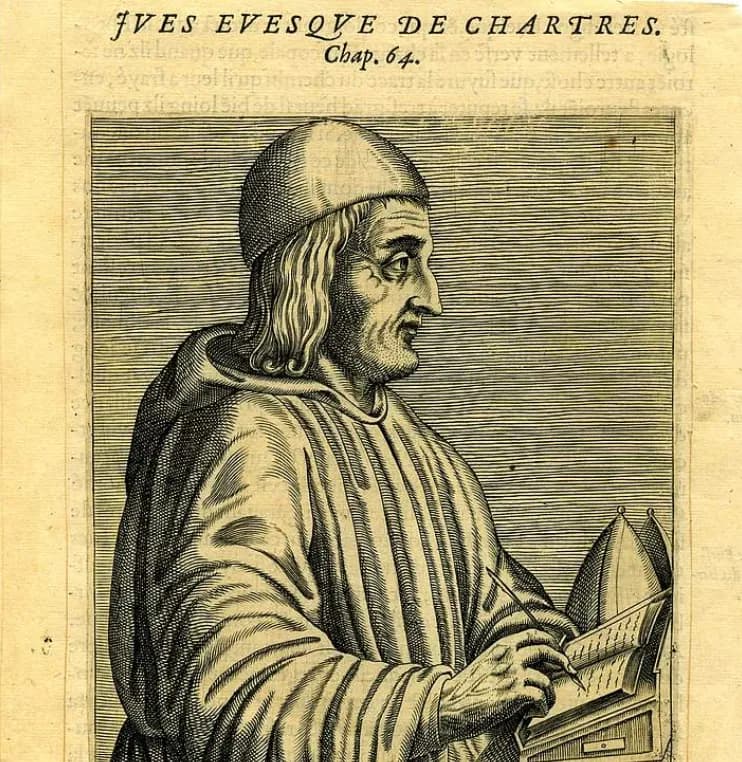
Saint Ivo of Chartres was a French bishop and, in the words of the 1910 Catholic Encyclopedia, "the most important canonist before Gratian in the Occident." 1 His collections of church law were copied across Europe, his 288 letters were read for generations, and his moderate views on lay investiture helped prepare the settlement that ended the struggle between popes and emperors. 1 He also spent time in prison for refusing to accept King Philip I of France's repudiation of his queen. 124
A student of Lanfranc
Ivo was born about 1040, near Beauvais, into a noble family. 12 He studied first at Paris and then at the Abbey of Bec in Normandy under Lanfranc, at the same time, the encyclopedia notes, as Anselm of Canterbury. 1 The Norwegian bishops' saints database adds that he joined a community of canons at Nesles before becoming a canon regular at Saint-Quentin in Beauvais. 2
He taught there, and well. katolsk.no says he taught Scripture, theology and canon law, and became prior about 1078; the encyclopedia puts his appointment as prior of the canons of Saint-Quentin about 1080, made "at the desire of his bishop." 12 By then, the encyclopedia says, he was one of the best teachers in France. 1
Bishop of Chartres
In 1090 he was made Bishop of Chartres, replacing Geoffroy, who had been deposed for simony. 12 Geoffroy's supporters opposed him at first, and his government of the diocese lasted some twenty-five years. 1 His years as a teacher, the encyclopedia says, prepared him "to infuse a new life into the celebrated schools of Chartres." 1 The Roman Martyrology remembers him as the bishop who restored the order of canons and who worked and wrote much for concord between clergy and civil power and for the good of the Church. 3
His letters are the chief record of him. "No man, perhaps, is better portrayed in his writing than is Ivo in his letters and sermons," Ghellinck writes, and the portrait is of a man "always faithful to his duties, high-minded, full of zeal and piety, sound in his judgments, a keen jurist, straight-forward, mindful of others' rights, devoted to the papacy and to his country, at the same time openly disapproving of what he considered wrong." 1 He was consulted constantly on theological, liturgical, political and above all canonical questions. 12
The king's marriage
The test came early. In 1092 King Philip I of France set aside his lawful wife, Bertha, to marry Bertrade of Anjou. 12 katolsk.no explains that Bertrade was already married to Count Fulk of Anjou and was related to the king, and that Ivo refused to recognize her as queen because the marriage was unlawful. 2 The encyclopedia says only that "his opposition gained him a prison cell." 1
katolsk.no says the king had him imprisoned in 1092 and seized his property, and that Pope Urban II secured his release two years later and excommunicated the king. 2 Goyau, writing on the Diocese of Chartres, also says he was imprisoned for two years for opposing the repudiation of Queen Bertha. 4 The marriage went ahead regardless, with the Archbishop of Reims and a number of French bishops presiding. 2 After ten years of conflict, katolsk.no says, Philip and Bertrade submitted barefoot before an assembly of bishops at Paris in 1104 and promised to keep apart, and on Ivo's proposal the king was absolved. 2
Investiture
In the struggle over lay investiture, then at its height in France and especially in Germany, Ivo stood with what the encyclopedia calls "the moderate party." 1 katolsk.no speaks of his moderating influence on the dispute. 2 His views are set out in letters of 1099, 1106 and 1111, which touch on the relation of Church and State, the validity of sacraments given by heretics, and the sin of simony. 1 He also rebuked corruption and simony in certain papal legates and other churchmen. 2
He did not live to see the outcome. The encyclopedia says he "died too early to witness the final triumph of his ideas with the Concordat of Worms (1122)," but that "his endeavours and his doctrines may be said to have paved the way for an agreement satisfactory to both sides." 1 It also notes that his independence later made him a favorite of very different readers: he was sometimes quoted as a patron of Gallican liberties, and Flacius Illyricus counted him among his "witnesses to the truth." 1
The canonist
His lasting work is in canon law. The encyclopedia names two collections composed before 1096: the "Decretum" in seventeen books and the "Panormia" in eight, the latter "undoubtedly the work of Ivo himself." 1 The Panormia spread quickly, to Durham and elsewhere in England and to Naumburg in Germany. 1 Ivo added many canons from Italian sources to the earlier work of Burchard of Worms, and his preface, the "Prologus," gave new rules for resolving apparent contradictions among the Fathers and the councils. 1 katolsk.no also names the "Collectio Tripartita" and says the Decretum had great influence on the development of canon law. 2
The encyclopedia traces that influence through Alger of Liège and Hugh of Saint Victor, and sees a clear line from the Prologus to Abelard's "Sic et Non" and to Gratian. 1 His 288 letters were copied into the catalogs of many monastic libraries, and his sermons, twenty-five in the encyclopedia's count and twenty-four in katolsk.no's, deal with liturgy, doctrine and morals. 12
The letters are where he is most himself. Many deal with the political and religious questions of the day; others answer difficulties put to him on moral, liturgical or canonical matters, and a few take up questions of doctrine. 1 The encyclopedia says nearly everything known of his life comes from them, and that numerous manuscripts survive. 1 Hugh of Saint Victor, it adds, borrowed from his sermons on holy orders and on the dedication of churches. 1
Death
What is Saint Ivo of Chartres the patron saint of?
Saint Ivo of Chartres's feast day
Praying with Saint Ivo of Chartres
Ivo spent his life on the law of the Church, and the work was not dry to him. His Prologus is about how to read authorities that seem to contradict each other without throwing any of them away. 1 It is an approach to disagreement as much as a rule of law.
The same temper shows in his politics. He would not accept a king's second marriage and went to prison for it, but when the king submitted, it was Ivo who proposed his absolution. 12 In the investiture struggle he looked for an agreement both sides could live with, and the Martyrology remembers him for working toward concord. 13
Moderation is easily mistaken for weakness. The encyclopedia's portrait of him is of a man devoted to the papacy who still said openly what he thought was wrong, including to churchmen. 12 He did not live to see the settlement he had argued for, and his letters went on arguing for it after him. 1
Saint Ivo of Chartres, pray for us.
Sources
- 1.Joseph de Ghellinck, "St. Ivo of Chartres," The Catholic Encyclopedia, Vol. 8 (New York: Robert Appleton Company, 1910).
- 2."Den hellige Ivo av Chartres (~1040-1116)," Den katolske kirke (katolsk.no), Catholic Diocese of Oslo (in Norwegian).
- 3.Roman Martyrology, entry for December 23, "Sant'Ivo, vescovo," as printed in "Santo del giorno," Conferenza Episcopale Italiana (in Italian).
- 4.Georges Goyau, "Diocese of Chartres," The Catholic Encyclopedia, Vol. 3 (New York: Robert Appleton Company, 1908).
Saints to turn to next
Others in this collection who are turned to for some of the same things.