Saint Irenaeus of Sirmium
Died 304
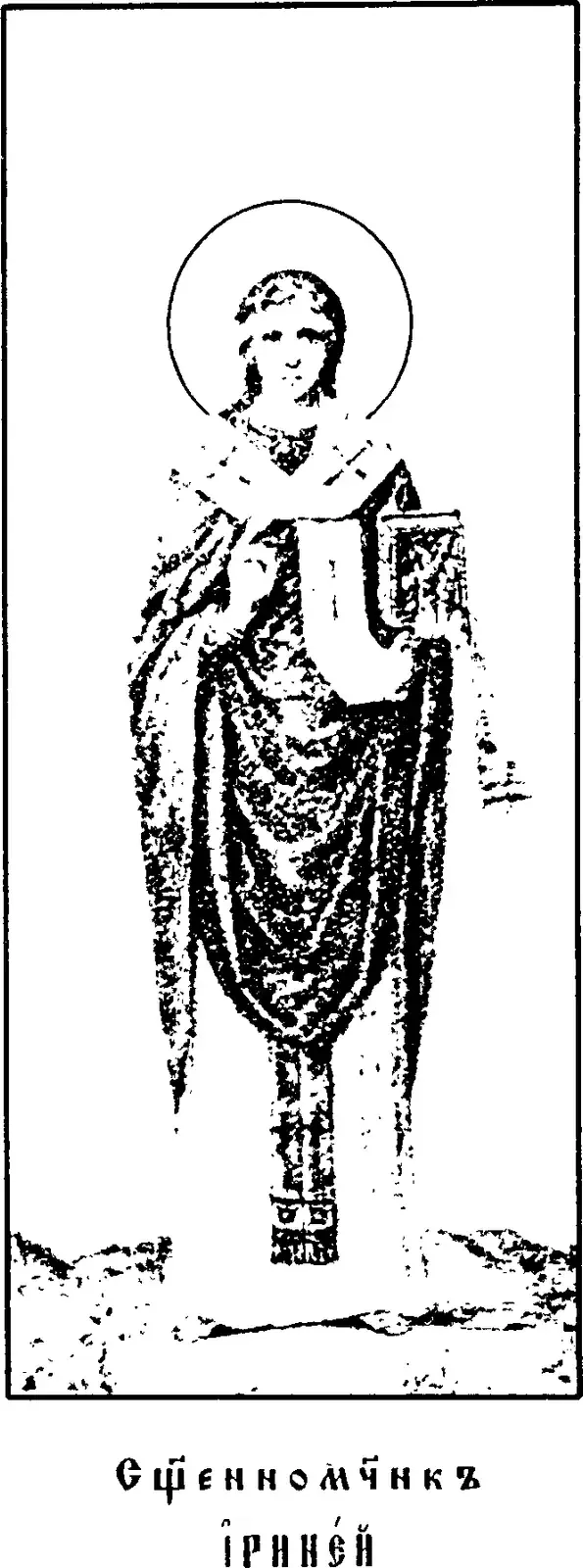
- Bishop of
- Sirmium in Pannonia, today Sremska Mitrovica in Serbia, says katolsk.no 1; Srijem, in present-day Croatia, says the Italian Martyrology 2
- Patronage
- Patron of Sirmium itself, says Ruinart 3
- Not to be confused with
- Saint Irenaeus of Lyon, kept on June 28
Saint Irenaeus of Sirmium was a young bishop of one of the capitals of the Roman Empire, on the Sava in what is now Serbia, who was tortured, imprisoned and beheaded under Diocletian in 304, and whose body was thrown from a bridge into the river. 123 The record of his trial survives in Latin, close to the court's own minutes, and it is remembered for one scene: his children at his feet and his family in tears, begging him to sacrifice, and his refusal to answer them. 13 His feast is April 6. 2
A bishop in an imperial city
Nothing is known of Irenaeus before his trial except what the trial reveals. The Norwegian bishops' saints database (katolsk.no) says he was born in the Balkans sometime in the third century and was married, with young children, when he was chosen bishop of Sirmium; it does not know whether any bishop had come before him. 1 The Acts call him young. The governor appeals to his tender youth, and the family pleads by his face and his age. 13
Sirmium was no backwater. It was the capital of Pannonia, and in 294 it became one of the four seats of the empire under the tetrarchy, beside Trier, Milan and Nicomedia. 1 The Caesar Galerius governed Illyricum from it from 295, katolsk.no says, and kept to the letter of the four edicts against the Christians issued in 303 and 304, which singled out the clergy as leaders of a faith that refused the cult of the emperors. 1 The city is now Sremska Mitrovica, in Vojvodina in Serbia; the surrounding region of Syrmia is divided today between Serbia and Croatia. 1 The Italian bishops' text of the Martyrology places it in present-day Croatia, and Butler, in 1842, called it Sirmisch, a village in Hungary. 24
Irenaeus was not the first to be caught. The Acts of Pollio, a lector of nearby Cibalae, say that when the persecution reached Sirmium the governor Probus began with the clergy, putting to death Montanus, a priest of Singidunum, and then Irenaeus, before going on to the neighboring towns. 3 Singidunum is today Belgrade. 1 katolsk.no adds that Montanus was condemned with his wife Maxima only a few days before the bishop. 1
An authentic record
Thierry Ruinart, the Benedictine scholar who gathered the martyr acts he judged genuine, printed the Passion of Irenaeus in 1713 from six manuscripts, noting that the Bollandists had already published it as taken almost word for word from the governor's proceedings. 3 katolsk.no agrees that it survives in its original Latin form, probably a copy of the oral hearing, with only the opening and the close added by a Christian writer, and calls it important both for Christianity on the Danube and for Roman court procedure under Diocletian and Galerius. 1 A Greek version also exists. 3 Butler's English life is a free retelling of the same Acts, and quotes from it below are his wording. 4
The first hearing
Arrested, Irenaeus was brought before Probus, governor of Pannonia, who told him to obey the divine commands and sacrifice to the gods. 3 He answered with a line of Scripture: whoever sacrifices to the gods and not to God will be rooted out. 3 katolsk.no identifies the verse as Exodus 22:20; Butler, retelling it, has him say: "Into hell fire shall he be thrown, whoever shall sacrifice to the gods." 14
Probus reminded him that the emperors had ordered sacrifice or torture. Irenaeus said he had been commanded to suffer torment rather than deny God and sacrifice to demons. 3 Threatened with torture, he said he would be glad of it, because it would make him a sharer in his Lord's sufferings. 3 Probus had him tortured, and while it went on asked him again. In Butler's English the answer reads: "I sacrifice to my God by confessing his holy name, and so have I always sacrificed to him." 34
His family at the rack
Then his family came. The Acts as Ruinart prints them say his relatives saw him being tortured and pleaded with him; his children clung to his feet and begged their father to have pity on himself and on them; and the women of the house wept and begged him by his face and his youth. 3 Servants groaned, neighbors wailed and friends lamented, all calling on him to spare himself. 3 The manuscripts differ over who the weeping women were: Ruinart's text has wives, in the plural, one variant his wife, and another mothers. 3 Butler names his mother, his wife and his children. 4 katolsk.no names his mother and his former wife, and says that he had evidently parted from her when he became bishop. 1 Butler says he had married before his ordination and lived continent afterward, as the Church's laws required. 4
Irenaeus did not answer any of them. The Acts say he kept before his eyes the Lord's words that whoever denies him before men, he will deny before his Father, and hurried on toward the hope of his heavenly calling. 3 Probus urged him to let their tears bring him back from his madness and to think of his youth. Irenaeus said that by refusing he was thinking of himself, for eternity. 3 He was sent to prison, and the Acts say he was held there for many days and made to suffer in various ways. 23
The night hearing
Some time later, in the middle of the night, Probus took his seat on the tribunal again and had the prisoner brought in. 3 He told him to sacrifice and spare himself further pain. Irenaeus told him to do as he had been ordered. 3 Probus had him beaten with clubs. Irenaeus said he had a God whom he had learned to worship from his earliest years, who strengthened him in everything; to him he sacrificed, and he could not adore gods made by hands. 3
Then the governor asked about his family. Did he have a wife? No. Children? No. Parents? No. 3 Who, then, had been weeping at the last hearing? Irenaeus answered with Christ's words that whoever loves father or mother, wife or children, brothers or kin more than him is not worthy of him. 13 Probus told him to sacrifice at least for their sakes. Butler's English gives the reply: "My children will not lose much by my death; for I leave them for father that same God whom they adore with me." 34
Probus passed sentence: for disobeying the imperial commands, Irenaeus was to be thrown into the river. 13 The bishop answered that after so many threats and torments he had expected to end under the sword, and asked the governor to do it, so that the governor might learn how Christians, for their faith in God, had learned to despise death. 3 Angered, Probus ordered that he be beheaded as well, and Irenaeus gave thanks for what the Acts call a second palm. 13
The bridge over the Sava
He was taken to a bridge. Ruinart's manuscripts call it the bridge of Basentis; Ruinart notes that the Greek text names it after Artemis, and Butler calls it "the bridge of Diana." 34 There Irenaeus took off his clothes, stretched his hands toward heaven and prayed. 3 Butler's English has him ask Christ to "command the heavens to open, that the angels may receive the soul of thy servant," who suffered "for thy name, and for thy people of the catholic church of Sirmium." 4 In the Latin he asks also that God would receive him and strengthen the others in the faith. 3 He was struck with the sword and thrown into the Sava. 23
The Acts close with the date: the eighth day before the Ides of April, which is April 6, under the emperor Diocletian and the governor Probus. 13 They give no year. Ruinart settled on 304, the year Butler and katolsk.no also give. 134 katolsk.no notes that other sources put the death on March 24, 304. 1
His church after him
Nothing is known of his relics. 1 katolsk.no reports that excavations found a martyr's shrine in a Christian cemetery on the south bank of the Sava, which may have drawn the later churches of Sirmium, and that digs in 1976 and 1977 uncovered the ruins of a basilica of the later fourth century, where an epitaph names the basilica of the lord Irenaeus. 1 When Pope Gregory IX restored the see in 1231, a church of Saint Irenaeus of Syrmia is mentioned, though no one knows where it stood. 1 The Martyrology of Jerome and a Syriac breviary of 411 both record his martyrdom on April 6. 1 He is honored especially in Serbia today. 1
What is Saint Irenaeus of Sirmium the patron saint of?
No general patronage for Saint Irenaeus of Sirmium appears in the sources consulted for this page, and the page does not supply one. 124 Ruinart, writing in 1713, says that Sirmium, once famous for its sacred and civil privileges and by then reduced to a village, acknowledged Irenaeus as its patron. 3
Saint Irenaeus of Sirmium's feast day
Saint Irenaeus of Sirmium's feast day is April 6, the day the Acts give for his death. 13 The Roman Martyrology, in the text published by the Italian bishops, commemorates on that day the passion of Saint Irenaeus, bishop and martyr, who in the time of the emperor Maximian, under the governor Probus, was first scourged, then tormented for many days in prison, and at last completed his martyrdom by beheading. 2
For centuries he was kept on March 25 instead. The 1897 English Martyrology enters him that day, and Butler, who places him under March 24, says he died on March 25, "on which day his name occurs in the Roman Martyrology." 45 Ruinart found the same split in the manuscripts: most martyrologies had March 25, a few older ones April 6, and several copies of the Acts read the eighth day before the Kalends of April, which is March 25, where the others read the eighth before the Ides. 3 katolsk.no reads the March date as that same slip, and says the current Martyrology returned him to the day of his death. 1 In the Orthodox calendar his days are March 26 and August 23 by the old reckoning. 1
Praying with Saint Irenaeus of Sirmium
The hardest part of Irenaeus's trial was not the rack. It was his children at his feet, asking him to have pity on himself and on them, and the Acts say he gave them no answer at all. 3 The record does not explain the silence or soften it.
When the governor asked a second time, at night, whether he had a wife, children or parents, he said no to each. 3 They had stood in the courtroom only days before. He answered with the Gospel, and then said the one thing about his children that he could say: that the God he worshiped was theirs too, and could save them. 34
He was young, the Acts insist, and the governor kept returning to it. 3 He was also the bishop of a church in an imperial capital, and his last prayer at the bridge was for the people of that church, that God would strengthen them in the faith. 34
Saint Irenaeus of Sirmium, pray for us.
Sources
- 1."Den hellige Ireneus av Sirmium (d. 304)," Den katolske kirke (katolsk.no), Catholic Diocese of Oslo (in Norwegian).
- 2.Roman Martyrology, entry for April 6, "Sant'Ireneo, vescovo e martire," as printed in "Santo del giorno," Conferenza Episcopale Italiana (in Italian).
- 3.Thierry Ruinart, ed., "Passio sancti Irenaei episcopi Sirmiensis," with Ruinart's admonitio and notes, and the "Passio sancti Pollionis," in Acta primorum martyrum sincera et selecta (Amsterdam, 1713), pp. 400-403 (in Latin), via the Internet Archive.
- 4.Alban Butler, "St. Irenaeus, Bishop of Sirmium, M.," The Lives of the Fathers, Martyrs, and Other Principal Saints, Vol. 3, March 24 (Derby: Richardson and Son, 1842), via the Internet Archive.
- 5.The Roman Martyrology, March 25 (Baltimore: John Murphy Company, 1897), Internet Archive.
Saints to turn to next
Others in this collection who are turned to for some of the same things.