Saint Hyacintha Mariscotti
1585 - January 30, 1640
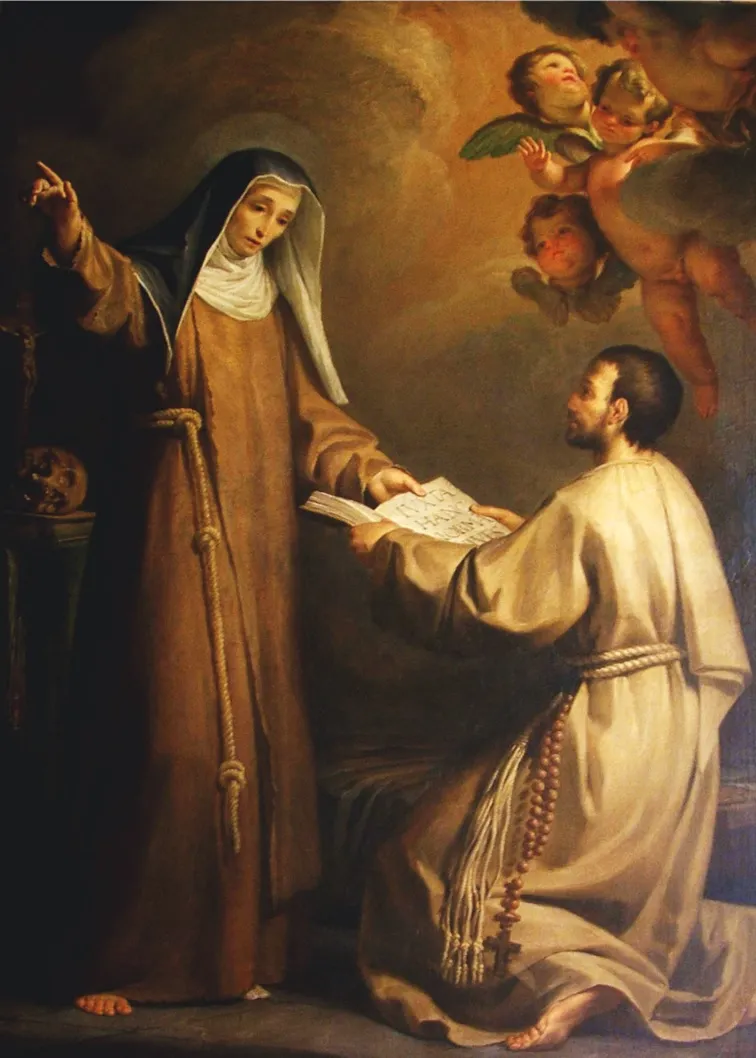
- Conversion
- After ten years of comfortable convent life by the encyclopedia, fifteen by the Martyrology 14
- Founded
- Two confraternities, whose members were called Oblates of Mary or Sacconi 1
- Beatified
- 1726, by Pope Benedict XIII 1
- Patronage
- EWTN lists "the care of the sick; Viterbo, Italy" without naming an authority 3
Saint Hyacintha Mariscotti entered a convent in Viterbo to hide a disappointment, told her father as much, and asked him for rooms there furnished with every comfort. 1 After ten or fifteen years of that, depending on the source, an illness and her confessor turned her around, and she spent the rest of her life in hard penance and in organizing care for the poor, the old and the imprisoned. 124 She died on January 30, 1640, and that is her feast. 1
Clarice
She was born in 1585 at Vignanello, near Viterbo, to Marc'Antonio Mariscotti and Ottavia Orsini, and was baptized Clarice. 12 EWTN gives the day as March 16. 3 The family was noble. 1
The 1910 Catholic Encyclopedia says that in early youth she "was remarkable for piety," but that as she grew older "she became frivolous, and showed a worldly disposition." 1 Two things might have checked it and did not. At seventeen her life was saved in a way the encyclopedia calls "almost miraculous," without saying what happened. And she was sent for her education to the convent of Saint Bernardine at Viterbo, where an older sister was already a nun. 1
At twenty she set her heart on marrying a Marquess Cassizucchi. He married her younger sister. 1 Clarice, the encyclopedia says, "was sadly disappointed, became morose, and at last joined the community at St. Bernardine," where she was given the name Hyacintha. 1
A nun on her own terms
She did not pretend to a vocation. The encyclopedia reports that she told her father she was doing this "only to hide her chagrin and not to give up the luxuries of the world," and asked him to furnish her apartments with every comfort. 1 She kept her own kitchen, wore a habit cut from the finest cloth, and received and paid visits as she pleased. 1 EWTN adds that she paid for these things from her own funds. 3
How long this went on is told two ways. The encyclopedia says ten years, and calls it a life "so contrary to the spirit of her vows and such a source of scandal to the community." 1 The Irish Franciscans say she "led a very comfortable life for fifteen years," and the current Roman Martyrology also counts fifteen years spent among empty pleasures. 24
The encyclopedia is careful to say what she did not lose in those years. She kept her faith, was regular at her devotions, remained chaste, treated the mysteries of religion with respect, and had "a tender devotion to the Blessed Virgin." 1
The illness
The change came with a serious illness. 12 Her confessor came to her, and EWTN says he was shocked by the way she was living and told her to be faithful to the vows she had made. 3 The encyclopedia says his "earnest exhortations" made her see the folly of the past and "brought about a complete change in her life." 1
She began in public. She confessed her faults before the whole community in the refectory, gave up her costly clothes, put on an old habit, and went barefoot. 1 After that the encyclopedia lists fasts on bread and water, night vigils and severe scourging, carried so far that, it says, the decree of her canonization "considers the preservation of her life a continued miracle." 1
Her devotion grew in four directions the encyclopedia names: to the Mother of God, to the Infant Jesus, to the Eucharist, and to the sufferings of Christ. 1 It also credits her with miracles, with prophecy, with reading the secret thoughts of others, and with ecstasies. 1 Through all of it, it says, she "always conceived the greatest contempt for herself." 1
The Sacconi
She also organized. When an epidemic struck Viterbo, the encyclopedia says, she "showed heroic charity in nursing the sick." 1 She then founded two confraternities, whose members were called Oblates of Mary or Sacconi. 1
The first the encyclopedia compares to the Society of Saint Vincent de Paul. It collected alms for convalescents, for prisoners, and for "the poor who were ashamed to beg." 1 The second found homes for the aged. 1 The Martyrology describes her foundations a little differently, as confraternities for the care of the elderly and for adoration of the Eucharist. 4
The Irish Franciscans add that the work spread through people she had herself brought back to God: others "whom she in turn converted, were influenced to promote institutions for the old and the sick." 2
Death and canonization
She died at Viterbo on January 30, 1640. 13 The encyclopedia says the town grieved and crowds came to her funeral. 1 EWTN reports that during her wake her habit had to be replaced three times because people kept cutting pieces from it as relics, and that her body rests in the church at Viterbo that now bears her name. 3
Pope Benedict XIII beatified her in 1726, and Pope Pius VII canonized her on May 14, 1807. 12
What is Saint Hyacintha Mariscotti the patron saint of?
The encyclopedia, the Irish Franciscans and the Martyrology name no patronage for Saint Hyacintha Mariscotti. 124 EWTN's page lists her as "Patron Saint of the care of the sick; Viterbo, Italy," without saying on what authority. 3 The first part at least fits the record: she nursed the sick in an epidemic and founded a confraternity to support convalescents. 1
Saint Hyacintha Mariscotti's feast day
Her feast is January 30, the anniversary of her death. The encyclopedia gives that date, the Roman Martyrology enters her on it, and the Irish Franciscans and Vatican News list her the same day. 1245 The encyclopedia notes that in Rome, when it was written, her feast was kept on February 6. 1 Vatican News and the Martyrology spell her family name Marescotti. 45
Praying with Saint Hyacintha Mariscotti
She entered religion for a bad reason and said so. 1 There was no early call, only a failed marriage plan and a wish to keep her comforts, and for a decade or more she kept them. 12
Even the encyclopedia, which does not spare her, records that prayer never quite stopped in those years. She was "regular in her devotions" the whole time she was living against her vows. 1 The conversion, when it came, built on something that was already there.
It also did not stay private. The same woman who had kept her own kitchen ended by collecting alms for people too ashamed to beg for themselves. 1
Her penances were extreme by any measure, and the sources report them without recommending them. 1 What the Martyrology chooses to remember is the turn itself and the confraternities that came out of it. 4
Saint Hyacintha Mariscotti, pray for us.
Sources
- 1.Francis Mershman, "St. Hyacintha Mariscotti," The Catholic Encyclopedia, vol. 7 (New York: Robert Appleton Company, 1910).
- 2."St. Hyacinth Mariscotti," Franciscan Saints, 30 January, Irish Franciscans (OFM Ireland).
- 3."St. Hyacintha Mariscotti," Daily Saint, EWTN Mission, 2025.
- 4."Santa Giacinta Marescotti," Santo del giorno, 30 gennaio (from the Roman Martyrology), Conferenza Episcopale Italiana.
- 5."St. Hyacintha Marescotti, Roman Virgin," Saint of the Day, 30 January, Vatican News.
Saints to turn to next
Others in this collection who are turned to for some of the same things.
- Saint Aidan of Lindisfarnec. 590 - August 31, 651Poverty and simplicityConversion
- Saint Andrew Corsinic. 1302 - January 6, 1374ConversionPoverty and simplicity
- Saint Bavo of Ghentc. 590 - c. 655ConversionPoverty and simplicity
- Saint Bernard of CorleoneFebruary 6, 1605 - January 12, 1667ConversionPoverty and simplicity