Saint Hyacinth
c. 1183 or 1185 - August 15, 1257
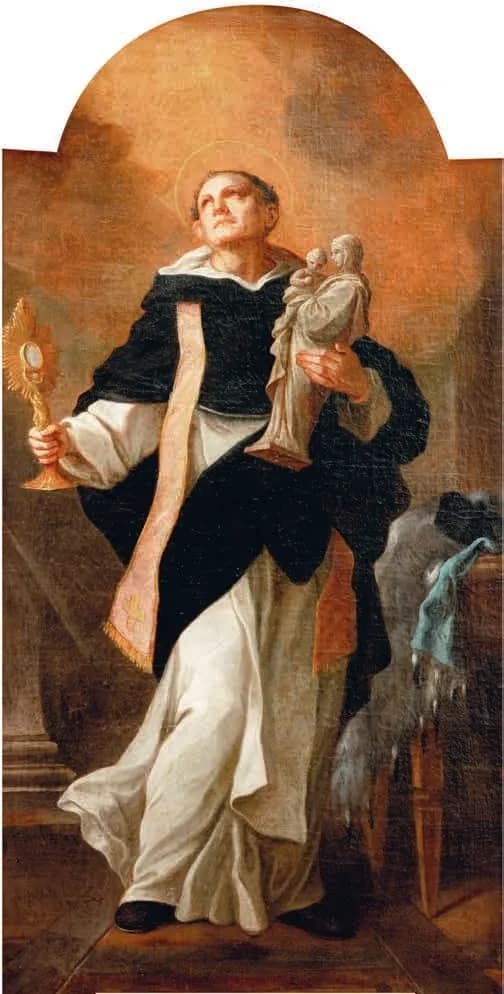
- Also known as
- Jacek Odrowaz; "Jacko," called Hyacinth from the fourteenth century onward 24. The Apostle of the North 16
- Born
- 1185 at Kamin in Silesia, according to the Catholic Encyclopedia 1; about 1183 at Kamien Slaski near Opole, according to the English Dominicans 3
- Shown in art with
- A monstrance and a statue of Our Lady, after a legend set in Kyiv 3
- Buried
- In the Dominican church in Krakow 3
Saint Hyacinth was a canon of Krakow who received the Dominican habit in Rome around 1220 and went home to found the Order of Preachers in Poland. 123 The friars remember him as the Apostle of the North, John Paul II called him "this apostle of the Slav countries," and his feast is kept on August 17. 146 He is usually painted holding a monstrance in one hand and a statue of Mary in the other, because of a legend about carrying both out of Kyiv under attack. 3
A canon from a noble family
The 1910 Catholic Encyclopedia makes him the son of Eustachius Konski, of the noble family of Odrowaz, born in 1185 at the castle of Lanka at Kamin in Silesia. 1 The English Dominicans give about 1183 and place his birth at Kamien Slaski near Opole, and the Order's own liturgical note says only that he was born at the end of the twelfth century at Kamien, in the diocese of Wroclaw. 23 The same note gives his name as Jacko, and says he was called Hyacinth from the fourteenth century onward. 2
Where he studied depends on whom you read. The encyclopedia names Cracow, Prague and Bologna, where he "merited the title of Doctor of Law and Divinity," and says he came home to a prebend at Sandomir. 1 The English Dominicans name Paris and Bologna and have him become a canon of the cathedral on the Wawel, in Krakow. 3 The Order's note calls him a canon of the church of Krakow. 2 Fr. Toby Lees, writing for the English province, adds that he was punctual about the divine office, visited the sick in the hospitals, and gave his income to the poor, and presents this as what his contemporaries said of him. 7
Meeting Saint Dominic in Rome
He went to Rome with his uncle Ivo. The encyclopedia and the English Dominicans make Ivo the bishop of Krakow; Lees says he had just been elected archbishop of Gniezno and was going to ask the pope to excuse him from it. 137 Dominic was in Rome at the time. 7 According to the Western Dominican Province, the bishop asked Dominic for friars to evangelize northern Europe, Dominic had none to send, and the bishop's nephew asked to join the Order instead. 6 Lees tells it with Dominic proposing that the bishop give him men to train, and the nephews volunteering. 7
The encyclopedia says he was "one of the first to receive at his hands (at Santa Sabina, 1220) the habit of the newly established Order of Friars Preachers." 1 The Order's note agrees on Rome and 1220; the English Dominicans date the clothing to 1221. 23 All of them have Dominic giving him the habit himself. 136
Founding the Dominicans in Poland
In 1221, the Order's note says, Dominic appointed him with Henry of Moravia to spread the Order in Poland. 2 On the way home he founded a convent at Friesach in Carinthia, which Lees calls the first German foundation. 137 A Dominican house was established in Krakow in 1222, by the Order's reckoning; the English Dominicans say he settled at the church of the Holy Trinity there in 1223 and founded a priory that "since that time has been existing without interruption." 23
A fourteenth-century biography, quoted by the Western Dominican Province, says that when he was sent to Poland "the Poles were strengthened against their vices, encouraged from their neglect, moved to contemplate heavenly things, and freed from the power of evil." 6 The encyclopedia puts it more plainly: the new preachers "were favourably received and their sermons were productive of much good." 1
The Apostle of the North
The 1910 encyclopedia gives him an enormous range. It has him founding communities at Sandomir, Cracow and Plocko on the Vistula; preaching through Prussia, Pomerania and Lithuania; crossing the Baltic to Denmark, Sweden and Norway; and then going into Red Russia, founding houses at Lemberg and on into Muscovy, and reaching the shores of the Black Sea. 1 Lees repeats that list and says these journeys earned him the name Apostle of the North. 7
The Dominicans' own liturgical note is more specific and more modest. It says the first provincial of Poland, Gerard of Wroclaw, sent the Krakow friars out along five routes in 1225; that Hyacinth founded the convent at Gdansk in Pomerania and later one at Kyiv; and that he lived in Kyiv from 1229 to 1233, working among both Orthodox and Catholics, and left shortly before the friars were expelled by Prince Vladimir Rurikovich. 2 The English Dominicans name Prussia, Ruthenia and Lithuania. 3 John Paul II, writing to the Dominicans in 2004, spoke of the Slav countries, "which he travelled across on his way from Gdansk to Kiev." 4 This page gives the encyclopedia's list as the encyclopedia's.
The legend of Kyiv
The English Dominicans are clear that this is one of "many legends associated with St. Hyacinth." 3 During a Tatar attack on Kyiv, the story goes, he went to the chapel to save the Blessed Sacrament from the tabernacle before it could be profaned. As he took it, he heard the voice of Mary asking why he was taking her Son and leaving her behind. The statue was alabaster and very heavy, but she promised to make it light, and it was, so he carried both. 3 That, they say, is why he is usually shown with a monstrance and a statue of Our Lady. 3
The Order's liturgical note tells a different story with the same two objects. It records "the famous miracle in which he crossed the Vistula River with dry feet," with his companions, spreading their cloaks on the water while carrying the Eucharist and a statue of the Virgin. 2 It does not mention Kyiv burning, and its account of his years there ends with his leaving before the friars were expelled. 2 The 1910 encyclopedia mentions neither story. 1
His death in Krakow
He came back to Krakow in 1243, according to the English Dominicans, and died there on August 15, 1257. 3 The encyclopedia says that on that morning he attended Matins and Mass, received the last sacraments, and died. 1 Lees adds that he fell ill with a fever on the feast of Saint Dominic, was warned of his death on the eve of the Assumption, and was anointed at the altar during Mass on the feast itself. 7
The encyclopedia says the record of miracles attributed to him "fills many folio pages" of the Acta Sanctorum. 1 Clement VII beatified him in 1527 and Clement VIII canonized him on April 17, 1594. 123 His tomb is in the Dominican church in Krakow, and the encyclopedia notes a portion of his relics in the Dominican church in Paris. 13 The English Dominicans add that he is the only Polish saint among the statues on Bernini's colonnade around Saint Peter's Square. 3
What is Saint Hyacinth the patron saint of?
None of the sources consulted for this page names a patronage for Saint Hyacinth. 123 What he is given is a title: the Apostle of the North, in the 1910 encyclopedia and among the Dominicans today, and the "apostle of the Slav countries" in John Paul II's letter. 146 In 2004 the Dominicans chose him as the special patron of their General Chapter, the first ever held in Krakow, which is a patronage of one meeting rather than of a cause. 4
Saint Hyacinth's feast day
His feast is August 17. 25 The Dominicans keep it as an obligatory memorial in their own calendar, and John Paul II, writing on August 16, 2004, said the Church would commemorate him "in the liturgy" the next day. 24 The 1910 Catholic Encyclopedia gives the feast as August 16, 1 and he died on August 15, the feast of the Assumption. 17
Praying with Saint Hyacinth
His life turns on one visit to Rome. He went as a canon in his uncle's party and came back a friar, sent by Dominic to start something in Poland that did not yet exist there. 236 Lees describes him returning to the life of a novice and its hardships, giving up what he had as a canon. 7
The record of what he did next is thinner than his reputation. The encyclopedia sends him to the Black Sea; the Order's own note talks of Gdansk and four years in Kyiv. 12 What all of them agree on is the house in Krakow, which the English Dominicans say has gone on without interruption since he founded it. 3 John Paul II asked that the same spirit accompany Dominicans doing the same work "on all the continents." 4
The legend people know him by is about two things he would not leave behind. In the English Dominicans' telling he went back for the Blessed Sacrament first, and then for Mary when she asked. 3 The Order's note gives the same pairing on a different river. 2 Whether or not either crossing happened as told, the two objects in his hands are what the Dominicans chose to remember, and the Order's note records his "filial devotion to the Mother of the Lord." 2
He died in the house he had founded, on the feast of the Assumption, after hearing Mass. 17
Saint Hyacinth, pray for us.
Sources
- 1.Francis Mershman, "St. Hyacinth," The Catholic Encyclopedia, Vol. 7 (New York: Robert Appleton Company, 1910).
- 2.Order of Preachers, "S. Hyacinthi de Polonia: St. Hyacinth of Poland, Priest," after the Proprium Officiorum Ordinis Praedicatorum (Rome: Santa Sabina, 1982).
- 3.Godzdogz Team, "Saint Hyacinth," The Dominican Friars in Britain, August 16, 2014.
- 4.John Paul II, Letter to the Master General of the Dominicans on the Occasion of the General Chapter of the Order, August 16, 2004.
- 5."St. Hyacinth of Cracow, dominican priest," Saint of the Day, 17 August, Vatican News.
- 6."The Apostle of the North: Memorial of St. Hyacinth of Poland, August 17," Dominican Friars, Western Dominican Province.
- 7.Toby Lees, O.P., "Great Dominicans: St Hyacinth," The Dominican Friars in Britain, October 27, 2015.
Saints to turn to next
Others in this collection who are turned to for some of the same things.
- Saint Benedict of Nursiac. 480 - March 21, 547PrayerWork and vocationDiscernment
- Saint Catherine LabouréMay 2, 1806 - December 31, 1876PrayerDiscernmentWork and vocation
- Saint Francis de SalesAugust 21, 1567 - December 28, 1622PrayerDiscernmentWork and vocation
- Saint Ignatius of Loyola1491 - July 31, 1556DiscernmentPrayerWork and vocation