Saint Honoratus of Arles
c. 350 or 375 - 429 or 430
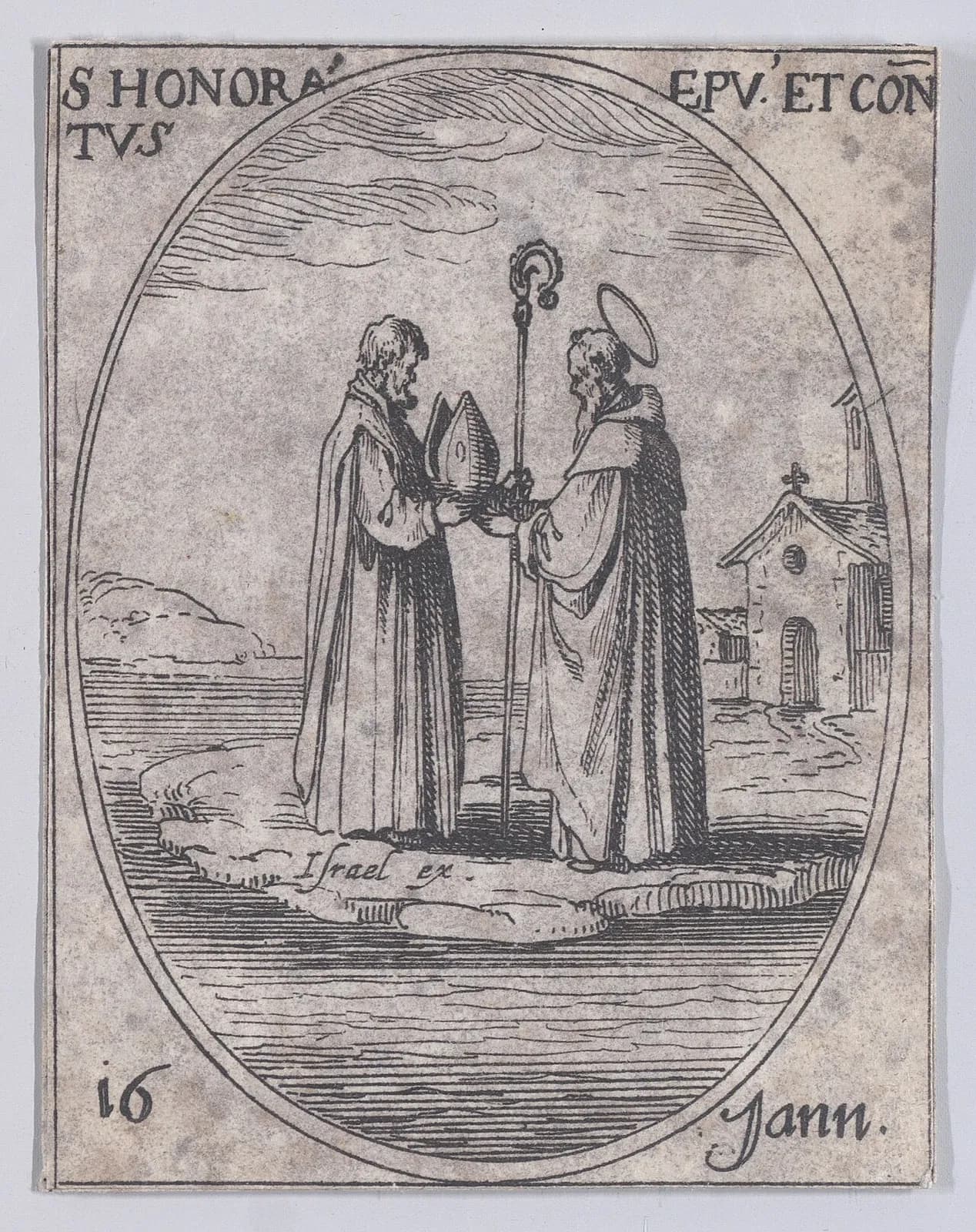
- Founded
- The monastery of Lérins, on the island now called Saint-Honorat, early in the fifth century 234
- Invoked
- Against drought, misfortune and rain, and for rain; patron of Arles 5
Saint Honoratus founded the monastery of Lérins, on a small island off the coast of Provence, early in the fifth century, and governed the Church of Arles for the last few years of his life. 124 Lérins became, in the 1910 Catholic Encyclopedia's words, "a nursery for illustrious bishops and remarkable ecclesiastical writers," and a community of monks lives on his island still. 17
A convert and a journey east
Léon Clugnet, who wrote the encyclopedia's article, gives his birth as about 350 and says he is believed to have come from the north of Gaul, from "an illustrious pagan family." 1 Isabelle Cousturie, writing for Aleteia, puts his birth about 375. 6 Butler's Lives of the Saints, as Catholic Culture reprints it, calls the family consular and Roman, settled in Gaul. 5
He turned from the old gods young. Butler says he "renounced the worship of idols" in his youth and won his elder brother, Venantius, to Christ, while "a fond pagan father put continual obstacles in their way." 5 Nominis, the French bishops' site, says the two brothers were baptized young, and Cousturie that Honoratus sold what he had and gave it to the poor. 36
Nominis says that, seized by a desire for perfection, they set out for the East, the homeland of monks. 3 About 368, by Clugnet's date, they sailed from Marseilles with a holy man named Caprasius as their guide, meaning to visit the holy places of Palestine and the monks of Syria and Egypt. 1 Butler says they hoped to live unknown in some desert in Greece. 5 At Methone, in Achaia, Venantius died suddenly, and the journey ended. 1 Honoratus, sick himself according to Butler, came home with Caprasius by way of Italy and Rome. 15
The island
Back in Provence he lived first as a hermit in the mountains near Fréjus. 5 Cousturie places him in a cave in the Esterel, behind Cannes. 6 Leontius, bishop of Fréjus, encouraged him, and Nominis says the bishop gave him one of the Lérins islands, then deserted. 13 Butler says he chose the smaller of the two. 5
It was not an obvious choice. Cousturie describes an island overgrown with brambles, crawling with venomous snakes, and without drinking water, a place the people on the coast spoke of with dread. 6 Nominis says the two solitaries drove out the demons and the snakes. 3 He came, Clugnet writes, "with the intention of living there in solitude." 1
He did not get to. "Numerous disciples soon gathered around him," Clugnet says, "and thus was founded the monastery." 1 J. Besse, writing the encyclopedia's article on the abbey, says they came from all over Roman Gaul and even from Brittany. 2 Butler dates the foundation to about the year 400; Cousturie to between 400 and 410; Besse and the abbey itself simply to the beginning of the fifth century. 2567
How Lérins lived
Butler describes the arrangement. Some of the monks lived in community; others, "who seemed more perfect," lived alone in cells as anchorites. His rule "was chiefly borrowed from that of St. Pachomius." 5 Nominis calls it a supple cenobitic community and says the Rule of Saint Honoratus insisted on the monk's stability, served as a model for others and was admired by John Cassian. 3 Clugnet adds a sobering fact: neither his writings nor the rule he gave the monks has survived. 1 Cassian, who visited, dedicated several of his Conferences to him. 1
What has survived is a portrait. His disciple Hilary wrote his life, and Butler says nothing could be "more amiable" than Hilary's description of the community: its charity, concord, humility, compunction and devotion under its abbot. 5 Cousturie, drawing on the same tradition, says he read the hearts of the people who came to him and understood their troubles at once, that he taught gentleness and respect in a violent age, and that Hilary said of him that he turned wild beasts into men. 6 Within thirty years, she writes, the island had fresh water, no more snakes, and a reputation among sailors, who went out of their way to stop for his hospitality. 6
A nursery of bishops
Lérins became one of the great monasteries of the West. Clugnet calls it "a nursery for illustrious bishops and remarkable ecclesiastical writers" in the fifth and sixth centuries. 1 Besse names them: Honoratus and his successors at Arles, Hilary and Caesarius; Maximus and Faustus of Riez; Eucherius of Lyons; Lupus of Troyes; Valerianus of Cimiez; Salvianus of Geneva; Veranus of Vence; and Vincent of Lérins. 2 Catholic Culture adds that Lupus, Eucherius and Hilary joined him on the island. 5
Besse is careful about what this did and did not mean. So many writers in one monastery have led people to think it was a theological school, "which, however, it was not." It had a reputation for learning but no organized teaching body. 2 He also records that Saint Patrick "lived some time in the monastery," as did Cassian, founder of Saint-Victor at Marseilles. 2 Cousturie mentions Patrick only as a tradition. 6
Bishop of Arles
In 426 Patroclus, the archbishop of Arles, was assassinated, and Honoratus was called from his island to replace him. 1 Butler says he was consecrated "by compulsion." 5 The diocese had been troubled by Arian and Manichaean teaching, and Clugnet says he "appears to have succeeded in re-establishing order and orthodoxy," while still directing the monks of Lérins from a distance. 1 The history of the Archdiocese of Aix and Arles, quoted on Nominis, has him bishop in 425. 3 Nominis itself says he restored harmony to a divided Church. 3
His time there was short. Clugnet admits that "the acts of his brief pontificate are not known." 1 He died in the arms of Hilary, his disciple and probably a relative, who succeeded him. 1 Butler says he died "exhausted with austerities and apostolical labors." 5 Clugnet gives the date as January 6, 429, adding that some authors say January 14 or 15. 1 The French text of the Roman Martyrology on Nominis also says 429, while Nominis's own heading and Cousturie say 430. 36 Cousturie quotes what the people of Arles are supposed to have said about why they had fetched him from his island: he had so much love to give that the city ought to have a little of it too. 6
Lérins after him
Besse traces the rest. Saracen raids made monastic life on the island impossible or precarious for two centuries; Abbot Porcharius and his monks were massacred about 732. The abbey revived in the eleventh century, built a fortified tower as a refuge, passed through Italian, Maurist and Cluniac congregations, and was suppressed in 1791. 2 It was refounded by monks from Sénanque, in 1868 according to Besse and in 1869 according to the abbey. 27
Today the island of Saint-Honorat, 1.5 kilometers long and 400 meters wide, belongs to the Cistercians of the Congregation of the Immaculate Conception. It has a nineteenth-century abbey with a medieval cloister, the old tower-monastery, six chapels and 8.5 hectares of vines. 7 The monks say the island has been home to a monastic community for sixteen centuries, and that it is still a place of prayer, work and welcome. 7
What is Saint Honoratus the patron saint of?
Catholic Culture lists Saint Honoratus as patron of Arles and as invoked against drought, against misfortune, against rain and for rain. 5 The other sources read for this page give no patronage.
Saint Honoratus's feast day
Saint Honoratus's feast day is January 16. The Roman Martyrology enters him on that day, Nominis lists it, and Catholic Culture keeps it as his commemoration. 345 It is not the day the encyclopedia gives for his death, January 6. 1 The Martyrology also remembers, on January 16, Saint James of Moûtiers, a disciple of Honoratus of Lérins. 4
Praying with Saint Honoratus
Honoratus went to Lérins to be alone, and it did not work. People kept arriving, and he made room for them. 12 The monastery that resulted was not his plan so much as his answer to the people who came.
The thing remembered about him, through Hilary, is how he treated them: that he understood at once what was troubling the people who came to him, and that he could take rough men and make them gentle. 56 That is a gift worth asking for, and it is not only for abbots.
He was then taken from the island against his will to run a troubled diocese, and died within a few years of it. 15 The record of his time in Arles is nearly blank. 1 Whatever he did there, Hilary was beside him at the end. 1
Saint Honoratus of Arles, pray for us.
Sources
- 1.Léon Clugnet, "St. Honoratus," The Catholic Encyclopedia, Vol. 7 (New York: Robert Appleton Company, 1910).
- 2.J. Besse, "Abbey of Lérins," The Catholic Encyclopedia, Vol. 9 (New York: Robert Appleton Company, 1910).
- 3."Saint Honorat," Nominis, Conférence des évêques de France, quoting the Dioceses of Aix and Arles and of Fréjus-Toulon (in French).
- 4.Roman Martyrology, entry for January 16, "Sant'Onorato," as printed in "Santo del giorno," Conferenza Episcopale Italiana (in Italian).
- 5."St. Honoratus," Liturgical Year, January 16, Catholic Culture, excerpting Alban Butler, Lives of the Saints (Benziger Bros., 1894).
- 6.Isabelle Cousturie, "Saint Honorat, le moine qui changeait les fauves en hommes," Aleteia, January 15, 2018 (in French).
- 7."L'île Saint-Honorat," Abbaye de Lérins (in French).
Saints to turn to next
Others in this collection who are turned to for some of the same things.