Holy Maccabees
Martyred under Antiochus IV Epiphanes, second century BC
- Ages
- Eleazar was ninety 3; the youngest brother is called a young man, whom his mother had nursed three years 4
- When
- In the persecution of Antiochus IV Epiphanes, which began after his Egyptian campaign of 168 BC 1
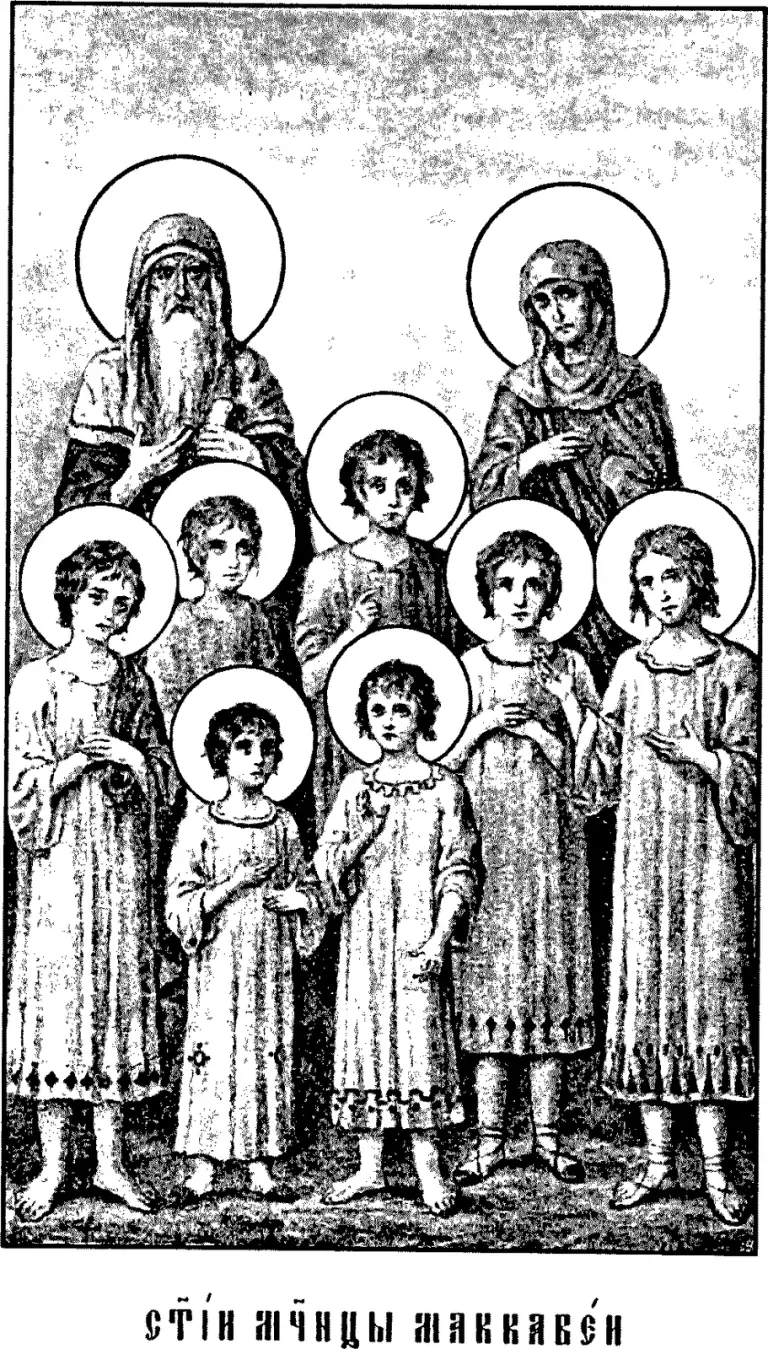
The Holy Maccabees are the martyrs of the Second Book of Maccabees: Eleazar, a ninety-year-old scribe, and a mother and her seven sons, who were tortured to death under the Syrian king Antiochus IV Epiphanes because they would not eat swine's flesh against the law of God. 345 The Roman Martyrology keeps them as martyrs although they died before Christ, 5 and Saint Augustine says the books of the Maccabees are held as canonical by the Church "on account of the extreme and wonderful sufferings of certain martyrs." 8
The persecution of Antiochus
In 168 BC Antiochus IV, king of Syria, set out on a second campaign against Egypt and was stopped by an ultimatum from the Roman Senate. 1 Florentine Bechtel, in the 1910 Catholic Encyclopedia, says he "vented his rage on the Jews, and began a war of extermination against their religion." 1 Jewish worship was forbidden under pain of death, and a pagan altar was built on the altar of holocausts in the Temple, where sacrifices were offered to Olympian Jupiter. 1
The Second Book of Maccabees describes the same months from inside Jerusalem. The king sent "a certain old man of Antioch, to compel the Jews to depart from the laws of their fathers and of God," and to rename the Temple for Jupiter Olympius. 3 Two women who had circumcised their children were led through the city with the infants at their breasts and thrown from the walls, and people keeping the sabbath in caves were burned. 3
Many conformed, Bechtel says, but "the majority remained faithful and a number of them laid down their lives rather than violate the law of their fathers." 1 It was this persecution that drove the priest Mathathias and his sons into revolt, and the name Machabee, which Bechtel takes to mean "hammerer," began as the surname of one of those sons, Judas. 1 It spread to the whole family and their followers, and from them to the martyrs of 2 Maccabees 6 and 7. 1
Eleazar, the old scribe
Eleazar was "one of the chief of the scribes, a man advanced in years, and of a comely countenance," and he was pressed to open his mouth and eat swine's flesh. 3 He refused. Old friends among the officials took him aside and offered him a way out: they would bring meat he was allowed to eat, and he could make a show of eating the sacrifice and live. 3
He turned them down, and Scripture gives his reasons. At his age, he said, pretending would teach the young that "Eleazar, at the age of fourscore and ten years, was gone over to the life of the heathens." 3 He would rather die and "leave an example of fortitude to young men." 3 Dying under the blows, he prayed that God knew he could have escaped, "but in soul am well content to suffer these things because I fear thee." 3
Pope Francis preached on this passage at Mass in 2013. Eleazar, he said, "was credible and consistent to the very end," and what his friends offered him was the pretense Jesus calls hypocrisy. 11 "Faced with martyrdom, Eleazar was aware of his responsibility to the young," the Pope said, and thought not only of God but of what he would leave behind. 11
The seven brothers
Chapter 7 begins without a pause: seven brothers and their mother were arrested and, under the whip, "compelled by the king to eat swine's flesh against the law." 4 The text gives none of them a name. The eldest spoke for all: "we are ready to die rather than to transgress the laws of God, received from our fathers." 4 The king had pans and cauldrons heated. The eldest's tongue was cut out, his scalp torn off and his hands and feet cut off, and he was fried alive while his mother and brothers watched and urged one another to die bravely. 4
Each of the others was brought forward in turn and asked whether he would eat. 4 The second, at his last breath, told the king that "the King of the world will raise us up, who die for his laws, in the resurrection of eternal life." 4 The third put out his tongue and held out his hands, saying he had them from heaven and hoped to receive them back, and the king and his court were astonished at him. 4 The fourth said that it was better, being put to death by men, "to look for hope from God, to be raised up again by him." 4 The fifth warned the king that the nation was not forsaken by God, and the sixth said that they suffered for their own sins. 4
Saint Ambrose, writing for his clergy, set the brothers beside the Maccabees who fought Antiochus in arms: "The latter in truth were armed, but they conquered without arms." 7 He gives the brother who was told to put out his tongue a speech that is not in the book: God "heard Moses when silent," and spilled blood, like Abel's, has a voice that cries to God. 7
The mother
Scripture saves its highest praise for her. She "was to be admired above measure, and worthy to be remembered by good men, who beheld seven sons slain in the space of one day, and bore it with a good courage, for the hope that she had in God." 4 She encouraged each of her sons in her own language, "joining a man's heart to a woman's thought." 4 "I know not how you were formed in my womb," she told them; the Creator who made them would restore breath and life to them, as they now gave it up for his laws. 4
When only the youngest was left, Antiochus swore to make him rich and his friend if he would give up the law, and then asked the mother to persuade him. 4 She agreed, leaned toward her son and, mocking the king, said in her own language: "My son, have pity upon me, that bore thee nine months in my womb, and gave thee suck three years." 4 She told him to look at heaven and earth and know that God made them out of nothing, "that in that mercy I may receive thee again with thy brethren." 4
The young man interrupted her to refuse the king, prayed that God would soon be merciful to his people, and was killed more cruelly than the rest. 4 "And last of all after the sons the mother also was consumed." 4
The Catechism quotes this chapter twice. Her words to her sons are its scriptural witness to creation "out of nothing" as "a truth full of promise and hope." 9 And where it describes how God revealed the resurrection of the dead to his people little by little, it quotes the brothers' words as what "the Maccabean martyrs confessed" in their trials. 10
The book and the Church
Bechtel describes the Second Book of Maccabees as the abridgment of a longer history by one Jason of Cyrene, written to edify rather than simply to record, and notable for "the prominence which he gives to the doctrine of the resurrection of the dead." 2 He grants that the martyrdoms are told rhetorically, but says "there is no reason to doubt that in spite of the rhetorical form the story of the martyrdoms is substantially correct." 2 A Fourth Book of Maccabees, which the Church does not count as Scripture, retells the deaths of Eleazar and the brothers to illustrate a Stoic argument about reason and the passions. 2
Augustine says the Jews did not hold the books of the Maccabees as canonical, but the Church did, for the sake of martyrs "who, before Christ had come in the flesh, contended for the law of God even unto death." 8 The 1897 Roman Martyrology records that their relics were brought to Rome and placed in the church of Saint Peter in Chains on the Esquiline, whose dedication falls on the same day. 6
What are the Holy Maccabees the patron saints of?
The Holy Maccabees' feast day
The feast of the Holy Maccabees is August 1. 5 The current Roman Martyrology, as the Italian bishops print it, commemorates on that day the passion of the seven holy brothers who were put to death at Antioch in Syria under Antiochus Epiphanes together with their mother, who suffered in each of her sons. 5 With them it remembers Saint Eleazar, one of the most esteemed scribes, who refused the forbidden meat and went willingly to his death ahead of the others. 5
The 1897 Martyrology also keeps them on August 1, at Antioch, but names only "the seven holy brothers Machabees with their mother." 6
Praying with the Holy Maccabees
Eleazar was offered something that sounds like mercy: meat he was allowed to eat, and a pretense that would hurt no one. 3 What he weighed was the young people watching, who would only see an old man give way. 311 Pope Francis drew from it the duty of the old to hand on what they have kept. 11
The mother's story is the hardest in the book. She watched seven sons die in one day and spoke to each of them, and when the king asked her to save the last one, she asked him to die. 4 Scripture praises her for it, and the Catechism reads her words as a confession that God made the world from nothing. 49
They died for the law of Moses, generations before Christ, and the Church counts them among its martyrs. 58 Augustine says the Church kept the books for their sake, and the Catechism hears in what the brothers said a stage in the slow revelation of the resurrection of the dead. 810
Holy Maccabees, pray for us.
Sources
- 1.Florentine Bechtel, "The Machabees," The Catholic Encyclopedia, Vol. 9 (New York: Robert Appleton Company, 1910).
- 2.Florentine Bechtel, "The Books of Machabees," The Catholic Encyclopedia, Vol. 9 (New York: Robert Appleton Company, 1910).
- 3.2 Maccabees (Machabees) 6, Douay-Rheims Bible, Challoner revision, as hosted by drbo.org.
- 4.2 Maccabees (Machabees) 7, Douay-Rheims Bible, Challoner revision, as hosted by drbo.org.
- 5.Roman Martyrology, entry for August 1, "Santi sette fratelli Macabei, martiri," Santo del giorno, Conferenza Episcopale Italiana (in Italian).
- 6.The Roman Martyrology, August 1 (Baltimore: John Murphy Company, 1897), Internet Archive.
- 7.Saint Ambrose, On the Duties of the Clergy, Book I, chapter 41, trans. H. de Romestin, E. de Romestin and H. T. F. Duckworth, Nicene and Post-Nicene Fathers, Second Series, Vol. 10 (Buffalo, NY: Christian Literature Publishing Co., 1896), via New Advent.
- 8.Saint Augustine, The City of God, Book XVIII, chapter 36, trans. Marcus Dods, Nicene and Post-Nicene Fathers, First Series, Vol. 2 (Buffalo, NY: Christian Literature Publishing Co., 1887), via New Advent.
- 9.Catechism of the Catholic Church, paragraph 297, "The Creator," Libreria Editrice Vaticana.
- 10.Catechism of the Catholic Church, paragraph 992, "Christ's Resurrection and Ours," Libreria Editrice Vaticana.
- 11.Pope Francis, "Grandpa's table," morning meditation in the chapel of the Domus Sanctae Marthae, November 19, 2013, as reported in L'Osservatore Romano, The Holy See.
Saints to turn to next
Others in this collection who are turned to for some of the same things.
- Saints Dionysia and MajoricusPersecuted in Vandal Africa, 484CourageParentingSuffering and illness
- Saint Gianna Beretta MollaOctober 4, 1922 - April 28, 1962ParentingCourageSuffering and illness
- Saints Perpetua and FelicityMartyred at Carthage, March 7, 203CourageParentingSuffering and illness
- Saints Quiricus and Julittad. c. 304ParentingCourageSuffering and illness