Saints Dionysia and Majoricus
Persecuted in Vandal Africa, 484
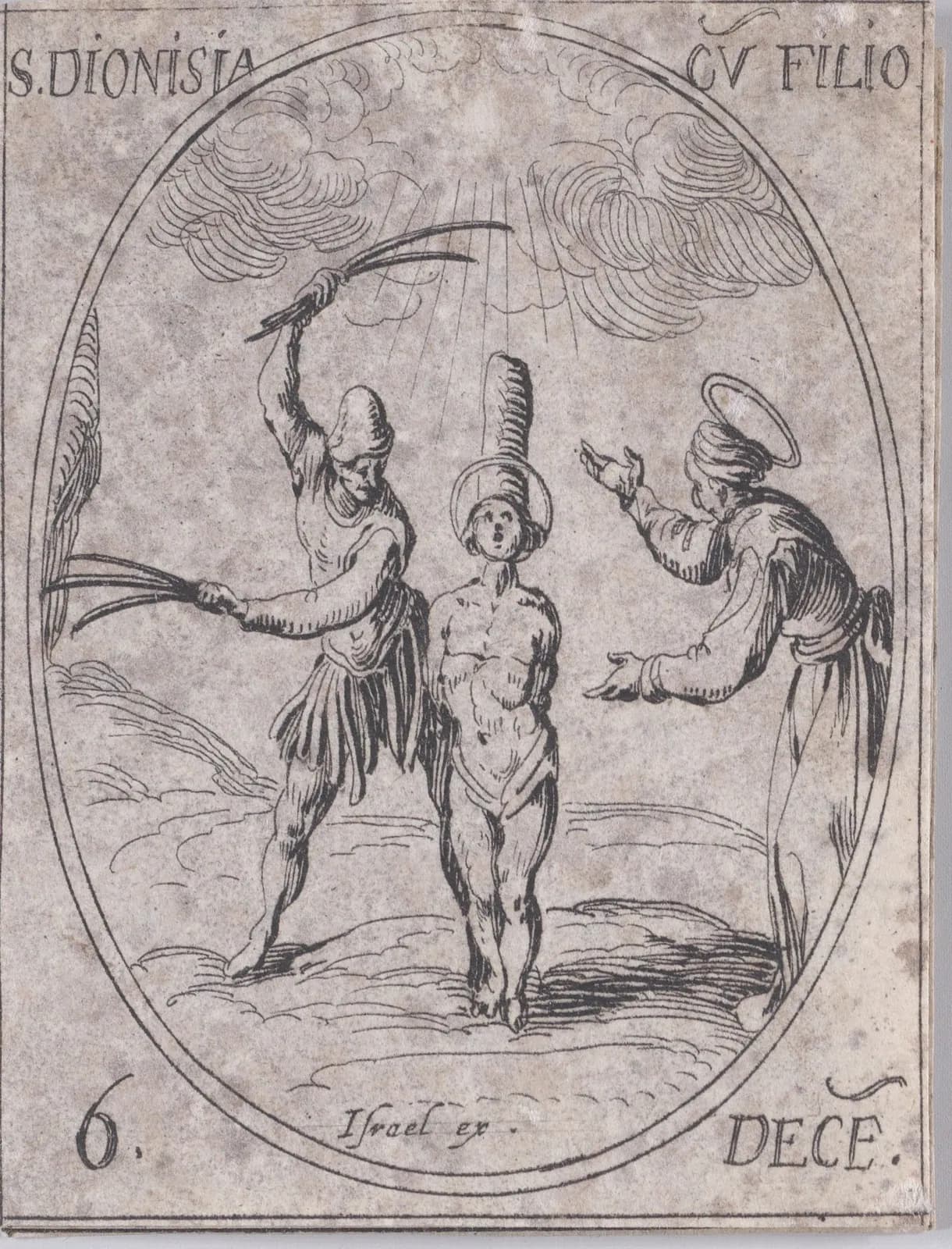
- Year
- 484 2
Saints Dionysia and Majoricus were a mother and her young son, tortured for the Catholic faith in North Africa in 484 under Huneric, the Arian king of the Vandals. 23 Their story survives in a few lines by Victor of Vita, a bishop who lived through the persecution. 15 He says Dionysia was stripped and beaten in public, and that when she saw her son afraid of the torture she held him steady with a look and a few words about his baptism until he died. 1
Huneric's persecution
The Vandals who ruled Roman Africa in the fifth century were Arian Christians, and under their kings the Catholics of Africa were persecuted. 56 Victor, bishop of Vita in the province of Byzacena, wrote the history of their persecution, and the 1912 Catholic Encyclopedia judges that his account of Huneric's reign is "strictly contemporary," written about events "of which the author was in the main an eyewitness." 5 It also warns that Victor "at all times... exaggerates," while recording "little that did not happen." 5
Huneric summoned the Catholic bishops to a conference at Carthage with his own bishops, held, the Catholic Encyclopedia says, some time between 481 and February 484; it ended when the chief Arian bishop withdrew. 6 The encyclopedia says that the king then exiled forty-six bishops to Corsica and three hundred and two to the African deserts. 6 Victor describes how they were sorted. They were asked to swear an oath supporting the succession of the king's son; those who swore were sent to work the land as tenants, forbidden to sing psalms, pray, carry a book, baptize or ordain, and those who refused were sent to Corsica to cut timber for the royal ships. 1
Before the bishops had even been sent away, Victor says, Huneric dispatched torturers into every province of Africa at once, so that no house was left without mourning, and no age or sex was spared except those who gave in. 1 People were beaten with clubs, hanged, burned. Women, and noble women especially, were tortured naked in public. Of all of them, Victor names one, "cursim ac breviter," quickly and briefly: Dionysia. 1
Dionysia
Victor calls her "nostram Dionysiam," our Dionysia. 1 The torturers singled her out first, he says, because she was bold and more beautiful than the other married women, and they prepared to strip her for the clubs. She asked them to torture her however they liked but to leave her clothed. That only enraged them, and they stood her naked on a raised place where everyone could see. 1 With blood running down her whole body under the rods, she told them that what they meant for her shame was her glory. 1
Victor adds that she knew the Scriptures well, and that even while she was being punished, a martyr already, she was encouraging others to stand firm. By her example, he says, she won almost her whole homeland free. 1 The current Roman Martyrology says it was her looks and her words that gave her son courage. 3 katolsk.no, which calls her a widow and a convinced Christian, says she had refused the king's demand that she become an Arian, and that she was flogged in the forum until her body was covered in wounds. 2
Majoricus
Dionysia had one son, Majoricus. Victor describes him as still very young and delicate, and later calls him an adulescens; the current Martyrology says he was still a child, and the 1897 Martyrology "quite a youth." 134 When she saw that he was afraid of the torture, Victor says, she rebuked him with her eyes and steadied him with such authority that he became much stronger than his mother. 1
Victor gives her words to him under the lash, and katolsk.no repeats them. 12 She told him to remember that they had been baptized in the name of the Trinity in their mother, the Catholic Church; that they must not lose the garment of their salvation, lest the one who invited them to the wedding find them without a wedding garment and have them thrown into the outer darkness. 1 Victor completes the speech: the punishment to fear is the one that never ends, and the life to desire is the one that is never lost. 1
He died under the torture. Victor says he gave up his spirit in the contest of confession and finished the course that wins the palm. 1 His mother took up his body, thanking God aloud, and chose to bury him in her own house, so that whenever she prayed to the Trinity over his grave she could trust that she was never parted from him. 1 The 1897 Martyrology tells it in the same order: "His mother took him in her arms, and having buried him in her own house, was wont to pray assiduously at his sepulchre." 4
Dativa, Emilius and the others
Victor ends the passage with a list. Through Dionysia, he says, more people were won for God in that city than could quickly be told, and he names her sister Dativa; Leontia, daughter of the holy Bishop Germanus; Dativa's kinsman Emilius, a physician; Tertius, a religious man known for his confession of the Trinity; and Boniface of Sibida. What they endured, and how they were torn apart, he leaves to anyone who can tell it in order. 1 The 1897 Martyrology names the same women, "a religious man named Tertius," "Æmilian, physician, and Boniface, with three others." 4 The current Martyrology names two more among them, given in Italian as Servio and Vittrice. 3
Victor does not say that Dionysia died. 1 The 1897 Martyrology keeps that reticence: it says the women and men of the group "merited to rank among the confessors of Christ," and its index lists Dionysia as a confessor and only Majoricus as a martyr. 4 katolsk.no is more definite, saying Dionysia was burned alive with her sister Dativa, and that Emilius and Tertius were flayed alive. 2 The current Martyrology commemorates the whole company as martyrs of the Vandal persecution. 3
katolsk.no adds that Emilius was later honored at Naples, where African exiles brought his relics, and that in the late fourteenth century the city's pharmacists took him as a patron and built him a church. 2
What are Saints Dionysia and Majoricus the patron saints of?
Saints Dionysia and Majoricus's feast day
The feast of Saints Dionysia and Majoricus is December 6. 234 The current Roman Martyrology keeps on that day a commemoration of the martyrs of the Vandal persecution under Huneric, and names Dionysia and her son Majoricus among them. 3 The 1897 Martyrology also placed them on December 6. 4 katolsk.no gives December 6 as well, and dates their deaths to that day about 484. 2
Praying with Saints Dionysia and Majoricus
Victor tells this as a story about a mother. Her son was afraid, and she did not tell him the pain would be small. She reminded him whose he was: baptized in the name of the Trinity, in the Church, and owed a wedding garment he must not throw away. 1
It is a hard thing to read. A mother watched her child tortured to death and urged him not to give way, and Victor counts it to her as strength. 1 None of the sources softens it.
Victor also leaves her alive at the end of his passage. She carries the body home, buries it in her own house, and prays over it. 14 For the 1897 Martyrology that is where her story ends: a confessor, praying at her son's grave. 4
Around them Victor sets a sister, a bishop's daughter, a doctor and a religious, and says he cannot tell all that they bore. 1 He named these few out of a persecution that, by his account, left no house in Africa without mourning. 1
Saints Dionysia and Majoricus, pray for us.
Sources
- 1.Victor of Vita, Historia persecutionis Africanae provinciae, book III, sections 19-24, ed. Karl Halm, Monumenta Germaniae Historica, Auctores Antiquissimi 3.1 (Berlin, 1879) (in Latin).
- 2."De hellige Dionysia og Majoricus av Vita og fem ledsagere (d. 484)," Den katolske kirke (katolsk.no), Catholic Diocese of Oslo (in Norwegian).
- 3.Roman Martyrology, entry for December 6, "Santi martiri della persecuzione vandalica," as printed in "Santo del giorno," Conferenza Episcopale Italiana (in Italian).
- 4.The Roman Martyrology, December 6 (Baltimore: John Murphy Company, 1897).
- 5.Patrick Healy, "Victor Vitensis," The Catholic Encyclopedia, vol. 15 (New York: Robert Appleton Company, 1912).
- 6.Mark McNeal, "St. Eugenius of Carthage," The Catholic Encyclopedia, vol. 5 (New York: Robert Appleton Company, 1909).
Saints to turn to next
Others in this collection who are turned to for some of the same things.
- Saint Gianna Beretta MollaOctober 4, 1922 - April 28, 1962ParentingCourageSuffering and illness
- Saints Perpetua and FelicityMartyred at Carthage, March 7, 203CourageParentingSuffering and illness
- Saints Quiricus and Julittad. c. 304ParentingCourageSuffering and illness
- Saint Agathac. 230 - c. 251CourageSuffering and illness