Saint Hilda of Whitby
614 - November 17, 680
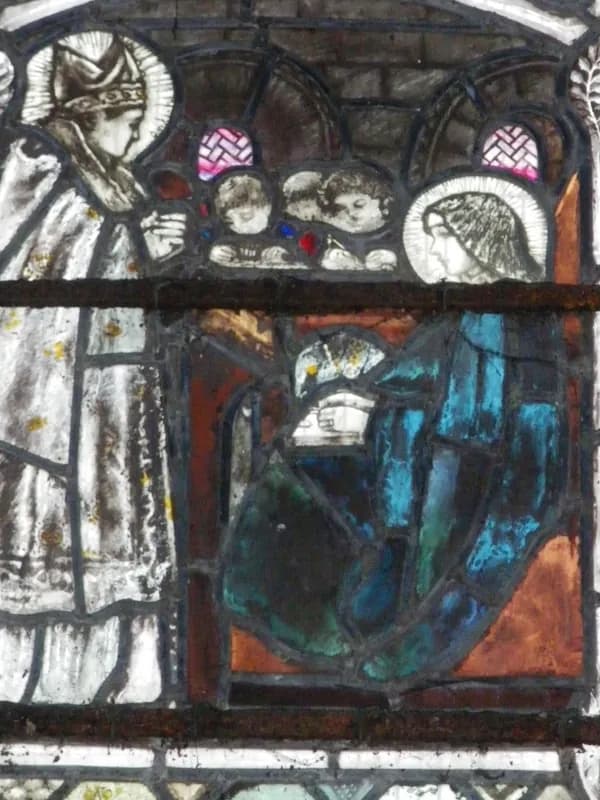
Saint Hilda, a great-niece of King Edwin of Northumbria, became a nun at thirty-three and spent the second half of her life as abbess of Whitby, the monastery where the English Church decided in 664 how it would date Easter. 123 Kings and princes came to her for advice, five of the men trained in her house became bishops, and it was to her that a man named Caedmon was brought after he began, in a dream, to sing. 1 Almost everything known about her comes from the Venerable Bede. 3
A royal family
Her father, Hereric, was a nephew of King Edwin of Northumbria, and he died in exile at the court of a British king, poisoned. 13 When Hilda was an infant, Bede says, her mother, Bregusuit, dreamed that she was searching everywhere for her husband and found instead a precious jewel under her own garment, which "cast such a light as spread itself throughout all Britain." 1 Bede reads the dream as fulfilled in the daughter. 1
She was baptized with King Edwin at the preaching of Paulinus, the first bishop of the Northumbrians. 1 The 1910 Catholic Encyclopedia dates this to about 627 and puts her age at thirteen; Butler says fourteen, and the Liturgy Office of England and Wales says only that she was baptized as a child. 345
Thirty-three years in the world
By Bede's count she lived thirty-three years "most nobly in the secular habit" and gave the other thirty-three to the monastic life. 1 Her first plan was to leave England. Her sister Hereswith, who had married into the royal house of East Anglia, was a nun at Chelles in Gaul, and Hilda went to East Anglia meaning to cross over and join her. 13 Bede says she stayed there a whole year with that intention; Butler's version has her spend the year with her sister. 15 Either way, Aidan, the bishop of Lindisfarne, brought her home and gave her the land of one family on the north bank of the Wear, where she lived for a year as a nun with a very few companions. 13
Abbess of Hartlepool and Whitby
Her next charge was the monastery Bede calls Heruteu, at Hartlepool, founded shortly before by Heiu, whom Bede describes as the first woman in Northumbria to take the veil. 135 Hilda "began immediately to reduce all things to a regular system," as learned men had taught her, and Aidan and other religious men visited often to instruct her "because of her innate wisdom." 1
In 655 King Oswy of Northumbria, facing defeat by Penda of Mercia, vowed his infant daughter Elfleda to God if he won. 25 He won, and the child, about a year old, was placed with Hilda at Heruteu. 2 Two years later Hilda acquired an estate of ten families at Streaneshalch and built a monastery there, the place later named Whitby. 23 Elfleda grew up in it, Bede says, "first a learner, and afterwards a teacher of the monastic life," and succeeded Hilda as abbess. 25
Bede describes Whitby under Hilda in some detail. She taught "the strict observance of justice, piety, chastity, and other virtues, and particularly of peace and charity," and ran the house on the model of the first Christians, so that "no person was there rich, and none poor." 1 She made her monks read the Scriptures closely enough that many were fit for the altar, and Bede names five of them who became bishops: Bosa, Hedda, Oftfor, John, and Wilfrid. 1 "Not only indifferent persons, but even kings and princes," Bede writes, "asked and received her advice." 1 Everyone who knew her, he says, called her Mother. 1
The Synod of Whitby
In 664 the dispute over the date of Easter came to a head in Northumbria, where King Oswy followed the Irish reckoning and his son Alfrid the Roman. 23 A synod was called to settle it, Bede says, "in the monastery of Streaneshalch, which signifies the Bay of the Lighthouse, where the Abbess Hilda, a woman devoted to God, then presided." 2
Hilda was not neutral. Bede records that "the Abbess Hilda and her followers were for the Scots," that is, with Bishop Colman and his Irish-trained clergy, against Wilfrid and the Roman party. 2 Oswy decided for Peter, who held the keys, "lest, when I come to the gates of the kingdom of heaven, there should be none to open them." 2 The Liturgy Office says that Hilda, though sympathetic to the Celtic tradition, "loyally accepted the synod's decision." 4 The encyclopedia adds, with a hedge of its own, that she "seems to have sided with Theodore against Wilfrid" in later years. 3
Caedmon
Bede says there was a man at her monastery, still in the secular habit and well on in years, who had never learned to make verses. 1 At a feast, when everyone was to sing in turn and he saw the instrument coming toward him, he would get up and go home. 1 One night he left early and went to "the stable, where he had to take care of the horses that night." 1 Asleep there, he saw a person who called him by name: "Caedmon, sing some song to me." 1 He said he could not. "However, you shall sing," the other replied, and told him: "Sing the beginning of created beings." 1 Caedmon sang verses in praise of the Creator that he had never heard before, and remembered them when he woke. 1
In the morning the steward took him to the abbess. 1 She had him tell the dream and repeat the verses before "many learned men," who gave him a passage of Scripture to put into verse; he came back the next morning with it done. 1 The abbess, "embracing the grace of God in the man," told him to take up the monastic life, received him into her community, and had him taught the whole course of sacred history, which he turned into English song. 13
Six years of fever, and her death
Late in her life, Bede says, she fell into a fever that did not leave her for six years. 1 Through all of it she went on thanking God and teaching her community, both in public and in private. 1 The encyclopedia counts seven years. 3 In the seventh year the illness turned inward. 1 At about cock-crow she received communion, called the community together, and urged them "to preserve evangelical peace among themselves, and with all others." 1 She died while still speaking, on November 17, 680. 1
That same night, at Hackness, a house she had founded that year about thirteen miles away, a nun named Begu woke to the sound of the bell that was rung when one of them died. 13 She saw the roof open and light pour in, and Hilda's soul carried up in it by angels. 1 Frigyth, who was in charge of the house, got the sisters up to pray, and in the morning brothers came from Whitby with the news. 1
She was buried at Whitby. 5 Butler says that when the Danes destroyed the monastery, the abbot Titus fled with her body to Glastonbury; the encyclopedia calls that story part of "the great Glastonbury myth" and records another that has her relics taken to Gloucester. 35 Butler also reports, in a footnote that explains it away, that "the common people formerly imagined" she changed serpents into stones at Whitby, from the coiled, headless snake shapes in the cliff that he identifies as ammonites. 5
What is Saint Hilda the patron saint of?
None of the sources consulted names her patron of anything, so this page claims no patronage for her. 345 The Liturgy Office says she "is remembered for her patronage of learning," meaning that she fostered it at Whitby rather than that she is invoked for it. 4 The 1910 encyclopedia notes a dozen or more old churches dedicated to her on the northeast coast of England, and suggests that the town of South Shields takes its name from her. 3
Saint Hilda's feast day
Saint Hilda's feast is November 17, the day Bede gives for her death. 1 The 1910 encyclopedia says her feast "seems to have been kept" on that day and notes that her name already appears in the calendar of Saint Willibrord, written early in the eighth century. 3 It is a feast of England rather than of the whole Church: the National Calendar for England lists her on November 17 with Hugh of Lincoln, and makes Elizabeth of Hungary's universal memorial that day optional to allow for them. 4 Vatican News's calendar for November 17 gives Elizabeth of Hungary and Gregory Thaumaturgus and does not list Hilda. 6 Butler's Lives of the Saints places her under November 18. 5
Praying with Saint Hilda
She came to religious life late, at thirty-three, and her first plan was to go abroad and live as a stranger in her sister's convent. 1 Aidan called her back, and she spent the rest of her life in Northumbria, first taking over a house that Heiu had founded and then building one of her own. 123
At the synod held in her own house she was on the side that lost. 2 Bede records her position in a single sentence and does not record her saying anything at all; the Liturgy Office says she accepted the decision loyally. 24 Whitby went on to train bishops for that Church all the same. 1
In the Caedmon story Bede gives the credit to God. 1 What he records of the abbess is that a man who looked after the horses was brought to her with a dream, and she listened, had what he made tested by learned men, and then received him into the community. 1
For six years she was ill, and for six years, Bede says, she went on teaching. 1 Her last recorded words were not about herself but about peace, among the community and "with all others." 1 She was still speaking to them when she died. 1
Saint Hilda of Whitby, pray for us.
Sources
- 1.Bede, The Ecclesiastical History of the English Nation (731), Book IV, chapters 23-24 (London: J. M. Dent, 1910; translator not named, probably L. C. Jane), in the Internet Medieval Sourcebook (Fordham University).
- 2.Bede, The Ecclesiastical History of the English Nation (731), Book III, chapters 24-25 (London: J. M. Dent, 1910; translator not named, probably L. C. Jane), in the Internet Medieval Sourcebook (Fordham University).
- 3.Herbert Thurston, "St. Hilda," The Catholic Encyclopedia, Vol. 7 (New York: Robert Appleton Company, 1910).
- 4."National Calendar for England," Liturgy Office of the Catholic Bishops' Conference of England and Wales.
- 5.Alban Butler, "St. Hilda, or Hild, Abbess," November 18, The Lives of the Saints, Vol. XI: November (1866), at Bartleby.com.
- 6."Saint of the Day: November 17," Vatican News.
Saints to turn to next
Others in this collection who are turned to for some of the same things.
- Saint Aloysius GonzagaMarch 9, 1568 - June 21, 1591DiscernmentSuffering and illness
- Saint Angela MericiMarch 21, 1474 - January 27, 1540Study and teachingDiscernment
- Saint Augustine of HippoNovember 13, 354 - August 28, 430Study and teachingDiscernment
- Saint Bonaventure1217 or 1221 - July 15, 1274Study and teachingDiscernment