Saint Hilarius
Died February 468
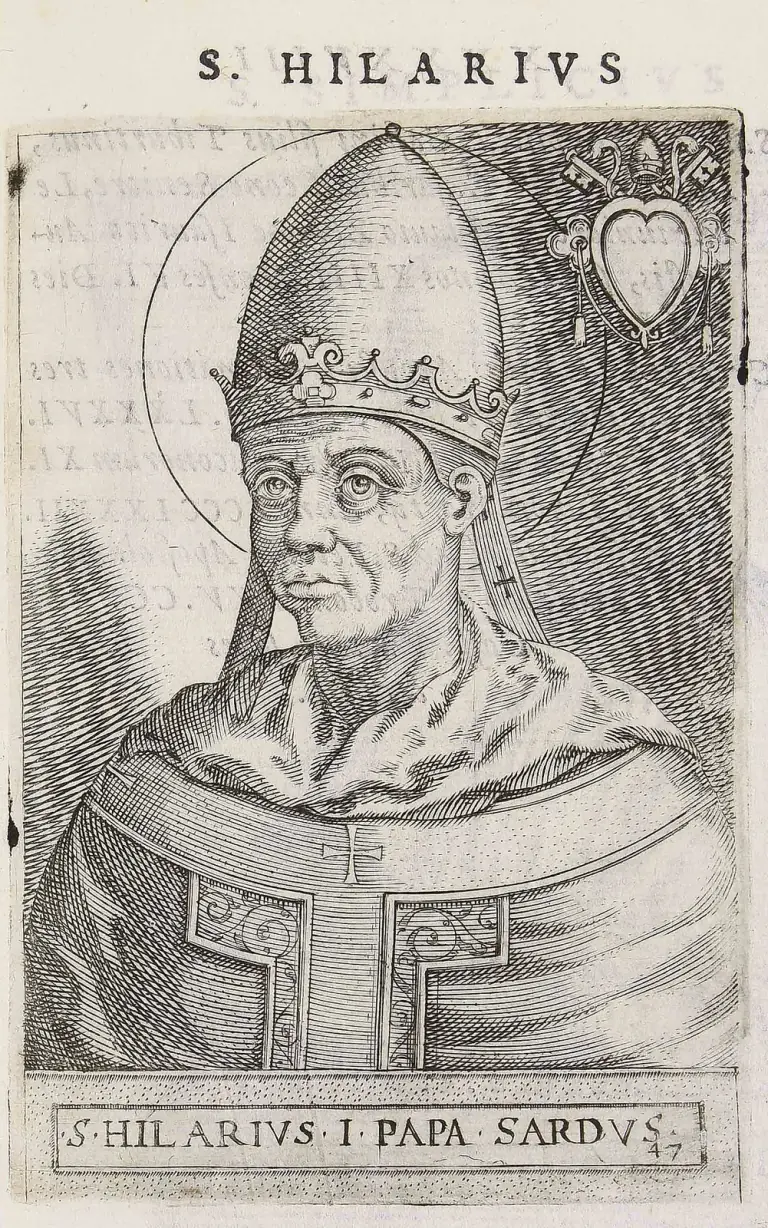
- Known for
- Protesting, as Leo the Great's legate, against the Robber Synod of Ephesus in 449; firm government of the churches of Gaul and Spain; the oratories of the Lateran baptistery 124
- Died
- February 28, 468, according to Kirsch 1; February 29, 468, according to the Holy See and katolsk.no 36
- Feast day
- February 29 in the current Roman Martyrology, kept on February 28 in other years 35910; formerly September 10 or November 17 17
- Not to be confused with
- Saint Hilary of Poitiers or Saint Hilary of Arles, two bishops in Gaul who have their own pages here
Saint Hilarius was the deacon whom Pope Leo the Great sent to the council at Ephesus in 449 that history remembers as the Robber Synod, and who, when the council deposed the bishop of Constantinople, said one word against it in the pope's name. 12 He escaped with his life, and in 461 he succeeded Leo as bishop of Rome. 13 He is kept on February 28, or February 29 in a leap year. 359
A Sardinian deacon in Leo's service
The Liber Pontificalis, the old book of the popes, says Hilary was a Sardinian and the son of Crispinus. 4 By the 440s he was archdeacon of the Roman Church under Leo I. 13 Johann Peter Kirsch, in the Catholic Encyclopedia, spells his name Hilarus, the form it takes in his own inscriptions. 14
In 449 the emperor Theodosius II summoned a council to Ephesus to judge whether Flavian, bishop of Constantinople, had rightly condemned the monk Eutyches, who taught that Christ had only one nature. 2 Leo agreed to it and sent legates: a bishop named Julius, a priest named Renatus, who died on the way, and the deacon Hilarus. 12
One word at the Robber Synod
John Chapman, in the encyclopedia's article on what came to be called the Robber Council, describes a meeting run from the start by Dioscorus of Alexandria. Leo had sent a letter to be read as a rule of faith; Dioscorus made sure it was never read. 2 Eutyches was cleared, and then Flavian and his ally Eusebius of Dorylaeum were declared deposed. 2 Chapman thinks the official acts of that last scene cannot be trusted: the bishops' secretaries were kept from taking notes, soldiers were brought into the church, and many signed under fear. 2
At that moment, Chapman writes, "the papal legate Hilarus uttered a single word in Latin, Contradicitur, annulling the sentence in the pope's name. He then escaped with difficulty." 2 Flavian was sent into exile and died a few days later. 2
Kirsch says the deacon "fought vigorously for the rights of the Roman See" and was "exposed to the violence of Dioscurus." 1 A letter he wrote afterward to the empress Pulcheria survives among Leo's letters; in it he apologizes for not delivering the pope's letter to her, because Dioscorus had tried to stop him from going to either Rome or Constantinople. 1 katolsk.no adds that he carried Flavian's appeal with him and brought Leo an eyewitness account. 3
He got away by hiding in the tomb of Saint John the Evangelist outside Ephesus, and he believed for the rest of his life that the apostle had saved him. 13 Vatican News, in its short calendar note, places him instead at the earlier Council of Ephesus of 431, the one that proclaimed Mary Mother of God; the encyclopedia and katolsk.no both put him at the council of 449. 138
Pope after Leo
Leo died on November 10, 461. 3 Hilarus was chosen to succeed him and, Kirsch thinks, "in all probability received consecration on 19 November, 461." 1 The Holy See dates his pontificate from that day. 6 "His pontificate," Kirsch writes, "was marked by the same vigorous policy as that of his great predecessor." 1
The Liber Pontificalis says he sent a letter through the East confirming the councils of Nicaea, Ephesus and Chalcedon and Leo's teaching against Eutyches and Nestorius. 4 Kirsch notes that nothing more is known of it, and Loomis, the book's translator, that no such documents survive, "but it is not unlikely that they once existed." 14
In Rome he had to live with an Arian church protected by Ricimer, the barbarian general who held real power in the West, according to katolsk.no. 3 When the emperor Anthemius let a favorite named Philotheus hold meetings in the city to spread the Macedonian heresy, the pope challenged the emperor at the tomb of Saint Peter and made him promise to stop it; katolsk.no dates the confrontation to 467. 13
Order in Gaul and Spain
The churches of Gaul and Spain, Kirsch says, "claimed his special attention," because the political disorder in both made it important to strengthen church government. 1 A man named Hermes had taken the see of Narbonne irregularly; a Roman synod of November 19, 462, let him keep the title but withdrew his powers as bishop, and ordered a yearly synod of the region under the bishop of Arles. 1 When Mamertus of Vienne consecrated a bishop for Die, which belonged to Arles, Hilarus had the matter examined and in February 464 had Mamertus warned that his faculties would be withdrawn if it happened again. 1
From Spain came complaints against Silvanus of Calahorra, who was ordaining bishops without authority, and a request to confirm the transfer of a bishop named Irenaeus to Barcelona. 1 A synod in the basilica of Santa Maria Maggiore on November 19, 465, refused the transfer and upheld the rights of the metropolitan. 13 Kirsch calls it "the oldest Roman synod whose original records have been handed down to us." 1
katolsk.no reads these decisions as an attempt to govern the Gallic church through Arles, which failed because the bishop of Arles could not fill the role. 3 Catholic.net's Spanish account notices something else: that in hard cases he liked to call bishops together and hear them before deciding. 9
The oratories of the Lateran
Rome's churches had been stripped by the Vandals in 455, and katolsk.no says Hilarus gave much of his own fortune to restore them. 3 Beside the Lateran baptistery he built three oratories, to Saint John the Baptist, Saint John the Evangelist and the Holy Cross. 14 The first two still stand. 4
Over the doors of the oratory of the Evangelist, Kirsch writes, an inscription still reads: "To St. John the Evangelist, the liberator of Bishop Hilarus, a Servant of Christ." 1 It is his thanks for Ephesus. 13
He also provided a set of gold and silver vessels to be carried to the stational Masses, at which the clergy of the whole city gathered around the pope in one church or another. 4 He built a monastery and two baths near Saint Lawrence Outside the Walls, libraries there as well, and a second monastery inside the city. 14 He died after six years, three months and ten days as pope, and was buried at Saint Lawrence near the body of Pope Sixtus III. 14
What is Saint Hilarius the patron saint of?
Saint Hilarius's feast day
Saint Hilarius's feast day falls on February 28, or on February 29 in a leap year. The current Roman Martyrology, in the text published by the Italian bishops, enters on February 29 the burial of Hilarus, pope, on the Via Tiburtina, recalling that he wrote letters on the Catholic faith confirming the councils of Nicaea, Ephesus and Chalcedon. 5 Vatican News lists him on the same day. 8 katolsk.no, Catholic.net and ACI Prensa all explain that in the three years out of four with no February 29 he is kept on the 28th. 3910
February 29 is the day the Holy See gives for his death, in 468, a leap year; Kirsch gives February 28. 16 ACI Prensa notes that historians differ on which. 10
Older calendars kept other days. Kirsch, writing in 1910, says "His feast day is celebrated on 17 November," and the 1897 English edition of the Roman Martyrology enters "blessed Hilary, pope and confessor" on September 10. 17
Praying with Saint Hilarius
The word he said at Ephesus was a single Latin verb, spoken by a deacon in a hall full of bishops and soldiers. 2 It changed nothing that day. Flavian was still deposed and died in exile, and Hilarus had to run for his life. 12
He did not take the credit for getting away. Years later, as pope, he put his escape over a door in the Lateran and gave it to Saint John. 1
Most of his pontificate went on ordinary things: a bishop who had taken a see he should not have, another ordaining where he had no right, a question of who belonged to which province. 1 He answered them by calling bishops together and holding them to the Church's rules, the same rules he had seen broken at Ephesus. 129
Saint Hilarius, pray for us.
Sources
- 1.Johann Peter Kirsch, "Pope Saint Hilarus," The Catholic Encyclopedia, vol. 7 (New York: Robert Appleton Company, 1910).
- 2.John Chapman, "Robber Council of Ephesus," The Catholic Encyclopedia, vol. 5 (New York: Robert Appleton Company, 1909).
- 3."Den hellige Hilarius," Den katolske kirke (katolsk.no), Catholic Church in Norway, compiled by Per Einar Odden (in Norwegian).
- 4.The Book of the Popes (Liber Pontificalis), vol. I, "Hilary," translated with notes by Louise Ropes Loomis (New York: Columbia University Press, 1916), via the Internet Archive.
- 5.Roman Martyrology, entry for February 29, "Sant'Ilario, papa," Santo del giorno, Conferenza Episcopale Italiana (in Italian).
- 6."Hilarius," The Supreme Pontiffs, The Holy See.
- 7.The Roman Martyrology, September 10 (Baltimore: John Murphy Company, 1897), and its index, "Hilary, St., P., C., Sept. 10."
- 8."Sant'Ilaro, papa," Santo del giorno, 29 febbraio, Vatican News (in Italian).
- 9."Hilario, Santo," Santoral, Catholic.net, from the Archdiocese of Madrid (in Spanish).
- 10.Abel Camasca, "¿Qué pasa con los santos que se celebran el 29 de febrero cuando no hay año bisiesto?," ACI Prensa, February 28, 2024 (in Spanish).
Saints to turn to next
Others in this collection who are turned to for some of the same things.