Saint Herman Joseph of Steinfeld
c. 1150 - 1241 (traditional dates)
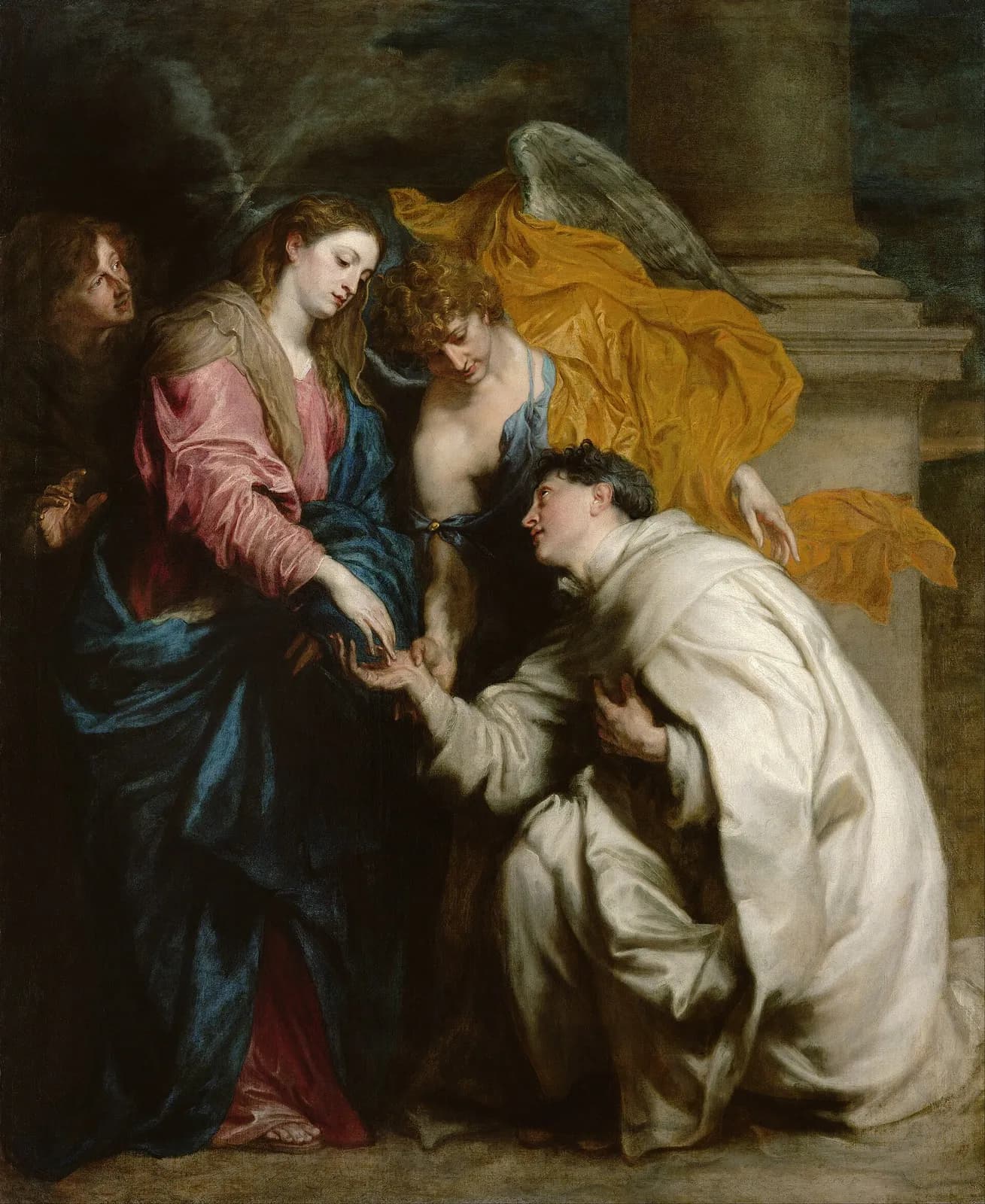
- Died
- April 7, 1241, at Hoven, says the Catholic Encyclopedia 1; date unknown, after 1225, says the Steinfeld pilgrim book 2
- Patron saint of
- Altar servers and sacristans; clockmakers; couples hoping for a child and expectant mothers; eye ailments; the dying 2
Saint Herman Joseph was a canon of the Premonstratensian abbey of Steinfeld, in the northern Eifel, and one of the great Marian mystics of medieval Germany. 12 He is remembered for the legend of the boy who gave an apple to the Christ Child in a Cologne church, for the visions in which Mary called him her chaplain and her spouse, and for the hymns and prayers he wrote for her. 1 He also mended the abbey's clocks. 1
One Life, written to edify
Almost everything known about him comes from one source. The 1910 Catholic Encyclopedia names it: a biography by Razo Bonvisinus, a prior of Steinfeld who knew him. 1 Helmut Kirfel, writing for the pilgrim book of the Salvatorian community at Steinfeld, says its author did not set out to write a modern biography but to hold up a mirror of virtues for his readers, especially the clergy, and that only one outward fact in it is truly reliable: Herman was born in Cologne. 2
Both accounts say his parents had once been well off and were poor by the time he was born. 12 Kirfel notes that this already fitted him to the ideal of poverty of the reforming religious movements of his age. 2
The apple and the shoes
He went to school at seven, and very early, Francis Mershman writes in the encyclopedia, "he began the tender devotion to the Blessed Virgin for which he was known during his entire life." 1 At every free moment he could be found in the church of St. Mary in the Capitol in Cologne, kneeling in "child-like appeal to Mary." 1 Kirfel places the beginning of his life as a mystic here, in a child who spoke to the Mother of God in prayer. 2
Two legends belong to these years, and the encyclopedia gives both as legends. One day, Mershman writes, the boy "is said to have presented an apple, saved from his own scanty repast, to the Child Who accepted it." 1 On another, when he came barefoot on a bitterly cold day, Mary saw that he got shoes. 1 The apple is the scene most often painted; Kirfel says he is most often shown as a boy holding out his apple to the infant Jesus. 12
Canon of Steinfeld
At twelve he entered the abbey of the Premonstratensian canons at Steinfeld. 12 Kirfel says his youth caused some unease in the community, and that he was therefore sent away for further training; he gives Frisia, Mershman the Netherlands. 12 Kirfel adds that the Life saw in the twelve-year-old novice an imitator of the boy Jesus in the Temple. 2
On his return he was put to work in the refectory and later in the sacristy. 1 Kirfel tells the story behind the first assignment: Herman found the lowly service hard, until the Mother of God herself taught him that there was no greater duty than to serve his brothers in love. 2 After his ordination he became sacristan of the abbey church, which Kirfel calls the recognition of his real gift, contemplative prayer. 2 Mershman notes the "reverence and devotion" with which he said Mass, and Kirfel the Masses that stretched on endlessly while he was absorbed in ecstasy. 12
The encyclopedia lists the virtues his brothers saw in him: his gentleness and affability, his humility, his "extraordinary mortifications," and above all his love for the Mother of God, before whose altar he spent hours in prayer and ecstatic visions. 1 Catholic.net adds that he suffered constant headaches that grew violent on the great feasts, so that he used to say he knew someone who never had a feast on feast days. 4
Mary's chaplain
His name comes from his visions. Mershman writes that Mary "called him her chaplain and her spouse, and confirmed his surname Joseph, given to him by his brothers in religion." 1 Kirfel explains that the name followed from what came to be called his mystical marriage with the Mother of God, and that Joseph was then an unusual Christian name. 2
He wrote prayers and hymns in her honor. 1 Mershman lists the surviving works: twelve acts of thanksgiving, a hymn to Saint Ursula and her companions, prayers to Christ drawn largely from the Song of Songs, and a short prayer on the five joys of Mary, adding that the last three are not certainly his. 1 Both sources say a commentary on the Song of Songs is lost, and Kirfel adds a lost Life of a nun named Elisabeth. 12 The Roman Martyrology says he celebrated devotion to the Sacred Heart of Jesus in hymns and praises. 3 Kirfel, more cautious, calls his authorship of the oldest Sacred Heart hymn, "Summi regis cor, aveto," very much disputed. 2
He had a practical side as well. Mershman says he was "in frequent demand for the making and repairing of clocks," and that he was sometimes sent out to do pastoral work, including the spiritual care of the Cistercian nuns at Hoven near Zülpich. 1
His death and the long road to recognition
He died among those nuns. Mershman gives the date as April 7, 1241. 1 Kirfel says the date of his death is not known. 2 He writes that the aged canon, on a pastoral visit before Easter to a convent of Cistercian nuns, by tradition the one at Hoven, died after a short illness on the Thursday of Easter week, and was buried there in a place he had chosen himself. 2 The Life says he foretold the murder of Archbishop Engelbert of Cologne in 1225 about four weeks before it happened; since a contemporary could hardly credit a dead man with such a prophecy unchallenged, Kirfel concludes that he died after 1225, and probably before 1252. 2
His brothers soon took him back. With the archbishop's help they exhumed him on the Tuesday after Pentecost and carried him to Steinfeld in a triumphal procession, and people reported cures at his grave. 2 In 1509 the tomb was moved to the middle of the abbey church; the marble tomb that stands there now dates from 1732. 2 Relics are also kept in Cologne and Antwerp. 1
Recognition took centuries. Mershman says a canonization process begun at the request of the archbishop of Cologne and the Emperor Ferdinand II was interrupted; he dates it to 1626, Kirfel to 1628, and Kirfel says it was lost in the Thirty Years' War. 12 In 1728 Pope Benedict XIII consecrated an altar to him in the Premonstratensians' Roman college and said Mass at it, which many treated as a beatification. 2 A note on New Advent's edition of the encyclopedia says he was canonized by Pope Pius XII in 1958. 1 Kirfel is more exact: a decree of August 11, 1958, confirmed the veneration given him from time immemorial and acknowledged that he was called a saint, and many call this a canonization, not quite correctly. 2 Catholic.net gives May 15, 1960, under John XXIII. 4
What is Saint Herman Joseph the patron saint of?
The Steinfeld pilgrim book gives a series of patronages, each with its reason. 2 Because of his work in the sacristy and at the altar he is patron of altar servers and sacristans, and because he made and repaired clocks, of clockmakers. 2 Miracles involving newborn children led couples hoping for a child, expectant mothers and anxious parents of newborns to ask his help; people with eye ailments invoke him because as sacristan he carried clear spring water up the hill for the liturgy; and his peaceful death makes him a patron of the dying. 2
He is shown as a boy holding out an apple, or as a canon in the white habit of his order, sometimes with a key at his belt for the sacristy, a book for his writings, or a chalice from which three roses grow. 12
Saint Herman Joseph's feast day
Saint Herman Joseph's feast day is April 7. 13 The Roman Martyrology enters him that day at the Premonstratensian monastery of Steinfeld. 3 Mershman says the Premonstratensians also kept the translation of his relics on May 24. 1 In Germany, Kirfel writes, his feast was kept in every diocese on April 7 from 1961, and moved to May 21 in 1967. 2 Steinfeld holds its great Herman Joseph festival on the Sunday before Pentecost, with an octave that ends on Pentecost Monday. 2
Praying with Saint Herman Joseph
The apple is a child's gift: the best thing he had, saved from a meager lunch and held out to a statue. 1 His whole life, as his sources tell it, kept that shape. He spoke to the Mother of God with a child's directness, and spent hours before her altar. 12
He also learned to serve. Kirfel's account of the refectory is worth keeping: a young canon who found waiting on tables hard, and who was taught in prayer that there is no greater duty than serving one's brothers in love. 2 He went on to keep the sacristy, carry water up the hill, and fix the clocks. 12
His headaches, Catholic.net says, were worst on the very feasts he loved most, and he lived with them, and with other illnesses, to the age of ninety. 4 He died on a pastoral visit, in Easter week, after a short illness, and was buried where he had asked to be. 2
Saint Herman Joseph of Steinfeld, pray for us.
Sources
- 1.Francis Mershman, "Bl. Hermann Joseph," The Catholic Encyclopedia, Vol. 7 (New York: Robert Appleton Company, 1910), with New Advent's editorial note.
- 2.Helmut J. Kirfel, "Der heilige Hermann Josef von Steinfeld: sein Leben und seine Verehrung," in Hermann-Josef-Pilgerbuch (Salvatorianer Kloster Steinfeld, 2007), published by the parish community of Steinfeld, Diocese of Aachen (in German).
- 3.Roman Martyrology, entry for April 7, "Sant'Ermanno Giuseppe, sacerdote," as printed in "Santo del giorno," Conferenza Episcopale Italiana (in Italian).
- 4."Germán José de Colonia, Santo," Santoral, Catholic.net (in Spanish).
Saints to turn to next
Others in this collection who are turned to for some of the same things.