Saint Henry of Uppsala
c. 1100 - c. 1156
- Died
- January 20, about 1156, near Köyliö in Finland, by tradition 1; the 1912 Catholic Encyclopedia says 1157 3
- Canonization
- Never formally canonized; venerated in Finland since the thirteenth century 1
Saint Henry of Uppsala was an English-born bishop who went to Finland with the Swedish king Eric in the 1150s, stayed behind to look after the newly baptized, and was killed there by a Finnish peasant, by tradition on the ice of a frozen lake. 12 Finland recognized him early as its patron and the founder of its Church, and still keeps him as both. 14 Almost everything told about him comes from a legend written more than a century after his death, and the Church in the North says plainly how much of it is uncertain. 1
An Englishman in the North
Henry was born in England, perhaps around the year 1100, and is said to have been a priest there before he went to Rome. 1 The Roman Martyrology also has him born in England. 2 A late fifteenth-century legend places him among the companions of Cardinal Nicholas Breakspear, another Englishman, whom the pope sent to Norway and Sweden as legate in 1152. 1 Breakspear would later become Pope Adrian IV.
The cardinal's journey is better documented than Henry's part in it. He went to Nidaros, now Trondheim, to give the pallium to Norway's first archbishop, and in the autumn of 1153 he came to Linköping in Sweden, where a church council agreed to create an archbishopric for Sweden at Uppsala. 1 The 1912 Catholic Encyclopedia notes that the plan stalled because the Swedes could not agree on the see, and that Uppsala became an archdiocese only in 1164. 3 The Norwegian biography thinks it natural that Henry was traveling with the legate and was consecrated bishop of Uppsala by him before he left. 1
Was he bishop of Uppsala?
Both the encyclopedia and the Martyrology say so. The encyclopedia lists him among the bishops of the old see, and the Martyrology says he was given charge of the Church of Uppsala. 23 The Norwegian biography is less sure. It reports that historians now doubt it, because no bishop of that name can be found at Uppsala during King Eric's reign, and the early history of the diocese is dark until its first archbishop in 1164. 1
The evidence it weighs is thin and late. An Uppsala chronicle of the early fifteenth century names a Henry among the early bishops and knows only that he was martyred and buried in Finland. 1 A different Bishop Henry of Uppsala appears in 1129 and died in battle in 1134, and it is possible, the biography suggests, that the two Henrys were later merged. 1 Its own conclusion is that "bishop of Finland" is the most accurate title for him. 1
The expedition to Finland
In King Eric's day the pagan Finns were raiding into Sweden, and Eric fitted out an expedition against them which was justified by calling it a crusade. 1 With Henry, his friend and fellow worker, he crossed to southwestern Finland with an army. 1 The year is uncertain: katolsk.no gives 1155 and notes that 1154 and 1157 are also proposed, and that Finland celebrated the 700th anniversary of the landing in 1857 and the 850th in 2005. 1 The encyclopedia dates it 1157 and calls it "the Crusade to Finland led by St. Eric." 3
The Norwegian account does not dress it up. The aim, it says, was without doubt to strengthen Swedish interests in the region, and partly also to do missionary work. 1 The story goes that Eric offered the Finns peace and Henry offered them the faith, and they refused both. They lost the battle that followed, and Henry baptized the defeated at the spring of Kupittaa, near Turku. 1 Eric went home. Henry stayed. The legend says he preferred the life of a preacher to that of a great prelate, and he built a small church at Nousiainen that became the center of his work. 1
His death on the ice
Henry's official legend, written at the end of the thirteenth century, contains few concrete facts. 1 Its account of his death is short. A convert named Lalli had killed a Swedish soldier, and Henry imposed a severe penance on him as the condition for receiving Communion again; Lalli was so enraged that he killed the bishop with an ax. 1 The Martyrology tells it the same way in a single sentence: Henry was cruelly murdered by a killer whom he had tried to correct according to the discipline of the Church. 2
Tradition puts this on January 20, around 1156, on the frozen lake of Köyliö. 1 The encyclopedia dates his martyrdom to 1157, and historians, according to the Norwegian biography, have proposed every year from 1150 to 1158. 13
The Finns remember a different story. A ballad on the bishop's death, probably from the thirteenth century but written down only in the seventeenth, has Henry traveling by ski through Satakunta and stopping at Lalli's house while Lalli was away. 1 His wife, Kerttu, refused the bishop bread and beer, and Henry insisted on what custom owed a traveler, but paid her well before he left. When Lalli came home she told him the bishop had taken everything without paying. Lalli put on his skis, caught Henry on the ice of Köyliö and killed him. 1
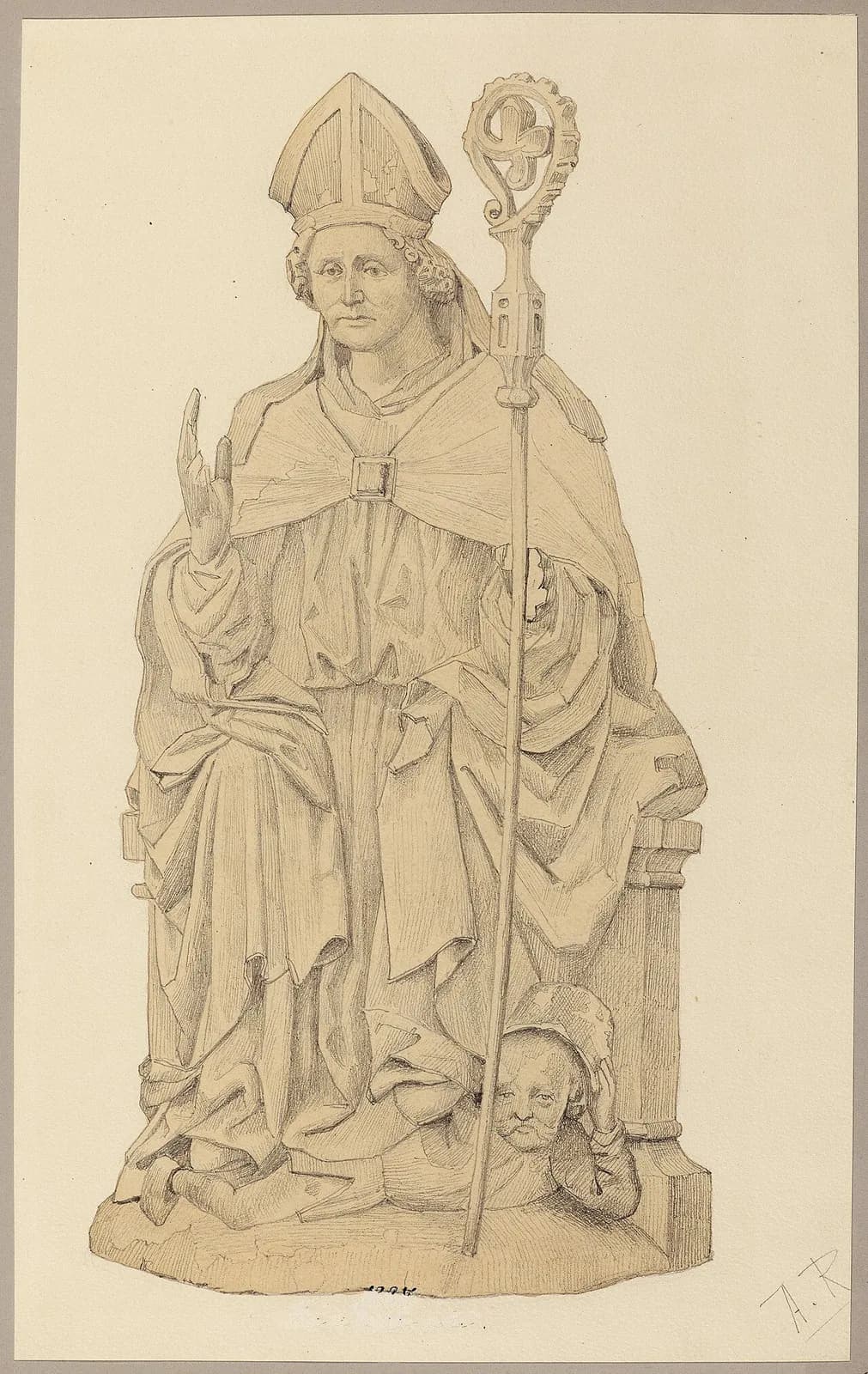
The ballad has its revenge. Lalli put on the dead bishop's cap and boasted that he had shot a bear, and when he took it off his scalp came away with it. 1 He tried to pull the bishop's ring from his finger, and when it would not come, he cut off the finger. 1 Medieval Finnish churches are full of images of Henry standing on his murderer, who is often shown without his scalp. 1
Relics and a legend
His servants, the legend says, followed instructions he had given them in advance. They harnessed oxen to his bier and let the animals go where they would, and where the oxen finally stopped, at Nousiainen, he was buried and a church was built over his grave. 1 A list of miracles followed. In the most famous, a blind old man fishing on Köyliö in midsummer found a raven pecking at a finger with a gold ring on it, rubbed his eyes with it and could see again. 1
The story that Pope Adrian IV canonized him in 1158 is, according to the Norwegian biography, without foundation: it has been traced to a book published in 1623 and is usually regarded as a fabrication. 1 He was never formally canonized. His relics were moved to the new cathedral at Turku, which by 1296 was already called the church of Our Lady and Saint Henry, and his cult was centered there. 1 In 1720 the Russians removed most of the bones from Turku, and what became of them is not known. 1
Something survives. A piece of a forearm bone, long kept in a reliquary in Turku Cathedral, was moved to the National Museum in Helsinki in 1924, and in the Holy Year 2000 it was placed in the altar of St. Henry's Cathedral in Helsinki, the cathedral of Finland's Catholic diocese. 1
What is Saint Henry the patron saint of?
Saint Henry is the patron saint of Finland. Benedict XVI called him the patron of the Finns' "beloved land" in 2011, and Francis called him "the patron of your country" in 2015. 45 katolsk.no says he was recognized early as Finland's patron and the founder of its Church, and was honored as a national saint both before and after the Reformation. 1 It adds that the local seal hunters called on him in storms. 1
Saint Henry's feast day
Saint Henry's feast day is January 19. 1 It was not always. In the diocese of Turku he was kept from the thirteenth century on January 20, the day of his death; in Sweden and elsewhere he was moved to January 19 because January 20 already belonged to Saints Fabian and Sebastian, and Finland followed in the late seventeenth century. 1 The Roman Martyrology still enters him on January 20. 2 The anniversary of the translation of his relics, June 18, was once a second feast; the Finns called the two days Winter Henry and Summer Henry. 1
For more than thirty years an ecumenical delegation of Finnish Lutherans and Catholics has come to Rome for his feast, and the pope has received it. 45 Benedict XVI met the pilgrims on January 15, 2011, and Francis on January 22, 2015, when the tradition was thirty years old. 45 katolsk.no adds that on January 19 he is honored with a solemn celebration in the Finnish chapel of Santa Maria sopra Minerva in Rome. 1
Praying with Saint Henry
The first thing his story asks for is honesty. He came north with a king and an army, and the source that tells his life most fully says the expedition was about Swedish interests as much as the Gospel. 1 Whatever he did in Finland, he did in the shadow of a battle the Finns had lost. The Church in Norway does not hide that, and a reader praying with him does not need to either.
What is left when the legend is stripped back is a man who stayed. Eric went home and Henry did not. 1 The official story of his death is about a confessor holding a murderer to a penance, and paying for it with his life. 12 The folk story is about a bishop who paid for his bread and was accused of stealing it. 1 Neither is flattering to the man who killed him, and the folk version is the one the Finns kept singing.
It is worth noticing, too, what became of him. A missionary who arrived alongside a conquering army is now the occasion of a yearly pilgrimage in which Finnish Lutherans and Catholics travel to Rome together. 45 Francis, receiving them in 2015, recalled what John Paul II had told the first delegation thirty years earlier: "The fact that you pray together is a witness to our belief that only through the grace of God can that unity be achieved." 5
Saint Henry of Uppsala, pray for us.
Sources
- 1.Per Einar Odden, "Den hellige Henrik av Finland (~1100-~1156)," Den katolske kirke (the Catholic Church in Norway), katolsk.no (in Norwegian).
- 2.Roman Martyrology, entry for January 20, "Sant'Enrico, vescovo e martire," as printed in "Santo del giorno," Conferenza Episcopale Italiana (in Italian).
- 3.Gustav Armfelt, "Ancient See of Upsala," The Catholic Encyclopedia, Vol. 15 (New York: Robert Appleton Company, 1912).
- 4.Benedict XVI, address to an ecumenical delegation from Finland on the occasion of the feast of Saint Henry, Patron of Finland, January 15, 2011.
- 5.Francis, address to an ecumenical delegation from Finland for the feast of Saint Henrik, January 22, 2015.
Saints to turn to next
Others in this collection who are turned to for some of the same things.