Saint Habakkuk
Late seventh century BC
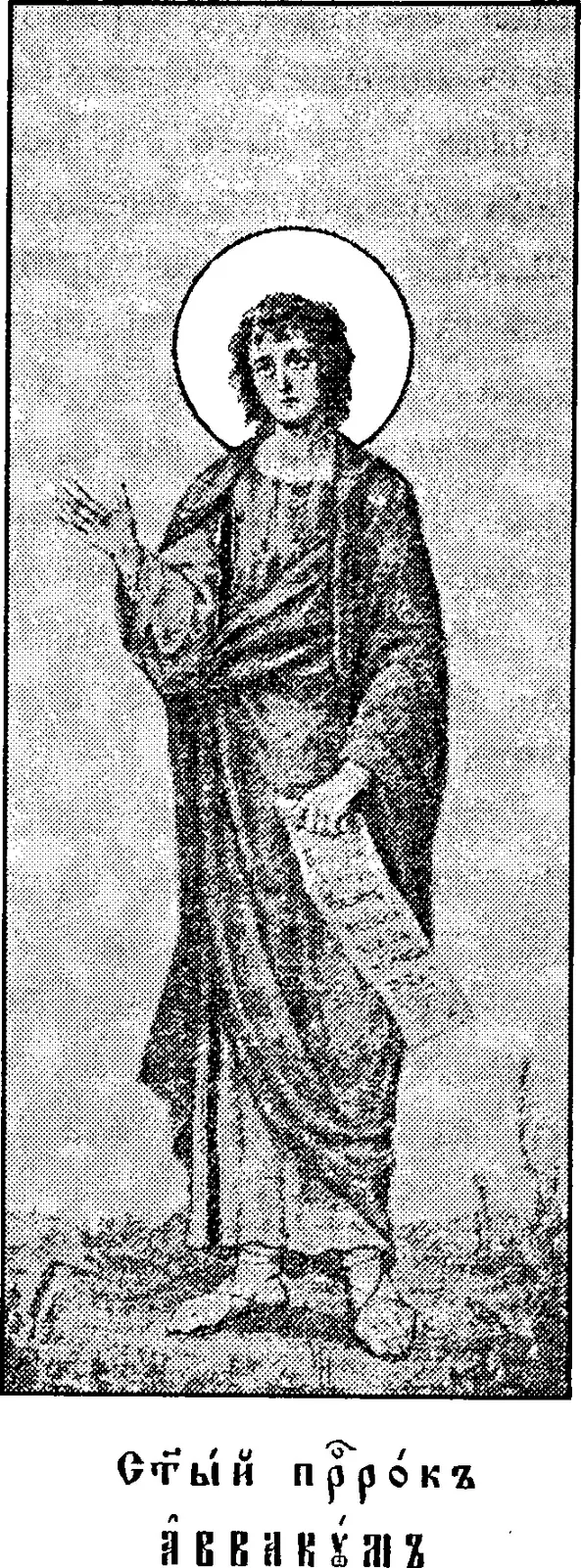
- Book
- The eighth of the twelve minor prophets 1
- Relics
- Found at Cela near Eleutheropolis under Theodosius the Great (Sozomen) 10
Saint Habakkuk was a prophet of Judah, probably at the end of the seventh century before Christ, who asked God why he let the wicked prosper and was told to wait for the answer. 134 The answer, "the just shall live in his faith," is quoted three times in the New Testament, twice by Saint Paul. 1478 The current Roman Martyrology keeps him on December 2. 12
Who was the prophet Habakkuk?
Francis Gigot, writing in the Catholic Encyclopedia in 1910, is blunt: "Of this prophet's birth-place, parentage, and life we have no reliable information." 1 His name may mean "embrace." 1 His book twice calls him "the prophet," which suggests to Gigot that he held a recognized place as one, and the musical notes attached to his prayer in chapter 3 have suggested to some that he sang in the Temple choir and was therefore a Levite, though Gigot thinks most scholars doubt it. 15
Legend filled the gap. Gigot lists the stories: that he was the son of the Shunammite woman whose child Elisha raised, or the watchman Isaiah set to look for the fall of Babylon; and, from the ancient Lives of the Prophets, that he fled to the Egyptian coast when Nebuchadnezzar came and later lived as a farmer in his home town. 1 "The exact amount of positive information embodied in these conflicting legends cannot be determined at the present day." 1
When he wrote is disputed too. The New American Bible's introduction dates the book between 605 and 597 BC, after the Babylonian victory at Carchemish and before Nebuchadnezzar's invasion ended in the capture of Jerusalem, when the kingdom of Judah was in a desperate state. 2 Gigot surveys a range of opinions, from Manasseh's reign to the Exile, and settles on 605 to 600 as the best fit; Jerome's view, that it came from the Exile, he thinks the least likely of all. 1
"How long, O Lord, shall I cry?"
The book opens with a complaint. "How long, O Lord, shall I cry, and thou wilt not hear? shall I cry out to thee suffering violence, and thou wilt not save?" 3 All around him the prophet sees "rapine and injustice," the law "torn in pieces," the wicked prevailing against the just. 3 The New American Bible's introduction calls it perhaps "the first time in Israelite literature" that a man questions the ways of God and calls him to account for his government of the world. 2
God's reply is worse news: he is raising up the Chaldeans, "a bitter and swift nation," whose horses are "swifter than evening wolves." 3 Babylon will punish Judah. 12 So Habakkuk argues again. "Thy eyes are too pure to behold evil, and thou canst not look on iniquity. Why lookest thou upon them that do unjust things, and holdest thy peace when the wicked devoureth the man that is more just than himself?" 3
"The just shall live in his faith"
Then he waits. "I will stand upon my watch, and fix my foot upon the tower: and I will watch, to see what will be said to me." 4 The answer comes with an instruction to write it down large, "upon tables: that he that readeth it may run over it," and to be patient: "if it make any delay, wait for it: for it shall surely come." 4 Then the oracle itself: "Behold, he that is unbelieving, his soul shall not be right in himself: but the just shall live in his faith." 4
Gigot calls this verse "the central and distinctive teaching of the book," a law of God's providence wider than the crisis that prompted it: the wicked carry the seeds of their own destruction, and the believer those of eternal life. 1 The New American Bible's introduction puts it more simply: the just Israelite will not perish in what is coming. 2
A taunt-song of five woes follows, against the conqueror who "heapeth together that which is not his own" and "buildeth a town with blood." 14 It ends: "But the Lord is in his holy temple: let all the earth keep silence before him." 4
Saint Paul made the verse a cornerstone. "The justice of God is revealed therein, from faith unto faith, as it is written: The just man liveth by faith," he writes to the Romans, and again to the Galatians; the Letter to the Hebrews quotes it as well. 789 Gigot sees this use in the New Testament as the sign of the oracle's "truly Messianic import." 1
The prayer of Habakkuk
The last chapter is headed "A prayer of Habacuc the prophet." 5 It asks God to revive his work "in the midst of the years" and to remember mercy in his anger, and then describes the Lord coming to save his people. 15 Gigot reports that many critics think the chapter a later poem attached to the book, and concludes that the question cannot be settled. 1 The New American Bible's introduction calls it "a magnificent religious lyric." 2
It ends with a refusal to despair. "For the fig tree shall not blossom: and there shall be no spring in the vines... the flock shall be cut off from the fold, and there shall be no herd in the stalls. But I will rejoice in the Lord: and I will joy in God my Jesus." 5
Dinner for Daniel, and a tomb at Cela
The Book of Daniel, in its deuterocanonical fourteenth chapter, tells of a prophet named Habacuc in Judea who was carrying boiled pottage and bread to his reapers when an angel told him to take it to Daniel in the lions' den in Babylon. 6 "Lord, I never saw Babylon, nor do I know the den," he answered, and the angel carried him there by the hair of his head; Daniel ate, and Habacuc was set back in his own place. 16 Whether this is the same man as the prophet of the book, Gigot calls doubtful. 1
His relics came to light many centuries later. The church historian Sozomen writes that in the reign of Theodosius the Great the place where the relics of Habakkuk lay was revealed in a dream to Zebennus, bishop of Eleutheropolis, and that they were found at Cela, with those of Micah a little later nearby. 10
Saint Jerome wrote a commentary on his book, one of the works he undertook at the suggestion of Saint Chromatius of Aquileia and dedicated to him. 11
What is Saint Habakkuk the patron saint of?
Saint Habakkuk's feast day
Saint Habakkuk's feast day is December 2 in the current Roman Martyrology, as the Italian bishops publish it, which remembers him as the prophet who, faced with human iniquity and violence, announced God's judgment and also his mercy, proclaiming that the just shall live by faith. 12 The Byzantine Catholic Menaion keeps him on December 2 as well, with nearly the same words. 14
The older Roman date was January 15. The 1897 English edition of the Roman Martyrology entered on that day "the holy prophets Habacuc and Michaeas, whose bodies were found by divine revelation in the days of Theodosius the Elder." 13 Gigot, in 1910, wrote that the Greek and Latin Churches both kept his feast on January 15. 1
Praying with Saint Habakkuk
Habakkuk's book begins with a prayer many people have prayed and few have dared to write down: how long, and why do you not act? 3 Scripture keeps the complaint, and the second, sharper one after God's first answer. 3
The answer he received was not an explanation. It was a promise to be written down and waited for, and a word about faith. 4 The Byzantine hymn for his day remembers him "standing on divine watch." 14
His last words are spoken with the harvest failing and the stalls empty. 5 He does not say things are better; he says he will rejoice in the Lord anyway. 5 Paul found in his oracle the words for the Gospel itself. 7
Saint Habakkuk, pray for us.
Sources
- 1.Francis E. Gigot, "Habacuc (Habakkuk)," The Catholic Encyclopedia, vol. 7 (New York: Robert Appleton Company, 1910).
- 2.Introduction to the Book of Habakkuk, The New American Bible, as hosted by the Holy See.
- 3.Habacuc (Habakkuk) 1, Douay-Rheims Bible, Challoner revision, as hosted by drbo.org.
- 4.Habacuc (Habakkuk) 2, Douay-Rheims Bible, Challoner revision, as hosted by drbo.org.
- 5.Habacuc (Habakkuk) 3, Douay-Rheims Bible, Challoner revision, as hosted by drbo.org.
- 6.Daniel 14, Douay-Rheims Bible, Challoner revision, as hosted by drbo.org.
- 7.Romans 1, Douay-Rheims Bible, Challoner revision, as hosted by drbo.org.
- 8.Galatians 3, Douay-Rheims Bible, Challoner revision, as hosted by drbo.org.
- 9.Hebrews 10, Douay-Rheims Bible, Challoner revision, as hosted by drbo.org.
- 10.Sozomen, Ecclesiastical History, Book VII, chapter 29, trans. Chester D. Hartranft, Nicene and Post-Nicene Fathers, Second Series, vol. 2 (Buffalo: Christian Literature Publishing Co., 1890), as revised by New Advent.
- 11.Johann Peter Kirsch, "St. Chromatius," The Catholic Encyclopedia, vol. 3 (New York: Robert Appleton Company, 1908).
- 12.Roman Martyrology, entry for December 2, "Sant'Abacuc, profeta," Santo del giorno, Conferenza Episcopale Italiana (in Italian).
- 13.The Roman Martyrology, January 15 (Baltimore: John Murphy & Co., 1897), Internet Archive.
- 14."Menaion - December 2," Metropolitan Cantor Institute, Byzantine Catholic Archeparchy of Pittsburgh.
Saints to turn to next
Others in this collection who are turned to for some of the same things.
- Saint Faustina KowalskaAugust 25, 1905 - October 5, 1938PrayerSuffering and illnessDesperate situations
- Saint JobFigure of the Book of Job; dates unknownSuffering and illnessPrayerDesperate situations
- Saint Aelred of Rievaulx1109 - January 12, 1166 (or 1167)PrayerSuffering and illness
- Saint Albert of Trapanic. 1240 - August 7, 1307PrayerSuffering and illness