Saint Faustina Kowalska
August 25, 1905 - October 5, 1938
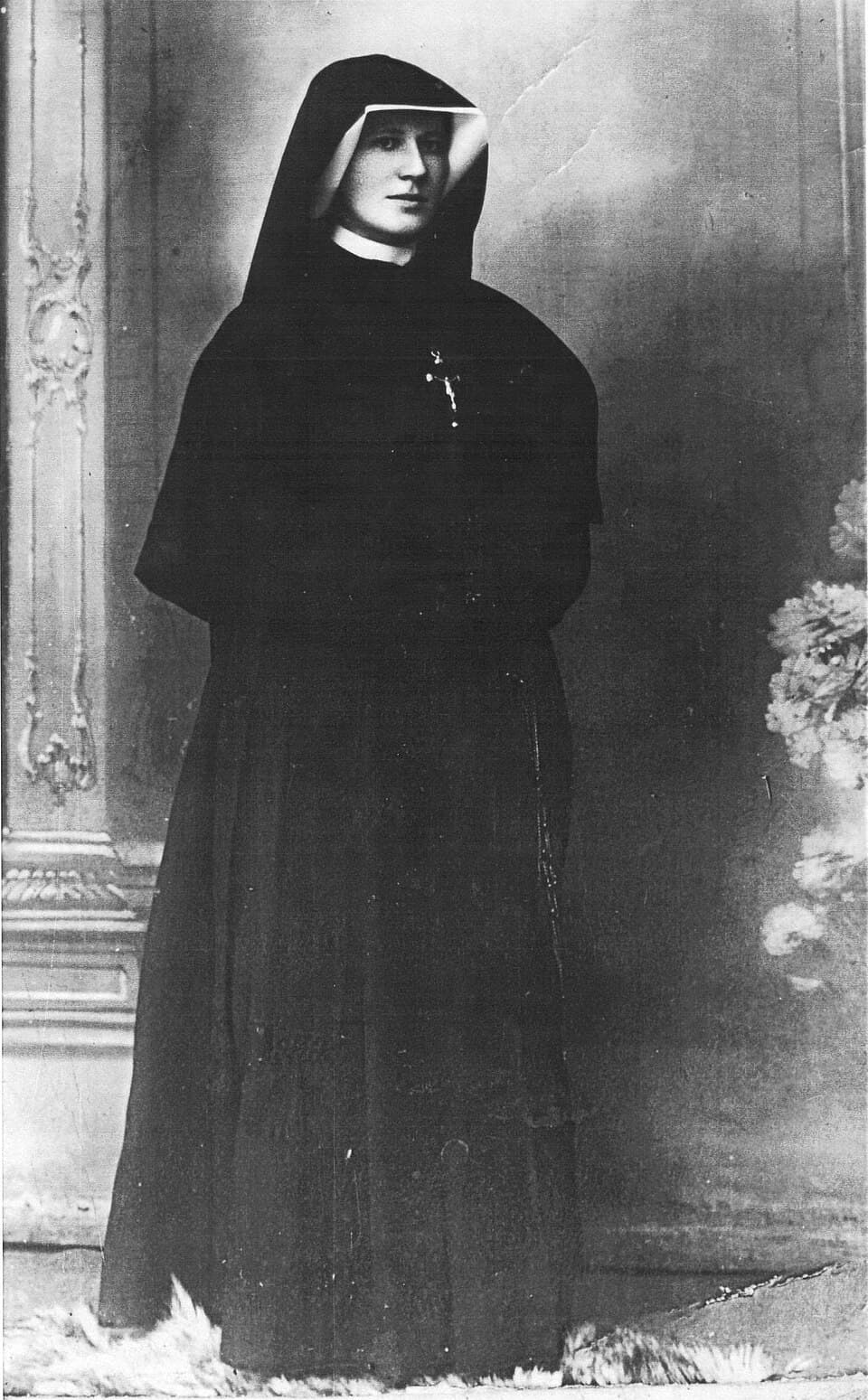
- Buried
- Sanctuary of Divine Mercy, Kraków-Łagiewniki 2
Saint Faustina Kowalska was a Polish nun with three years of schooling who worked as a cook, gardener and porter, and whose Diary carried the message of Divine Mercy to the whole Church. 23 The image inscribed "Jesus, I trust in You," the Divine Mercy chaplet and the prayer at three in the afternoon all come to the Church through her. 235 She died of tuberculosis in Krakow in 1938 at thirty-three, and John Paul II canonized her on April 30, 2000, calling her "a gift of God to our time." 12
A peasant girl from Głogowiec
She was born Helena Kowalska on August 25, 1905, in the village of Głogowiec in Poland, the third of ten children in what the Holy See biography calls "a poor and religious family of peasants." 2 Vatican News names her parents as Marianna and Stanislao Kowalski. 3 She was baptized in the parish church of Świnice Warckie. 2
The biography says she stood out early for her love of prayer, work and obedience, and for her sensitivity to the poor, and that she made her First Communion at nine. 2 She felt the first stirrings of a religious vocation at seven. 23 Her parents would not give their permission, and she could not pursue it. 23
She had three years of school. 23 At sixteen she left home to work as a housekeeper, in Aleksandrów, Łódź and Ostrówek, to support herself and help her parents. 2 Vatican News describes the work as domestic service in wealthy households. 3
Into the convent
What changed her course was a vision of the suffering Christ. 23 Vatican News gives the words she heard in a translation that is plainly a rough one: "How long will I have to bear you? As long as you trick me?" 3 She was twenty. 3
She entered the Congregation of the Sisters of Our Lady of Mercy in 1925 and took the name Sister Mary Faustina. 25 The sources disagree on the day: the Holy See biography says August 1, and Vatican News says August 10, at the congregation's convent in Warsaw. 23
She lived thirteen years in the congregation, moving among its houses in Krakow, Płock and Vilnius. 2 She worked as a cook, as a gardener and at the door as porter. 235 The biography is blunt about how this looked from outside. "Externally nothing revealed her rich mystical interior life," it says, and her life was "apparently insignificant, monotonous and dull." 2 Franciscan Media adds that she served the needs of the local people as well as the sisters. 5
The image, the Diary and the message
On February 22, 1931, she wrote in her Diary that she had seen Jesus in her cell, dressed in white, one hand raised in blessing and the other at his breast, where two great rays came from the opening of his robe, one red and the other pale. 3 She records that he told her to have an image painted to match what she saw, with the words "Jesus, I trust in You." 3 Vatican News says the image was painted and spread widely. 3 At the canonization John Paul II quoted her account of what the rays meant: "The two rays," Jesus explained, "represent blood and water." 1
Around the image grew what the Holy See biography calls new forms of devotion to the Divine Mercy: the image itself, a feast of Divine Mercy on the first Sunday after Easter, the chaplet, and prayer at the Hour of Mercy at three in the afternoon. 23 Franciscan Media notes that many people say the Divine Mercy prayer each day at 3 p.m. 5 The biography attaches a condition to the promises connected with these devotions: they hold provided a person entrusts his or her life to God and practices active love of neighbor. 2
She wrote all of it down in her Diary, which she kept at the request of her confessors; the biography adds that Jesus asked it of her too. 235 In the Diary she records Jesus calling her the secretary of his mercy and saying, "I do not want to punish aching mankind, but I desire to heal it, pressing it to My Merciful Heart." 25 Franciscan Media reads that against its time, when some Catholics imagined God as so strict a judge that they could be tempted to despair of being forgiven. 5
The Holy See biography lists the extraordinary gifts reported in her convent years: revelations, visions, hidden stigmata, bilocation, the reading of souls, prophecy. 2 Vatican News says the stigmata were the most visible sign of those graces. 3 She herself did not count any of it as holiness. "Neither graces, nor revelations, nor raptures, nor gifts granted to a soul make it perfect," she wrote, "but rather the intimate union of the soul with God." 25 The biography also notes her love of the Eucharist and her devotion to Mary as the Mother of Mercy. 2
Illness, death and canonization
Tuberculosis killed her. 235 The Holy See biography says she accepted it, along with innumerable other sufferings, as a voluntary sacrifice for sinners, and that she died in Krakow on October 5, 1938, at the age of thirty-three. 2 Her remains rest at the Sanctuary of Divine Mercy in Kraków-Łagiewniki. 2
Devotion spread quickly in Poland after her death, according to Vatican News, and in the 1960s the Archbishop of Krakow, Karol Wojtyła, promoted knowledge of her life and virtues. 3 The diocesan inquiry into her life ran from 1965 to 1967, and the cause opened in Rome in 1968. 2 As Pope John Paul II, Wojtyła beatified her on April 18, 1993, and canonized her on April 30, 2000. 235
At the canonization he said her life was "completely linked with the history of the 20th century," since Christ entrusted his message to her between the two world wars. 1 Those who lived through the sufferings of those years, he said, "know well how necessary was the message of mercy." 1 He died on April 2, 2005, which Vatican News notes was the eve of Divine Mercy Sunday. 3
What is Saint Faustina Kowalska the patron saint of?
None of the sources consulted names a patronage for Saint Faustina, and this page does not invent one. 1235 Vatican News records that she was among the patrons of the Jubilee of Mercy that Pope Francis proclaimed. 3 The Holy See biography calls her "an apostle of the Divine Mercy" and describes a worldwide movement of people who take up the tasks given through her. 2
Saint Faustina Kowalska's feast day
Saint Faustina is kept on October 5, the day she died. 235 Vatican News and Franciscan Media both list her on that date. 35 On May 18, 2020, the Congregation for Divine Worship, on behalf of Pope Francis, inscribed her in the General Roman Calendar and decreed that her optional memorial "be celebrated by all on 5 October." 4
Divine Mercy Sunday is a different day and is not her feast. It is the Second Sunday of Easter, which John Paul II said at her canonization "from now on throughout the Church will be called 'Divine Mercy Sunday'." 1 It celebrates the mercy of God shown in the risen Christ, the message she carried. 1
Praying with Saint Faustina Kowalska
For most of her life almost nobody could see anything unusual in her. She cooked, kept a garden and answered the door, in a congregation she had to wait years to enter. 23 The Holy See biography is willing to call that life monotonous, and it is worth taking the word at face value: the extraordinary part happened inside an ordinary routine and did not replace it. 2
Her own Diary is the best check on how to read the visions. She wrote that graces, revelations and raptures are "merely ornaments of the soul," and that what makes a person holy is "the close union of my will with the will of God." 25 Anyone drawn to her for the mystical gifts meets that sentence first.
The prayer most associated with her is four words long. John Paul II asked how many souls had been consoled by "Jesus, I trust in you," and called it a "simple act of abandonment." 1 He addressed the message especially to people "crushed by the weight of the sins they committed" and "tempted to give in to despair." 1 She herself wrote of carrying other people's sufferings: "All my neighbours' sufferings reverberate in my own heart." 1
She was thirty-three when tuberculosis killed her, and the biography says she offered that suffering for sinners. 2 The sources do not soften it, and her trust was made in the middle of it.
Saint Faustina Kowalska, pray for us.
Sources
- 1.John Paul II, Homily at the Mass for the Canonization of Sr. Mary Faustina Kowalska, St. Peter's Square, April 30, 2000.
- 2."Mary Faustina Kowalska (1905-1938)," biography published by the Holy See for the canonization of April 30, 2000.
- 3."St. Faustina Kowalska," Saint of the Day for October 5, Vatican News.
- 4."Pope Francis adds feast of Saint Faustina to Roman Calendar," Vatican News, May 18, 2020, with the English text of the decree of the Congregation for Divine Worship and the Discipline of the Sacraments.
- 5."Saint Maria Faustina Kowalska," Saint of the Day for October 5, Franciscan Media.
Saints to turn to next
Others in this collection who are turned to for some of the same things.
- Saint Charles de FoucauldSeptember 15, 1858 - December 1, 1916ConversionPrayerSuffering and illness
- Saint Joseph CafassoJanuary 15, 1811 - June 23, 1860PrayerConversionSuffering and illness
- Saint Josephine Bakhitac. 1869 - February 8, 1947Suffering and illnessConversionPrayer
- Saint Peregrine Laziosic. 1260 or 1265 - 1345Suffering and illnessConversionPrayer