Saint Peregrine Laziosi
c. 1260 or 1265 - 1345
- Patron saint of
- People with cancer, AIDS or other life-threatening diseases, according to the Servites 5; EWTN adds serious illness and skin disease 6
- Religious order
- The Servants of Mary (Servites), received in 1283 1
- Beatified
- By Paul V in 1609 2
Saint Peregrine Laziosi began his religious life by striking a saint. As a young partisan in Forlì he struck Saint Philip Benizi, who had come to the city to preach peace, and the mildness with which Philip took the blow turned him around. 1 He became a Servite friar, and in his sixties, by the Servites' own account, a cancer of the leg that was to be amputated disappeared overnight after he prayed before a crucifix. 2 That is why the sick, and people with cancer above all, ask for his prayers. 35
Forlì, and the blow
He was born at Forlì, the son of a leader of the Ghibellines, 1 the emperor's anti-papal faction, as EWTN describes it. 6 The 1912 Catholic Encyclopedia gives his birth year as 1265; EWTN says around 1260. 16 In his youth, the encyclopedia says plainly, he "bitterly hated the Church." 1
Forlì was under interdict at the time. In 1283 Philip Benizi, the prior general of the Servants of Mary, came at the request of Pope Martin IV to preach peace and bring the city back to obedience to Rome. 12 The citizens drove him out "with insults and violence," in the words of the Servites' USA Province, and Peregrine struck him. 12 EWTN says it was a blow to the face, and that Philip turned the other cheek. 6
What happened next is the hinge of his life. Philip did not answer in kind; the USA Province says he prayed for the men who were attacking him. 2 The encyclopedia writes that Peregrine's "generous nature was immediately aroused" by Philip's mildness, and that he asked the friar's forgiveness. 1 The Servite account makes him eighteen years old when he did it. 2
A Servite friar
The Servants of Mary were a young order, begun by seven men of Florence in the thirteenth century. 15 The USA Province says Peregrine began to pray to the Virgin Mary to show him the way of salvation, and a few years later, "guided by the Virgin," took the Servite habit at the priory in Siena. 2 EWTN describes a vision in which Mary asked him to join the order, and says Philip himself received him. 6 The encyclopedia simply dates his reception to 1283. 1
On one point the sources do not line up. The encyclopedia says that "so great was his humility it was only after much persuasion he consented to be ordained a priest." 1 The Grotto, a sanctuary in Portland, Oregon, run by the Servite friars, 7 says instead that he "labored for years as a brother in the Order." 5 Both are recorded here.
He was sent back to Forlì, where the encyclopedia says he founded a house of the order and "devoted all his energies to the restoration of peace" in the city he had once helped to divide. 12 The USA Province describes long hours of psalms and prayer, generous charity to the poor, and a story that he multiplied grain and wine during a severe shortage, which it introduces with "it is said." 2
He was hard on himself. When tired, the USA Province says, he leaned on a choir stall or a rock rather than sit, and when overcome by sleep he chose the bare ground over a bed. 2 EWTN says he stood rather than sat throughout the day and slept on the floor with a rock for a pillow. 6
The healing of his leg
The Servite accounts connect his illness to that penance. The USA Province says that, "as a result of this type of life, at the age of sixty he suffered from varicose veins which degenerated into cancer of the right leg." 2 The Grotto says the varicose veins came from years of praying on his feet and "became ulcerous." 5 Another page of the USA Province calls it "a cancerous ulcer on his leg which was considered beyond saving," and dates the healing to 1325. 3
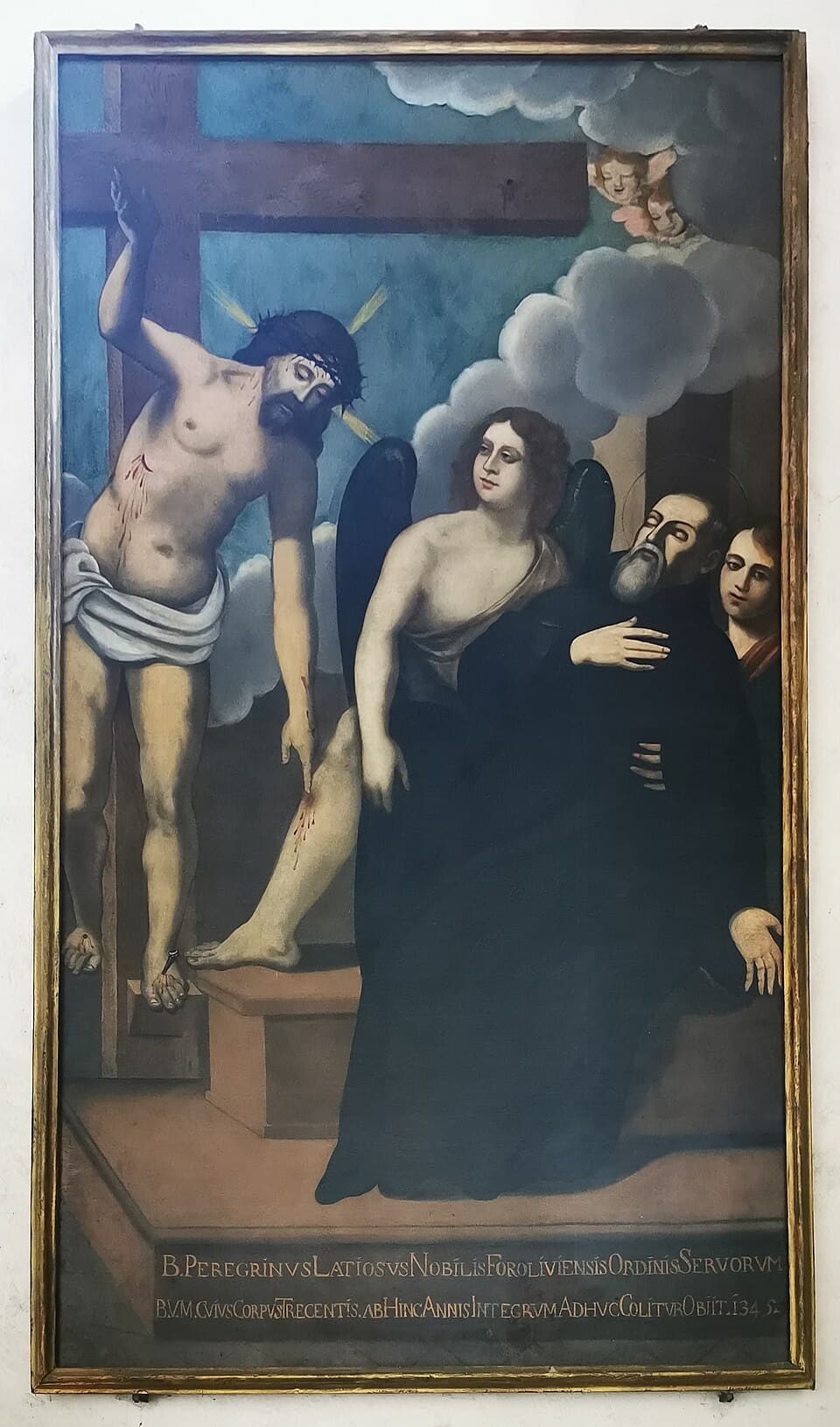
The leg got worse. A physician, Paolo Salazio, who visited him in the priory, decided, with the consent of all the friars, to amputate as soon as possible. 2 On the night before the operation, the USA Province says, Peregrine "dragged himself before the crucifix in the chapter room." There he grew drowsy "and seemed to see Jesus descend from the cross to heal his leg." 2
The accounts differ on what he saw. EWTN says that "he had a vision or dream in which Christ reached out from the crucifix and touched his leg." 6 The Grotto mentions no vision; it says he "fell into a deep trance-like sleep" at the foot of the cross and woke to find the leg "completely cured." 5 All agree on the morning. The USA Province says the doctor came to operate and "could find no sign of the cancer, or even of a wound," and was so shocked that he spread the news through the town. 2
The 1912 Catholic Encyclopedia does not tell this story at all. Its single paragraph on Peregrine says only that "his humility and patience were so great that he was called by his people a second Job." 1 Readers should know that the account of the healing comes from his own order and from EWTN, not from the encyclopedia.
Death, the body and canonization
He lived about twenty years after the healing. 23 The USA Province says he died of a fever around 1345, when he was nearly eighty, and that crowds from the town and the countryside came to honor him, and some of the sick among them were healed through his intercession. 2 The encyclopedia gives the year as 1345; EWTN gives the day as May 1. 16
His body lies in the Servite church at Forlì. 2 The encyclopedia, writing in 1912, says it "remains incorrupt to the present day." 1 EWTN says it rests in a glass reliquary and that pilgrims still come to the shrine. 6 Pope Paul V beatified him in 1609, and Pope Benedict XIII canonized him in 1726. 12
The Servites trace his patronage of the sick to the healing, which they say became known across the Western Church; after the canonization, devotion to him spread through the universal Church. 3 The Grotto puts it more directly, saying the Church canonized him "and named him patron of cancer sufferers." 5
In the United States the devotion is kept at Servite churches. The National Shrine of Saint Peregrine is at Our Lady of Sorrows Basilica in Chicago, where a Mass for the Sick, with a blessing with his relic, is celebrated on the third Saturday of each month. 4 The Grotto in Portland holds a Saint Peregrine Mass on the first Saturday of each month, with the same blessing for anyone who asks. 5
What is Saint Peregrine the patron saint of?
Saint Peregrine's feast day
The Grotto, a sanctuary run by his own order, gives his feast as May 4. 57 Patrick Griffin's 1912 article in the Catholic Encyclopedia, listing the canonized Servite saints, gives April 30. 1 EWTN dates his death to May 1, 1345, and does not give a feast day. 6 This page follows the date the Servites print today and records the older one beside it.
Praying with Saint Peregrine
Most of what people bring to Saint Peregrine is a diagnosis. His story begins somewhere else, in a street in Forlì, with a young man hitting a friar who had come to make peace. 12 The change in him started with being met by someone who would not hit back, and the encyclopedia credits it to that mildness rather than to anything Peregrine himself worked out. 1
The illness came late, after decades in the order, and the Servite account does not soften it: a leg so far gone that his brothers agreed it had to come off. 2 On the night before the operation he dragged himself to a crucifix and prayed, and the accounts disagree about what happened next even as they agree about the morning. 256
The Grotto draws its own conclusion from the story, and it is not the obvious one: "The lesson of Peregrine's life is not that God worked a miracle, but that a faithful, trustful servant placed himself, unconditionally, in the hands of our Lord." 5 That matters for anyone praying to him now, because most people who ask for his help will not wake up healed. The Servites say as much themselves: their page on his importance today acknowledges that many diseases are still incurable, and speaks of a "ministry of compassion" toward the sick rather than of cures. 3
Peregrine lived another twenty or so years after the leg was saved, and then died of a fever. 23 The encyclopedia does not mention the healing at all. What it remembers is humility, and a patience great enough that the people of Forlì called him a second Job. 1
Saint Peregrine Laziosi, pray for us.
Sources
- 1.Patrick Griffin, "Order of Servites," The Catholic Encyclopedia, Vol. 13 (New York: Robert Appleton Company, 1912).
- 2."St. Peregrine: History," Friar Servants of Mary, USA Province.
- 3."St. Peregrine: Importance Today," Friar Servants of Mary, USA Province.
- 4."National Shrine of St. Peregrine," Friar Servants of Mary, USA Province.
- 5."St. Peregrine Devotions," The National Sanctuary of Our Sorrowful Mother (The Grotto), Portland, Oregon, Order of Servants of Mary.
- 6."St. Peregrine Laziosi," Daily Saint, EWTN.
- 7."About the Servites," The National Sanctuary of Our Sorrowful Mother (The Grotto), Portland, Oregon.
Saints to turn to next
Others in this collection who are turned to for some of the same things.
- Saint Charles de FoucauldSeptember 15, 1858 - December 1, 1916ConversionPrayerSuffering and illness
- Saint Faustina KowalskaAugust 25, 1905 - October 5, 1938PrayerSuffering and illnessConversion
- Saint Joseph CafassoJanuary 15, 1811 - June 23, 1860PrayerConversionSuffering and illness
- Saint Josephine Bakhitac. 1869 - February 8, 1947Suffering and illnessConversionPrayer