Saint Job
Figure of the Book of Job; dates unknown
- Family
- Seven sons and three daughters, all killed; afterward seven sons and three daughters again 813
- Known for
- His patience under trial; his dispute with his three friends; "I know that my Redeemer liveth" 1411
- Died
- "An old man, and full of days," a hundred and forty years after his restoration, says the book 13
Job is the man of the Old Testament book that bears his name: rich, upright and God-fearing, he lost his flocks, his servants, his children and his health in quick succession, and would not curse God. 89 His friends insisted that such suffering must be the punishment of some sin; he insisted that it was not, and in the end God said that Job had spoken rightly and they had not. 413 The Roman Martyrology commemorates him on May 10 as a man of wonderful patience. 23
A man in the land of Hus
"There was a man in the land of Hus, whose name was Job, and that man was simple and upright, and fearing God, and avoiding evil." 8 So the book begins. He had seven sons and three daughters, thousands of sheep and camels, hundreds of oxen and asses, and he was "great among all the people of the east." 8 After his children's feasts he would rise early and offer a holocaust for each of them, in case they had sinned against God in their hearts. 8
Joseph Hontheim, who wrote the 1910 Catholic Encyclopedia article on the book, reads these details as placing Job long before Moses: the great age he reached, wealth counted in flocks and herds as with the patriarchs, and the father of the family offering sacrifice himself. 1 He was not an Israelite. The speakers avoid the name Yahweh and show no knowledge of Israel's own institutions, Hontheim notes, and yet "Job and his friends venerated the one true God." 1
Then the scene moves to heaven. When "the sons of God came to stand before the Lord," Satan came among them, and the Lord asked whether he had considered his servant Job. 8 "Doth Job fear God in vain?" Satan answered, and he was given leave to touch everything Job had. 8 Messengers came one on the heels of another: raiders had taken his herds, fire had fallen on his sheep, and a wind from the desert had brought down the house where his children were eating, and killed them all. 8 Job tore his garments, shaved his head, fell to the ground and worshipped: "the Lord gave, and the Lord hath taken away: as it hath pleased the Lord so is it done: blessed be the name of the Lord." 8
On the dunghill
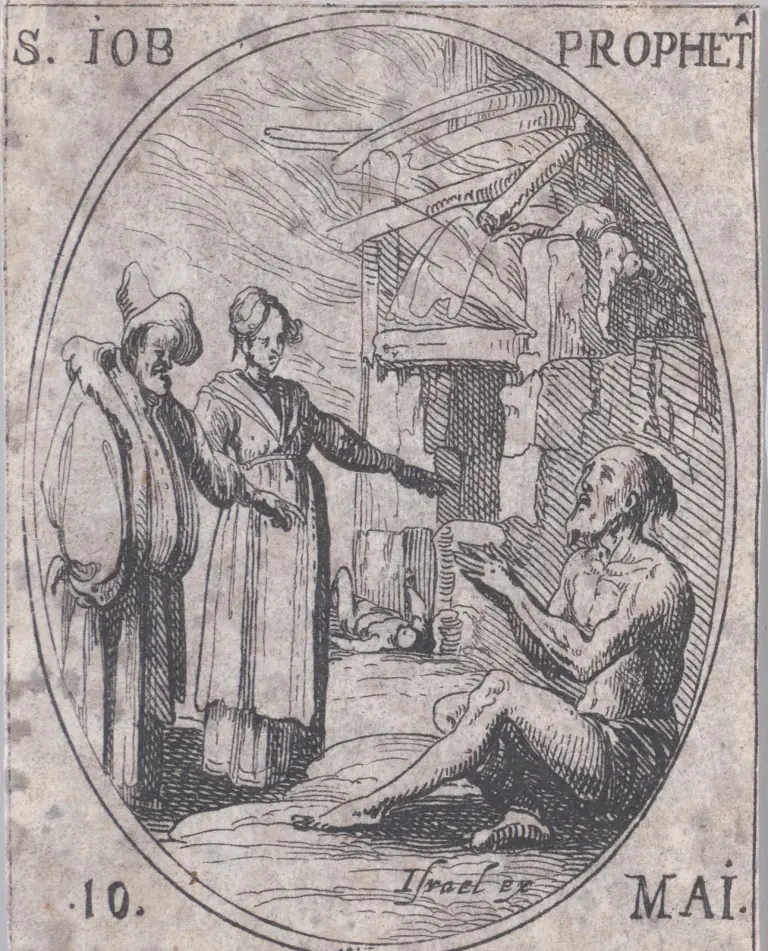
Satan asked for more, and was allowed to touch Job's body but not his life. 9 He struck him "with a very grievous ulcer, from the sole of the foot even to the top of his head," and Job sat on a dunghill scraping his sores with a potsherd. 9 His wife told him to "bless God and die." 9 The Douay note explains that the text writes "bless" where it means curse, out of horror at the very thought of blasphemy. 8 Job answered her: "if we have received good things at the hand of God, why should we not receive evil?" 9
Three friends, Eliphaz, Baldad and Sophar, came to comfort him. At first they did not recognize him; then they sat with him on the ground seven days and seven nights without a word, "for they saw that his grief was very great." 9
When Job finally spoke, it was to curse the day he was born. "Let the day perish wherein I was born." 10 The Douay note on the chapter is careful to say that he wished no evil on anything God had made, and was expressing "his sense of human miseries in general, and of his own calamities in particular." 10
Job and his friends
The long poem that follows is a debate. Hontheim sums up the friends' case: they "are fully convinced that trouble is always a result of wrongdoing," and so take Job for a great sinner and his protests of innocence for hypocrisy. 1
Job will not accept it. He knows he has not deserved what has happened, John Paul II writes in his 1984 apostolic letter on suffering, Salvifici Doloris, and so he "challenges the truth of the principle that identifies suffering with punishment for sin." 4 Hontheim does not make him a model of composure. In the course of the speeches, he says, Job "fails in reverence," speaking of God as a hard and inconsiderate ruler rather than a kind Father, and the rebukes that come later leave no doubt that he sinned. 1 He judges those lapses venial, almost the involuntary cry of a man in pain. 1 "No matter how terrible the persecutions of God might be, Job held fast to Him." 1
I know that my Redeemer liveth
In the nineteenth chapter, forsaken by his kinsmen and his servants, his breath loathsome to his own wife, Job asks that his words be cut into lead or flint with an iron pen, and then says them: "For I know that my Redeemer liveth, and in the last day I shall rise out of the earth. And I shall be clothed again with my skin, and in my flesh I will see my God." 11
Hontheim calls this the height of Job's hope, "his famous declaration of the resurrection of the body," and holds that critics' attempts to read it otherwise fail against the natural sense of the words, the argument of the book and "the opinion of all early commentators." 1 The Douay note agrees. 11 John Paul II is more measured about the words themselves, which he says "seem" to refer to Redemption, "at least in the Vulgate text." 4 But he goes further than either in what he draws from them: it is as though Job had foreseen the Passion of Christ and directed his own suffering toward it. 4
Out of the whirlwind
Before God speaks, a younger man among the listeners, Eliu, breaks in. In Hontheim's reading Eliu is filled with the spirit of prophecy and "solves the problem of suffering," teaching that it is not always the result of sin and can be a trial that purifies the just. 1
Then "the Lord answered Job out of a whirlwind." 12 He says nothing about the wager in heaven. He asks questions instead: "Where wast thou when I laid up the foundations of the earth? tell me if thou hast understanding." 12 Job's reply is short. "With the hearing of the ear, I have heard thee, but now my eye seeth thee. Therefore I reprehend myself, and do penance in dust and ashes." 13
Then the judgment turns. God tells Eliphaz that his wrath is kindled against the three friends, "because you have not spoken the thing that is right before me, as my servant Job hath," and orders them to bring a sacrifice to Job, who will pray for them. 13 The Lord accepted Job's prayer and gave him twice as much as he had before. He had seven sons and three daughters again, lived a hundred and forty years more, and "died an old man, and full of days." 13
John Paul II does not let the happy ending close the question. For him the book shows that suffering strikes the innocent, "but it does not yet give the solution to the problem"; Job's suffering "must be accepted as a mystery," and the book is "in a certain way" a foretelling of the Passion of Christ. 4 Here he and Hontheim, who credits Eliu with the solution, put the weight in different places. 14
A real man, a poem, or both?
Hontheim treats the Book of Job as a poem and asks how much of it is history. He reports that many regard it as "a freely invented parable" about a man who never lived, but that "Catholic commentators, however, almost without exception, hold Job to have actually existed." 1 Scripture seems to take it for granted: Ezekiel names him with Noe and Daniel as just men, and James writes, "You have heard of the patience of Job." 11415 His own conclusion is that the book "has a kernel of fact" with many imaginative additions. The persons, the place, the misfortunes, the patience and the restoration are in the main historical; the poetic form, the arrangement of the arguments and the rounded figures of Job's wealth belong to the author, and the scene in heaven "is plainly an allegory." 1
Vatican News, the Holy See's news service, reads the book more freely today. Its Italian calendar entry for May 10 calls the story of Job a metaphor of the sorrow of the world and a prefiguring of the suffering Christ, and its Spanish entry calls the book a midrash. 67 The two readings are given here side by side.
Gregory the Great wrote a long commentary on the book, the Moralia in Iob, reading the text in its literal, allegorical and moral senses, and Benedict XVI said that it became in the Middle Ages "a kind of summa of Christian morality." 5
What is Saint Job the patron saint of?
Saint Job's feast day
Saint Job's feast day is May 10. The current Roman Martyrology, as the Italian bishops print it, keeps on that day the commemoration of Saint Job, a man of wonderful patience in the land of Hus. 2 The 1897 English edition of the older Martyrology had him on the same day: "In the land of Hus, of holy Job, prophet, a man of wonderful patience." 3 Hontheim, writing in 1910, gives May 10 for the Latin Church and May 6 for the Greek Church. 1 The current entry, unlike the old one, does not call him a prophet. 23
Praying with Saint Job
The book does not show Job praying calmly. It shows a man who blessed God over the ruins of his house, then cursed the day he was born, then argued and protested and demanded a hearing for most of forty chapters, going too far at times, in Hontheim's judgment. 1810 At the end God still says that Job had spoken rightly and his comforters had not. 13
His friends began well, sitting with him in silence for seven days because they saw how great his grief was. 9 The trouble came when they started to explain it. John Paul II names their mistake: we must use "great caution in judging man's suffering as a consequence of concrete sins," and it is not licit to apply "the narrow criterion of direct dependance (as Job's three friends did)." 4
The last thing Job does in the story is pray for the men who had accused him, and it is when he prays for them that his fortunes turn. 13 John Paul II saw him looking further still, as though in saying "I know that my Redeemer lives" he had turned his suffering toward a Passion he could not see. 4 The book leaves the question of why the just suffer open, and the Church has read it as waiting for the Cross. 4
Saint Job, pray for us.
Sources
- 1.Joseph Hontheim, "Job," The Catholic Encyclopedia, vol. 8 (New York: Robert Appleton Company, 1910).
- 2.Roman Martyrology, entry for May 10, "San Giobbe," Santo del giorno, Conferenza Episcopale Italiana (in Italian).
- 3.The Roman Martyrology, May 10 (Baltimore: John Murphy Company, 1897).
- 4.John Paul II, Apostolic Letter Salvifici Doloris, on the Christian meaning of human suffering, February 11, 1984, sections 10-12, 14-15 and 18-19, Libreria Editrice Vaticana.
- 5.Benedict XVI, General Audience on Saint Gregory the Great (2), June 4, 2008, Libreria Editrice Vaticana.
- 6.Vatican News, "Santo del día," May 10, entry "s. Job" (in Spanish).
- 7.Vatican News, "Santo del giorno," May 10, entry "San Giobbe" (in Italian).
- 8.Job 1, Douay-Rheims Bible (Challoner revision), with notes, as hosted by drbo.org.
- 9.Job 2, Douay-Rheims Bible (Challoner revision), as hosted by drbo.org.
- 10.Job 3, Douay-Rheims Bible (Challoner revision), with notes, as hosted by drbo.org.
- 11.Job 19, Douay-Rheims Bible (Challoner revision), with notes, as hosted by drbo.org.
- 12.Job 38, Douay-Rheims Bible (Challoner revision), as hosted by drbo.org.
- 13.Job 42, Douay-Rheims Bible (Challoner revision), as hosted by drbo.org.
- 14.Ezekiel 14, Douay-Rheims Bible (Challoner revision), as hosted by drbo.org.
- 15.James 5, Douay-Rheims Bible (Challoner revision), as hosted by drbo.org.
Saints to turn to next
Others in this collection who are turned to for some of the same things.
- Saint Faustina KowalskaAugust 25, 1905 - October 5, 1938PrayerSuffering and illnessDesperate situations
- Saint Aelred of Rievaulx1109 - January 12, 1166 (or 1167)PrayerSuffering and illness
- Saint Albert of Trapanic. 1240 - August 7, 1307PrayerSuffering and illness
- Saint Aldegundc. 630 or c. 639 - 684Suffering and illnessPrayer