Saint Gummarus
c. 710 - 774 or 775
- Patronage
- None stated in the sources consulted; especially honored by woodworkers in Belgium 2
Saint Gummarus was a nobleman of Brabant who served King Pepin at court and in his wars, and who spent years married, at the king's wish, to a wife both his biographers describe as cruel to his household and impossible to live with. 12 He ended his life as a hermit in the chapel he had built near his home, and the town of Lier in Belgium grew up around it. 123 His feast is October 11. 3
A courtier who could not read
Gummarus was born at Emblehem, a village three miles from Lier in Brabant, in what is now Belgium. 1 katolsk.no puts his birth about 710 and calls him a son of the count of Brabant; Butler says that his parents were very rich and related to King Pepin. 12 Both say he never learned to read or write. 12
Pepin, then mayor of the palace and soon king of the Franks, called him to court. 1 Butler describes a man "meek, affable, exceeding compassionate," punctual in every duty and an enemy to "vanity, ambition, and dissimulation, (which is almost the soul of a court life)." 1 Pepin, "though tainted with ambition," valued his honesty and raised him to the highest offices at court. 1
A marriage arranged by the king
The king then proposed a match with a lady of high birth and fortune, whom Butler calls Gwinmary and katolsk.no Guinimaria. 12 Both consented and they were married. 1 katolsk.no says she was rich and beautiful but not of a likable nature. 2 Butler is blunter: she "was most extravagant and perverse in her humour; haughty, whimsical, and altogether ungovernable." 1
Butler spends some time on what that meant. Insults from strangers are easy to bear, he writes, but when those from whom we expect our greatest comfort "seem to have no other satisfaction but continually to wound and persecute us: this is one of the severest of trials." 1 Gummarus bore it for years, praying, fasting, and trying to bring his wife to a better mind. 1
Then Pepin took him to war, first in Lombardy, then in Saxony, and lastly in Aquitaine. 12 He was gone eight years. 1 When he came home he found his affairs in disorder and his servants and tenants mistreated; katolsk.no says she had threatened and abused the household while he was away. 12
Restitution, and a chapel at Nivesdone
His first act, in Butler's account, was to make "full restitution and satisfaction" to every servant, vassal and tenant she had wronged. 1 katolsk.no says he asked their pardon. 2 He built himself a chapel near his house, which Butler calls Nivesdone, as a place to pray; katolsk.no tells that he had once planned a pilgrimage to Rome with friends and was moved instead to build a chapel at home. 12
From here the two sources part. In Butler, his wife was shamed into a show of repentance that did not last, and her temper broke out "with greater rage than ever." 1 At length he obtained her consent to a retired life, built a cell beside his chapel, and lived there as a penitent while still looking after his wife and family, until she "became a remarkable penitent." 1 In katolsk.no, he simply left her and withdrew as a hermit; it adds that it is not clear how much weight these family troubles should be given. 2
The hermit of Lier
katolsk.no records that Gummarus became a close friend of Saint Rumold of Mechelen, settled as a hermit at Nivesdonck near Antwerp, and built a church there dedicated to Saint Peter; with Rumold he is counted as founder of the monastery that followed. 2 The Flemish town of Lier grew up around his cell. 12 Butler explains the name: the village of which he was lord was called Nivesdone, "afterward Ledo and now Lire." 1
He lived there, Butler says, nine years. 1 Butler dates his death to 774; katolsk.no to October 11, 775. 12 He was buried in his own chapel. 23 The Martyrology remembers him simply: near Lier, a soldier devoted to God, who built an oratory there with his own goods and was afterward laid in it. 3
His cult in Brabant
He became known as a wonderworker and his cult spread through the Low Countries. 2 By the eleventh century a college of canons kept his tomb and claimed him as its founder, and pilgrim banners with scenes from his life were in wide use by the fifteenth century. 2 Butler records that the relics were visited by the bishop's order in 1369 and 1406, that the shrine was plundered by Calvinists, and that the relics were saved by Catholics and kept in the collegiate church at Lier. 1
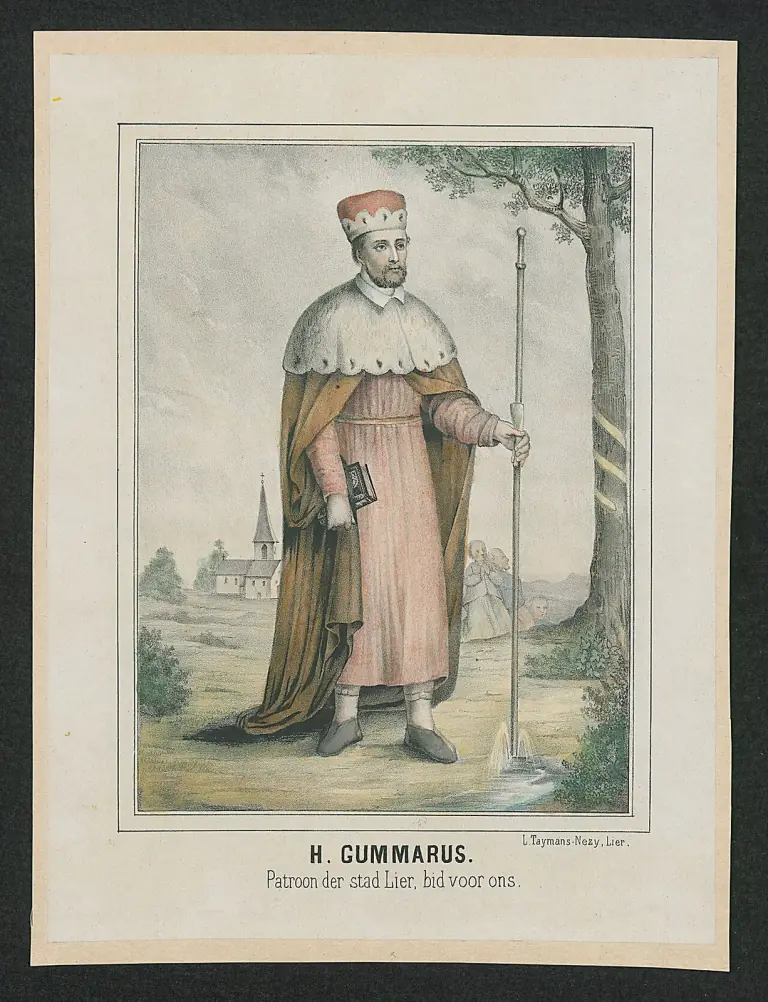
katolsk.no tells a legend that explains why Belgian woodworkers honor him. Gummarus once cut down a tree, and its owner meant to bring him to court; he prayed all night, and the next day the tree was standing again. 2 It also notes that the pictures of him say nothing of his marriage: early images show a knight, later ones a lord in an ermine stole and a Merovingian hat, with a pilgrim's staff from whose point a healing spring rises. 2
One Norwegian connection is kept at Lier. The last Catholic archbishop of Nidaros, Olav Engelbrektsson, died in exile there in 1538 and was buried before the high altar of the church of Saint Gummarus. 2
What is Saint Gummarus the patron saint of?
Saint Gummarus's feast day
Praying with Saint Gummarus
The hard part of this life is a marriage. Gummarus did not choose his wife; a king chose her for him, and by every account the home that followed was a misery for him and for everyone who worked in it. 12 The two sources do not even agree on how it ended, whether in a long patience that finally changed her or in his leaving. 12
What they agree on is what he did when he came home and saw the damage: he went to the people she had wronged and made it right with them. 12 Butler calls this heroic virtue. 1 It is also simply justice, done by the person who had the power to do it.
He ended his days in a chapel he had built near home, praying in one place, and a town grew up around it. 12
Saint Gummarus, pray for us.
Sources
- 1.Alban Butler, "St. Gummar, C., Called by the French Gomer," October 11, in The Lives of the Fathers, Martyrs, and Other Principal Saints, Vol. X (Derby: Richardson and Son, 1842).
- 2.Per Einar Odden, "Den hellige Gummarus av Lier," Den katolske kirke (katolsk.no), Oslo Catholic Diocese (in Norwegian).
- 3.Roman Martyrology, entries for October 11, Santo del giorno, Conferenza Episcopale Italiana (in Italian).
Saints to turn to next
Others in this collection who are turned to for some of the same things.
- Saint Bridget of Swedenc. 1303 - July 23, 1373Marriage and familySuffering and illness
- Saint Clotildec. 474 - June 3, 545Marriage and familySuffering and illness
- Saint Edward the Martyrc. 962 - March 18, 978 or 979Marriage and familySuffering and illness
- Saint Elizabeth of Portugal1271 - July 4, 1336Marriage and familySuffering and illness