Saint Gregory of Utrecht
c. 707 - c. 776
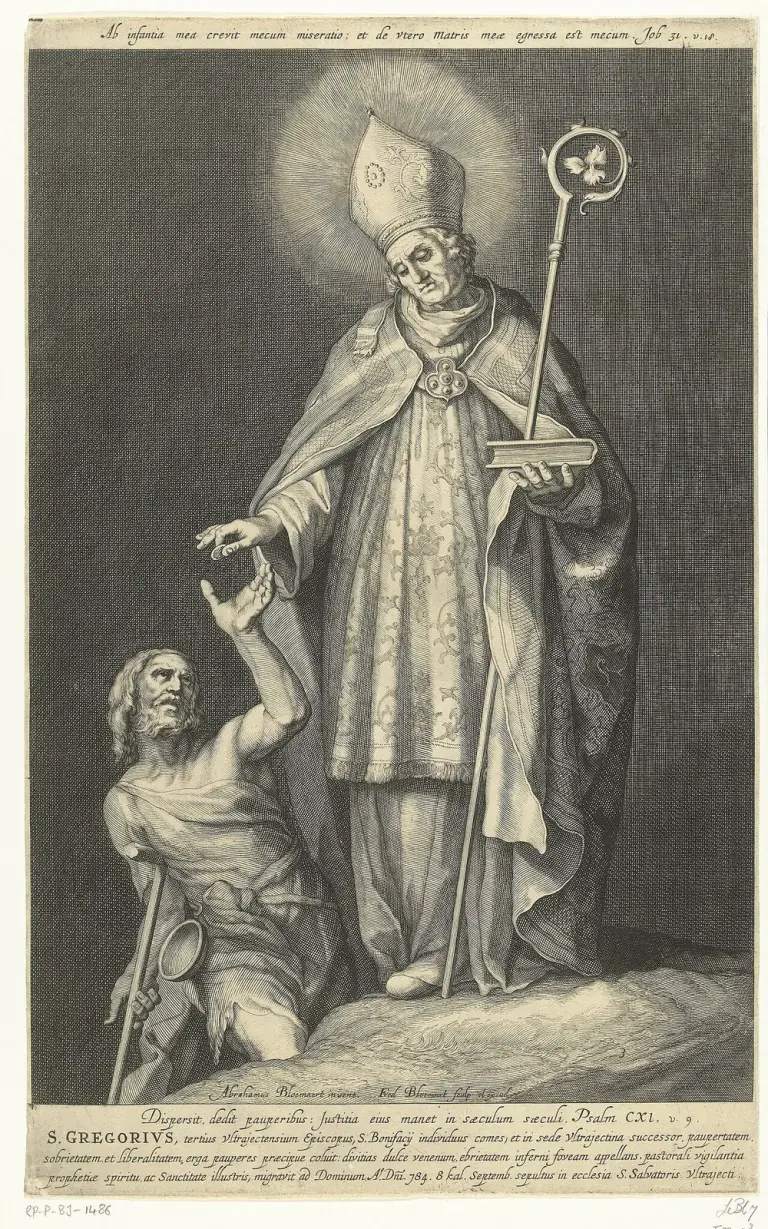
- Office
- Abbot of Saint Martin's at Utrecht and administrator of the diocese; a priest, never consecrated bishop 123
Saint Gregory of Utrecht was a teenager from a noble family near Trier when Saint Boniface stopped at his grandmother's convent in 722 and spoke at table about the apostolic life; Gregory announced that he was going with him, and nothing could change his mind. 12 After Boniface's martyrdom he governed the Church of Utrecht for more than twenty years as abbot of Saint Martin's, without ever being made a bishop, and turned its school into a seminary for missionaries. 12 His feast is August 25. 3
A family near Trier
Gregory was born about 707 or 708 of a noble family at Trier. 1 His grandmother, a widow, became abbess of the convent of Pfalzel near the city, and he received his early education there. 1
Who that grandmother was is disputed. Butler, writing in the eighteenth century, calls Gregory "a prince of royal blood," because his grandmother Adela was a daughter of Dagobert II, king of Austrasia, and he names her sister Irmina as abbess of another house. 2 The Catholic Encyclopedia says that his grandmother was in fact Addula, and that she has been confused with Adela, daughter of Dagobert II, because of the likeness of the names and "in consequence of a forged last will," which falsely made Gregory a Merovingian. 1
The reading at Pfalzel
In 722 Saint Boniface, traveling from Frisia toward Hesse and Thuringia, stopped at the convent and rested there. 12 Gregory, by Butler's account fifteen years old and just back from school, was asked by the abbess to read the Scriptures aloud to the nuns at the meal. 2
Butler tells what followed. When the reading was over, the abbess asked the boy to explain it for those who did not understand Latin, and he said he could not, probably, Butler thinks, because he did not know the Germanic language well enough. Boniface got up and did it for him, adding his own exhortations. 2 The Catholic Encyclopedia says that Boniface "dwelt upon the merits of an apostolic life," and that the heart of Gregory "was filled with enthusiasm." 1
He announced that he was going with Boniface, "and nothing could move him from his resolution." 1 Butler says his family does not seem to have opposed it, and that Boniface took him along, made himself the boy's teacher, and placed him for a time at the monastery of Ohrdruf to finish his studies. 2
With Boniface
From then on Gregory was the disciple, and in time the helper, of the apostle of Germany. The Catholic Encyclopedia says he shared Boniface's hardships and labors, went with him on all his missionary journeys, and learned from him "the secret of sanctity." 1 Butler says Boniface made him his constant companion and "always loved him as his son." 2
In 738 Boniface made his third journey to Rome, and Gregory went with him and brought back many valuable additions for his library. 1 Butler mentions the journeys to Rome among the travels on which Gregory accompanied his master. 2
Utrecht
About 750 Gregory was made abbot of Saint Martin's at Utrecht. 1 Butler says that Boniface sent him there, a little before his own martyrdom, to govern a monastery recently founded in the city. 2 Utrecht had been without a bishop since the death of Saint Willibrord in 744; Boniface had taken charge of it and appointed an administrator, Eoban. 1
In 754 Boniface set out on his last mission to the Frisians and took Eoban with him, and both were killed. 12 After that, Pope Stephen and King Pepin ordered Gregory to take care of the Church of Utrecht. 12 He did so to the end of his life, for twenty-two years by Butler's count, and never received episcopal consecration; he remained a priest. 2 Several chroniclers and historians called him bishop, Butler notes, but Mabillon and the Bollandists showed from Liudger's Life that he never was. 2 The Catholic Encyclopedia adds that some, "even the Mart. Rom.," call him bishop for this reason. 1
His abbey school became what the Catholic Encyclopedia calls "a kind of missionary seminary" and a center of piety and learning. Students came from every side: Franks, Frisians, Saxons, Bavarians, Swabians, and even from England, which had splendid schools of its own. 1 The best known of them was Saint Liudger, later the first bishop of Münster, who wrote Gregory's Life. 12 By his preaching and care, Butler says, Gregory made the Church of Utrecht "the most flourishing in all that country." 2
The men who killed his brothers
Butler tells one story from Liudger. Two of Gregory's brothers were murdered, and the civil magistrates, following the custom of the time, which left the punishment of killers to the family of the dead, sent the murderers to him to be put to whatever death he chose. 2 Gregory gave each of them a suit of clothes and an alms, and sent them away with good advice. 2
Liudger, as the Catholic Encyclopedia summarizes him, praised Gregory's contempt of riches, his sobriety, "his forgiving spirit and his almsdeeds." 1 Butler adds his spirit of mortification and prayer and his "invincible meekness and silence under all injuries." 2
Illness and death
About three years before his death a paralysis struck his left side and spread gradually through his whole body. 1 Butler speaks of his humility and patience under "three years severe sickness." 2 When he knew the end was near, he had himself carried into the church, and there he died. 1
The sources do not agree on the year. The Catholic Encyclopedia gives 775 or 780. 1 Butler says he died on August 26, 776. 2
His relics were kept at Utrecht and examined at episcopal visitations in 1421 and 1597. 12 A large part of his head is in the church of Saint Amelberga at Susteren, where the Bishop of Roermond made an official recognition on September 25, 1885. 1 A letter written to him by Saint Lullus, bishop of Mainz and another of Boniface's disciples, survives. 1
What is Saint Gregory of Utrecht the patron saint of?
Saint Gregory of Utrecht's feast day
Saint Gregory of Utrecht's feast day is August 25. The current Roman Martyrology enters him on that day as an abbot who as a youth followed Saint Boniface in his mission to Hesse and Thuringia, and at his command ruled the monastery of Saint Martin and governed the Church of Utrecht. 3 The 1897 English edition of the Martyrology also has him on August 25, as "St. Gregory, bishop." 4 Butler places him on August 25 as well, though he gives the 26th as the day of his death. 2
Praying with Saint Gregory of Utrecht
His vocation began with a reading he could not explain. A boy was asked to put the Scriptures into the language of the people listening, could not, and watched a stranger do it. 2 He left with the stranger. 12
He spent the rest of his life doing what he had seen done at that table: teaching, and training others to teach, in a school that drew students from many peoples. 1 He held the Church of Utrecht for twenty years without the title that went with it. 2
When the men who had killed his brothers were handed to him, he clothed them, gave them money and let them go. 2 Liudger, who knew him, counted that forgiving spirit among his virtues. 1
Saint Gregory of Utrecht, pray for us.
Sources
- 1."St. Gregory of Utrecht," The Catholic Encyclopedia (New York: Robert Appleton Company, 1907-1912), as published by Catholic Answers.
- 2.Alban Butler, "St. Gregory, A. C.," August 25, in The Lives of the Fathers, Martyrs, and Other Principal Saints, Vol. VIII (Dublin, 1866).
- 3.Roman Martyrology, entries for August 25, Santo del giorno, Conferenza Episcopale Italiana (in Italian).
- 4.The Roman Martyrology, August 25 (Baltimore: John Murphy & Co., 1897).
Saints to turn to next
Others in this collection who are turned to for some of the same things.
- Saint Aelred of Rievaulx1109 - January 12, 1166 (or 1167)Work and vocationStudy and teaching
- Saint Albert the Greatc. 1206 - November 15, 1280Study and teachingWork and vocation
- Saint Alexander Sauli1533 or 1534 - October 11, 1592Work and vocationStudy and teaching
- Saint Angela MericiMarch 21, 1474 - January 27, 1540Study and teachingWork and vocation