Saint Gregory of Nyssa
c. 335 - after 385
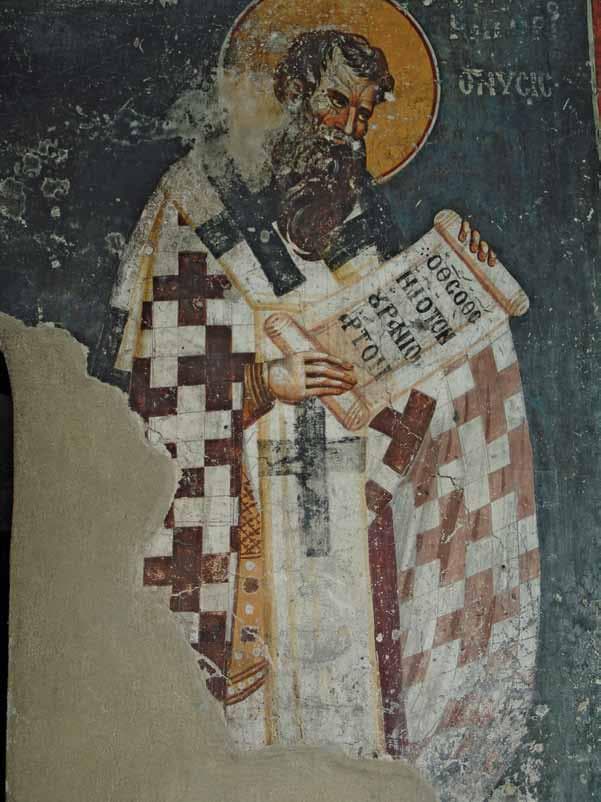
- Feast day
- January 10 2
- Born
- Cappadocia. Leclercq: "Date of birth unknown." The usual estimate is about 335 1
- Died
- Leclercq says after 385 or 386; the date commonly given elsewhere is 395 1
- His family
- Two brothers became bishops, his sister Macrina is a saint, and his mother was a martyr's daughter 12
- Married
- To Theosebeia, identified from a letter of condolence 1
Saint Gregory of Nyssa came from the most extraordinary family in Christian history: his mother was a martyr's daughter, his sister Macrina is a saint, and two of his brothers became bishops - one of them Basil the Great, who raised him, pushed him into a bishopric he did not want, and then complained in letters about how he was doing the job. 12 Gregory outlived Basil and only afterward became the theologian he is now read as. 2
The family
Leclercq begins by admitting the gaps: "Date of birth unknown; died after 385 or 386." 1 What he has instead of dates is a household.
"Gregory was born of a deeply religious family, not very rich in worldly goods, to which circumstances he probably owed the pious training of his youth." 1 His mother Emmelia "was a martyr's daughter." 1 Franciscan Media calls him "the son of two saints, Basil and Emmilia." 2
The siblings are the remarkable part. "Two of his brothers, Basil of Caesarea and Peter of Sebaste, became bishops like himself; his eldest sister, Macrina, became a model of piety and is honoured as a saint. Another brother, Naucratius, a lawyer, inclined to a life of asceticism, but died too young to realize his desires." 1 Franciscan Media says he was raised by Basil and Macrina. 2
Gregory's own testimony about his eldest brother survives in a letter to his younger one. He calls Basil "our father and our master", and Leclercq reads from it that Basil was old enough to have supervised the education of the younger boys. 1 Basil's teaching "was an antidote to the lessons of the pagan schools", which Gregory also attended. 1
The brother who would not do as he was told
The family wanted him in the Church and he had other plans. Leclercq tells it with visible amusement: "His family, it would seem, had endeavoured to turn his thoughts towards the Church, for when the young man chose a secular career and began the study of rhetoric, Basil remonstrated with him long and earnestly; when he had failed he called on Gregory's friends to influence him against that objectionable secular calling. It was all in vain." 1
Basil the Great lobbied his brother's friends to talk him out of a teaching career, and it did not work. Franciscan Media records what he became: "a professor of rhetoric." 2
"Moreover, it would seem that the young man married." 1 Leclercq identifies her from a letter of condolence sent to Gregory by Gregory of Nazianzus on the death of "one Theosebeia, who must have been his wife, and with whom he continued to live, as with a sister, even after he became bishop." 1 Franciscan Media notes the same, with the useful reminder that this was "at a time when celibacy was not a matter of law for priests." 2
He was eventually persuaded "to devote his learning and efforts to the Church", studied, and was ordained. 2
Made a bishop, more or less against his will
Nyssa was, in Leclercq's description, "a little town on the banks of the Halys, along the road between Caesarea and Ancyra." 1 Basil consecrated his own brother to it, about 371; Franciscan Media dates the election to 372. 12
"St. Basil tells us that it was necessary to overcome his brother's repugnance, before he accepted the office of bishop." 1 Leclercq then refuses to be moved by that, in one of the driest passages in the whole encyclopedia: "in the fourth century, and even later, it was not uncommon to express dislike of the episcopal honour, and to fly from the prospect of election. The fugitives, however, were usually discovered and brought back, and the consecration took place when a show of resistance had saved the candidate's humility. Whether it was so in Gregory's case, or whether he really did feel his own unfitness, we do not know." 1
What followed is the detail that makes both brothers human. "St. Basil seems to have regretted at times the constraint thus put on his brother, now removed from his influence; in his letters he complains of Gregory's naive and clumsy interference with his (Basil's) business." 1 Basil pushed him into the job and then found him a nuisance in it.
The Arian controversy caught up with him. Franciscan Media: it was "a period of great tension over the Arian heresy, which denied the divinity of Christ", and Gregory was "briefly arrested after being falsely accused of embezzling Church funds." 2 A doctrinal fight prosecuted as a financial scandal. He "was restored to his see in 378, an act met with great joy by his people." 2
After Basil
Basil died, and Franciscan Media is blunt about the effect: "It was after the death of his beloved brother Basil, that Gregory really came into his own." 2
He "wrote with great effectiveness against Arianism and other questionable doctrines, gaining a reputation as a defender of orthodoxy. He was sent on missions to counter other heresies and held a position of prominence at the Council of Constantinople." 2 That is the council of 381, which produced the creed most Christians still recite on Sundays.
Then a long decline that had nothing to do with him. "His fine reputation stayed with him for the remainder of his life, but over the centuries it gradually declined as the authorship of his writings became less and less certain." 2 Works were attributed to him that were not his, doubt spread to the ones that were, and a great theologian quietly faded.
"But, thanks to the work of scholars in the 20th century, his stature is once again appreciated. Indeed, Saint Gregory of Nyssa is seen not simply as a pillar of orthodoxy but as one of the great contributors to the mystical tradition in Christian spirituality and to monasticism itself." 2
Sixteen hundred years after he died, editors sorting manuscripts gave him back.
What is Saint Gregory of Nyssa the patron saint of?
Neither Leclercq nor Franciscan Media assigns Saint Gregory of Nyssa a patronage. 12 He is invoked in practice by theologians and by students of the spiritual life, on the strength of what Franciscan Media calls his contribution "to the mystical tradition in Christian spirituality and to monasticism itself." 2
He also has an unofficial claim on younger siblings, on people who took the secular career their family disapproved of, and on anyone whose best work came after the death of the person they had spent their life being compared to. 12
Saint Gregory of Nyssa's feast day
The feast of Saint Gregory of Nyssa is January 10. 2 He is kept near his brother Basil, whose memorial falls on January 2 in the Roman calendar, and near Gregory of Nazianzus, who shares Basil's day - the three of them known together as the Cappadocian Fathers. 1
The year of his death is genuinely unsettled. Leclercq will say only "after 385 or 386"; the date usually given now is 395. 1 The difference is a decade, and a reader will find both in print. Leclercq's caution is the older and more careful of the two, and his birth date is simply "unknown." 1
He should not be confused with Gregory of Nazianzus, his friend and fellow Cappadocian, nor with Gregory the Great, the pope, who lived two centuries later.
Praying with Saint Gregory of Nyssa
The thing to notice first is that a household produced four saints and one promising brother who died young, and that they did not get along smoothly. 1 Basil lobbied Gregory's friends behind his back to stop him teaching rhetoric; Gregory taught rhetoric anyway; Basil made him a bishop and then complained in writing about his clumsiness. 1 Families of remarkable people are still families.
His life also refuses the tidy story that a vocation arrives early and is obeyed. Gregory took the career his family did not want, married, was ordained later, and was pushed into a bishopric he may or may not have wanted at around forty. 12 Nothing about that sequence is exemplary in the usual sense, and it produced one of the finest theologians the Church has had.
The false accusation deserves a moment. He was arrested on a charge of embezzlement that was really about Arianism, and it took years to get his see back. 2 Doctrinal fights are frequently prosecuted as something else, and the something else is usually money or conduct. Being innocent does not make the charge go away quickly.
And then the long twilight and the recovery. For centuries he was neglected because scholars could not tell which books were his; in the twentieth century they worked it out and he came back. 2 There is something bracing in that for anyone whose work is currently unread. Gregory did not know, when he died, that he would be forgotten for a thousand years, or that he would stop being forgotten. He wrote it anyway.
Saint Gregory of Nyssa, pray for us.
Sources
Saints to turn to next
Others in this collection who are turned to for some of the same things.