Saint Gregory III
Died 741
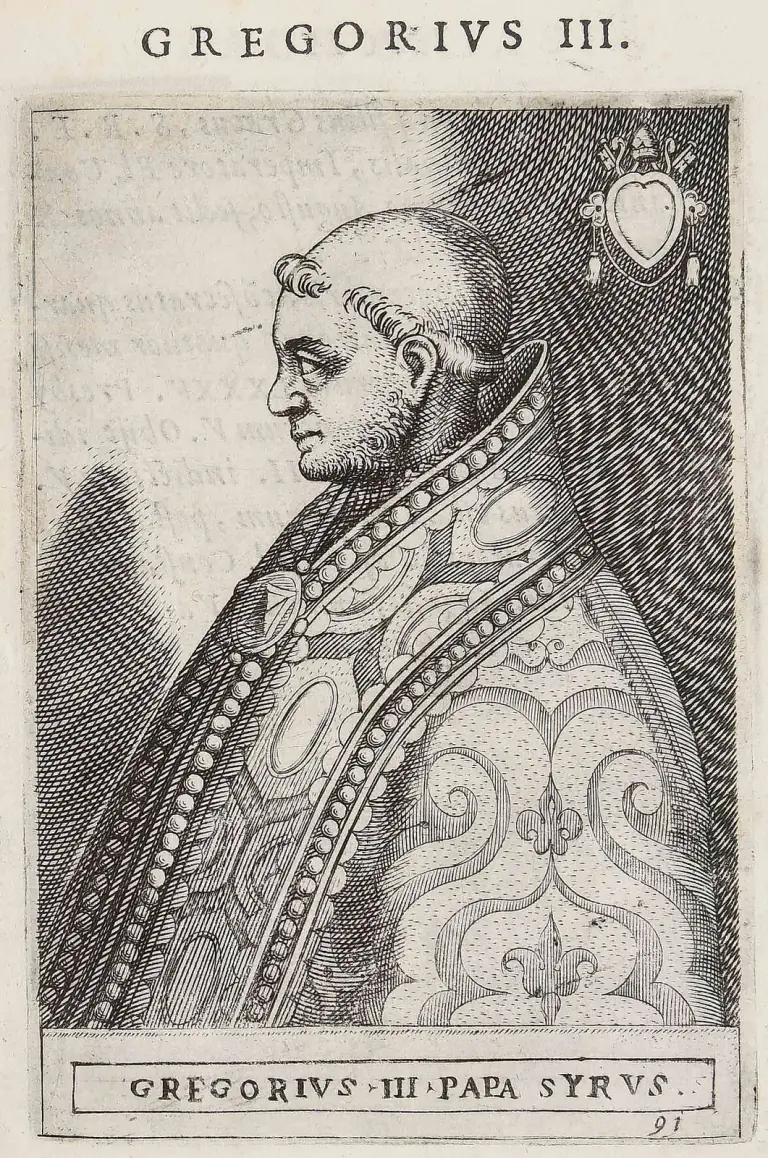
- Before his election
- A priest of the Roman Church, at San Crisogono by katolsk.no's account 2
Saint Gregory III was a Syrian priest of the Roman Church whom the people of Rome carried off and made pope in the middle of his predecessor's funeral, on February 11, 731. 17 That November he gathered ninety-three bishops at the tomb of Saint Peter and excommunicated anyone who destroyed or dishonored the images of Christ, his Mother and the saints. 57 The Roman Martyrology now keeps him on December 10; the older Martyrology had November 28. 13
Elected at a funeral
Gregory was the son of a Syrian named John, and nothing is recorded of the year he was born. 17 katolsk.no says he was a priest of the Roman Church at the church of San Crisogono and that nothing else is known of his earlier life. 2
When Gregory II was buried on February 11, 731, Gregory was among those walking in the procession. 12 The crowd and the clergy seized him there, took him to the Lateran and acclaimed him pope. 2 Horace Mann, in the Catholic Encyclopedia, puts it down to "his reputation for learning and virtue." 1 He was not consecrated until March 18, more than five weeks later. Mann presumes he was waiting for the exarch at Ravenna to confirm the election, and katolsk.no adds that he was the last pope to ask for that confirmation. 12
The Liber Pontificalis, the ancient lives of the popes, gives him a portrait that Mann's fuller history translates: "a man of the greatest meekness and one truly wise," who knew the Scriptures and all the Psalms by heart, preached well in Latin and Greek, loved poverty and the poor, protected widows and orphans, and was a friend of monks and nuns. 7 Mann notes, with some honesty, that the description is almost word for word the one the same book gives of Pope Leo II. 7
The synod of 731
Gregory came to the papacy in the middle of the quarrel his predecessor had fought with the Emperor Leo III, who had forbidden the veneration of holy images. 15 He wrote to the emperor at once and gave the letters to a priest named George. George reached Constantinople, lost his nerve, and came home with the letters undelivered. 25 Gregory wanted him deprived of his priesthood. A council talked him down to a penance, and George was sent again, only to be arrested by imperial officials in Sicily. 27
Then Gregory called the bishops. By Mann's account in his fuller history, ninety-three of them met at the confession of Saint Peter on November 1, 731, with the Roman clergy, the nobility and the people present. 7 katolsk.no counts two synods, George's case at the first and the ninety-three bishops at the second. 2 The decree, as Mann translates it, laid down that anyone who should "take away, destroy, or dishonour the images of Our Lord God and Saviour Jesus Christ, of His Mother, the immaculate and glorious Virgin Mary, or of the Saints" was to be "excluded from the body and blood of Our Lord and the unity of the Church." 7 katolsk.no observes that the emperor and his patriarch were included without being named. 2
A legate named Constantine carried the decree east and was also stopped and imprisoned in Sicily. 57 Leo sent a fleet against Italy, and it was wrecked by a storm in the Adriatic. 257 He then seized the Roman Church's estates in Calabria and Sicily and moved the churches of southern Italy, Sicily and Illyricum out of the pope's jurisdiction and into the patriarch of Constantinople's. 12 katolsk.no notes that the patriarchs kept hold of those provinces long afterward. 2
Honoring the images
Gregory's answer to the emperor was to fill the churches of Rome with images. Mann says he made a point of "paying special honour to images and relics," as a practical protest. 1 In Saint Peter's he built an oratory to the Savior and to Mary for the relics of the saints, and ordered special prayers to be said there. 127 Fragments of the marble inscriptions recording them, Mann wrote in 1909, could still be seen in the crypts of the Vatican. 1
The exarch Eutychius gave him six columns of onyx. Gregory set them before the confession of Saint Peter and placed images of Christ, Our Lady and the saints between them, under a beam plated with silver and hung with silver lamps. 27 Mann, following an Italian historian, reads the arrangement as a deliberate answer to the iconoclasts, a screen of images like those in the Greek churches. 7 The Martyrology remembers him for exactly this: against the iconoclasts he adorned the churches of Rome with sacred images. 3
For all the emperor did, Gregory did not break with the empire. katolsk.no says he helped Eutychius recover Ravenna from the Lombards in 733, though Mann, writing on Gregory II, thought it uncertain which of the two Gregorys did so. 12
Boniface, archbishop
Saint Boniface, sent to Germany by Gregory II, asked the new pope for the same support. 1 He received it. Benedict XVI, in his catechesis on Boniface, says Gregory III made him archbishop over the German peoples, sent him the pallium and gave him the faculties to organize the hierarchy there. 6 katolsk.no dates the appointment to 732. 2
About 737 Boniface came to Rome for the third time, Mann says to enjoy the pope's "life-giving conversation." 1 He stayed more than a year. 27 Gregory sent him back as legate of the Apostolic See to organize the Church in Bavaria, Alemannia, Hesse and Thuringia, with letters asking bishops and nobles to support him, and he sent Boniface's cousin, the monk Willibald, to help him. 12
Gregory looked after the English Church as well. He sent the pallium to Egbert of York, completing the plan of Gregory the Great for two English provinces, and gave it in turn to Tatwine and Nothelm of Canterbury. 12 katolsk.no adds that he made Tatwine his vicar for all England. 2
Calling on the Franks
The last years were troubled by Liutprand, king of the Lombards. Gregory finished rebuilding the walls of Rome, at his own expense by Mann's account, and bought back the stronghold of Gallese on the road to Ravenna from Transamund, duke of Spoleto. 17 In 739 Liutprand marched south, took Spoleto, and seized four towns of the Roman duchy. Transamund fled to Rome, and Gregory took him in. 127
With no help to be had from Constantinople, Gregory turned to Charles Martel, who ruled the Franks in all but name. 2 In 739 and 740 he sent embassies with gifts, relics and, by Mann's account, the keys of the confession of Saint Peter. 27 "Our affliction moves us to write to you once again," one letter begins, in Mann's translation, begging Charles to "come and defend the Church of God." 7 Charles received the envoys courteously and did not come; Liutprand had helped him against the Arabs in Provence only a short time before. 2
Gregory kept trying. In October 740, ill, he wrote to the bishops of Lombard Tuscany asking them to go with his envoys to the king. "Weak as I am from illness," he wrote, if they would not go, "I will undertake the journey myself." 7 Liutprand did not give the towns back. 17
What is Saint Gregory III the patron saint of?
Saint Gregory III's feast day
Saint Gregory III's feast day is December 10 in the current Roman Martyrology, which remembers him at Saint Peter's as the pope who worked for the preaching of the Gospel to the Germans and adorned the churches of Rome with sacred images against the iconoclasts. 3 Vatican News lists him on that day. 4
The older date is November 28. Mann's 1909 article says it is "on 28 November that he is commemorated in the Roman martyrology," and katolsk.no still gives November 28 as his day. 12 Mann adds that it is not certain whether he died in November or December of 741. 1 His fuller history says he was buried in Saint Peter's on December 10, 741, while the historian Jaffé gives November 29. 7 katolsk.no says his cult first appears in the ninth-century martyrology of Ado. 2
Praying with Saint Gregory III
Gregory was elected in a funeral procession and died ten years later with a Lombard army in the Roman countryside and no answer from the Franks. 17 Mann, in his fuller history, says he died with the din of battle still in his ears. 7 Almost nothing he asked of the powerful was granted.
Within those years he kept doing the things a bishop does. He sent the decree of a council by one messenger after another, though each was stopped in Sicily. 57 He built an oratory for the relics of the saints and had prayers said in it. 1 He gave Boniface the pallium, and had him in Rome for more than a year when the aging missionary came for the pope's "life-giving conversation." 167
His biographer says he knew the Psalms by heart. 7 The letter he wrote in 740 to the bishops of Tuscany shows a sick man who had run out of envoys offering to make the journey himself. 7 He was buried among the relics he had gathered, in the oratory he had built in honor of Mary. 12
Saint Gregory III, pray for us.
Sources
- 1.Horace Mann, "Pope St. Gregory III," The Catholic Encyclopedia, vol. 6 (New York: Robert Appleton Company, 1909).
- 2."Den hellige pave Gregor III," compiled by Per Einar Odden, Helgener, salige og andre, katolsk.no, the Catholic Church in Norway (in Norwegian).
- 3.Roman Martyrology, entry for December 10, "San Gregorio III, papa," Santo del giorno, Conferenza Episcopale Italiana (in Italian).
- 4."Saint Gregory III, Pope," Saints of the day, December 10, Vatican News.
- 5.Adrian Fortescue, "Iconoclasm," The Catholic Encyclopedia, vol. 7 (New York: Robert Appleton Company, 1910).
- 6.Benedict XVI, General Audience on Saint Boniface, March 11, 2009, The Holy See.
- 7.Horace K. Mann, The Lives of the Popes in the Early Middle Ages, vol. 1, part 2 (London: Kegan Paul, Trench, Trübner, 1902), "Gregory III," as digitized on the Internet Archive.
Saints to turn to next
Others in this collection who are turned to for some of the same things.