Saints Gorgonius, Dorotheus and Peter
d. 303 or 304
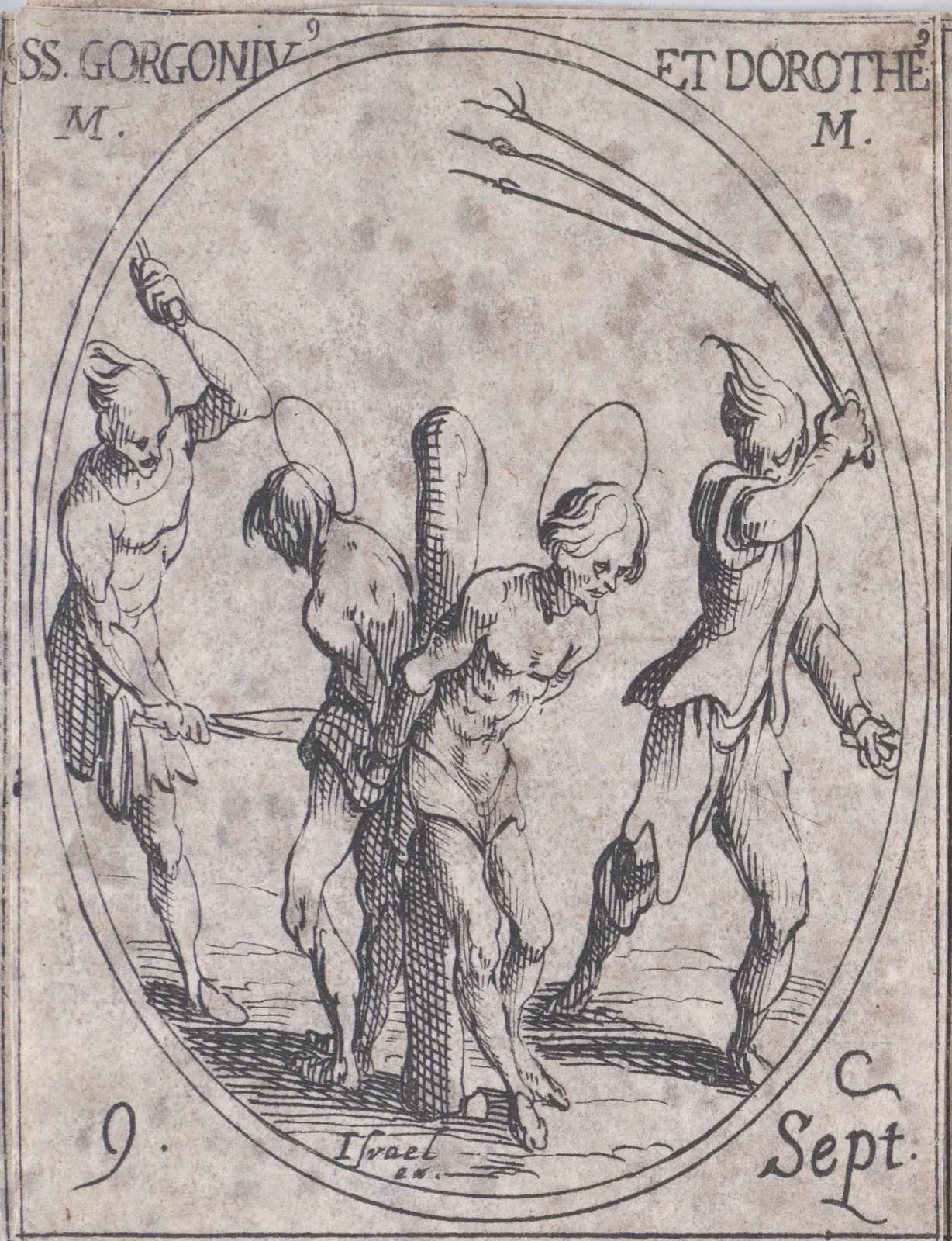
- Offices
- Peter, the emperor's chamberlain; Dorotheus, in charge of the imperial bedchamber; Gorgonius, a high official of the palace 34
Saints Gorgonius, Dorotheus and Peter served in the household of the emperor Diocletian at Nicomedia, close enough to him that Peter was his chamberlain and Dorotheus had charge of his bedchamber. 34 When the last great persecution began, they were among its first victims: Peter died over a fire, and Dorotheus and Gorgonius were strangled. 12 Eusebius of Caesarea, who lived through those years, says their praises were sung "whether among Greeks or barbarians." 1
Christians at the emperor's court
Nicomedia in Bithynia, the modern Izmit in Turkey, was one of the favorite residences of the emperors, and at the end of the third century it was Diocletian's. 3 katolsk.no gives the three men their offices: Peter was the emperor's chamberlain, his cubicularius; Dorotheus was in charge of the imperial bedchamber; and Gorgonius was another high official of the palace. 3 The Martyrology says the same of all three, that they were set over the emperor's rooms. 4
Eusebius describes the years before the persecution as a time when rulers let their wives, children and servants "speak openly before them for the Divine word and life." 1 He names Dorotheus as one of these, "the most devoted and faithful to them of all, and on this account especially honored by them among those who held the most honorable offices and governments," and adds: "With him was the celebrated Gorgonius." 1 J. F. X. Murphy, in the 1909 Catholic Encyclopedia, says Gorgonius "had often been entrusted with matters of the greatest importance." 2
Later, describing their deaths, Eusebius says the palace servants "received the highest honors from their masters, and were treated by them as their own children." 1 It is worth remembering when reading what happened to them.
The edict and the fire
Eusebius dates the first edict to the nineteenth year of Diocletian, in March, "when the feast of the Saviour's passion was near at hand": churches were to be "leveled to the ground," the Scriptures burned, and household servants who "persisted in the profession of Christianity" stripped of their freedom. 1 katolsk.no gives the year as 303. 3
Lactantius says the trouble inside the palace had started earlier. Christians among Diocletian's attendants had made "the immortal sign" on their foreheads while he was sacrificing, the omens failed, and the emperor ordered everyone who lived in the palace to sacrifice or be scourged. 6 Then part of the palace burned. Lactantius blames agents of Galerius Caesar, Diocletian's junior colleague, and says the rumor went round that the Christians, "in concert with the eunuchs, had plotted to destroy the princes." 6 Eusebius, writing of the same fire, says only that it broke out "I know not how" and was laid to the Christians "through a false suspicion." 1 katolsk.no thinks it was almost certainly a badly snuffed lamp or a spark from the kitchen. 3
Whatever started it, the result was the same. Lactantius says Diocletian "commanded that all his own domestics should be tortured," sat on his tribunal to watch, and afterward turned on the whole court: "Eunuchs, once the most powerful, and who had chief authority at court and with the emperor, were slain." 6 He names none of them. Murphy treats Lactantius and Eusebius together as the chief sources for these martyrs. 2
Peter
Eusebius tells one death in full and asks his readers to infer the rest from it. 1 A man of the palace was brought before the rulers and ordered to sacrifice. When he refused, he was hung up and beaten until his bones showed, salt and vinegar were poured into the wounds, and he was then roasted on a gridiron a little at a time, so that he would not die before he gave way. 1 He did not give way. "Such was the martyrdom of one of the servants of the palace, who was indeed well worthy of his name, for he was called Peter." 1
The Martyrology adds the reason he was singled out: Peter had complained, without fear, about the tortures being inflicted on the martyrs, and Diocletian himself ordered him taken to a public place and punished. 4 katolsk.no tells it as a test. The emperor learned there were Christians in his household and had images of the gods set out for everyone to sacrifice to, and Peter was the first to suffer for refusing. 3
Dorotheus and Gorgonius
In katolsk.no's telling, Dorotheus and Gorgonius protested to the emperor as Peter was being tortured. Peter's faith, they said, was theirs as well, and having served the emperor until now, from now on they would serve the God who made them. 3 The Martyrology says the same more briefly: they protested and were given the same punishments. 4
Eusebius passes over their sufferings "for the sake of brevity," and records only "that Dorotheus and Gorgonius, with many others of the royal household, after varied sufferings, ended their lives by strangling." 1 Murphy also has them strangled, after "the most frightful torments." 2 The Martyrology says they were finally hanged. 4 katolsk.no adds that an official named Migdonius was put to death with them, though other sources, it says, place a Migdonius at Rome. 3
The bishop of Nicomedia, Anthimus, was beheaded at about the same time, and Eusebius says a great multitude died with him, some by the sword, some by fire, some bound and drowned. 1 He dates all of it "at the beginning of the persecution." 1 Murphy gives the year of these deaths as 304. 2
Thrown into the sea
The palace servants were at first buried properly. Then, Eusebius writes, "those who had been esteemed their masters considered it necessary to dig up the bodies of the imperial servants," and threw them into the sea, "lest any, as they thought, regarding them as gods, might worship them lying in their sepulchers." 1 Murphy reads it the same way: Diocletian meant to deny their bodies the honor Christians gave to martyrs' relics. 2
Murphy says the Christians recovered the bodies anyway, and that the body of Gorgonius was later carried to Rome. 2 In the eighth century Saint Chrodegang, bishop of Metz, took it to the abbey he had founded at Gorze. 2 Francis Mershman's article on Chrodegang dates the founding of Gorze to 748 and says, more cautiously, that the bishop "is said to have obtained" the relics of Gorgonius for it. 7 Many French churches received portions from Gorze, and most of them, Murphy says, were lost in the Revolution. 2
Two saints called Gorgonius
There is a second Gorgonius. The current Roman Martyrology keeps, on September 9, a martyr of that name at Rome, in the cemetery called ad Duas Lauros on the Via Labicana, and says nothing more about him. 5 katolsk.no says he is supposed to have died around 290. 3
For centuries the two were treated as one. katolsk.no says the legend once attached to the Roman Gorgonius was really the story of the Nicomedian: the courtier who protested at Peter's torture, and whose body was later brought to Rome. 3 It holds the martyrologist Ado of Vienne almost certainly responsible for the confusion, who was followed by Usuard and, in the sixteenth century, by Cardinal Baronius when he revised the Martyrology. 3 The 1909 encyclopedia still tells the joined story, with the body carried to Rome and the feast on September 9, and lists a Nicomedian Gorgonius "reverenced in the East on 12 March" as a different man. 2 The present Martyrology has separated them again. 45
What are Saints Gorgonius, Dorotheus and Peter the patron saints of?
Saints Gorgonius, Dorotheus and Peter's feast day
The feast of Saints Gorgonius, Dorotheus and Peter is March 12. 34 The current Roman Martyrology keeps them on that day in one entry, headed by Peter, which tells how Dorotheus and Gorgonius protested and died after him. 4 katolsk.no says the three had a well-attested cult in both East and West on March 12, with March 11 also found. 3
September 9 is the older date in the West. The 1909 Catholic Encyclopedia says their feast "is kept on 9 Sept." 2 katolsk.no adds that the Greeks also honor Dorotheus and Gorgonius on that day. 3 The current Martyrology keeps September 9 for the Roman Gorgonius alone. 5
Praying with Saints Gorgonius, Dorotheus and Peter
These were men with a great deal to lose. Eusebius says the emperors trusted Dorotheus above everyone and treated their Christian servants like their own children. 1 They served in the rooms where the emperor slept. 34
What brought each of them to his death was speaking up for someone else. The Martyrology says Peter was arrested for complaining about the tortures of other martyrs, and Dorotheus and Gorgonius for protesting at his. 4
Eusebius says that their bodies were dug up and thrown into the sea so that nobody could honor them. 1 He wrote their names down anyway, and they are still read out on March 12. 14
Saints Gorgonius, Dorotheus and Peter, pray for us.
Sources
- 1.Eusebius of Caesarea, Church History, Book VIII, chapters 1, 2 and 6, trans. Arthur Cushman McGiffert, Nicene and Post-Nicene Fathers, Second Series, Vol. 1 (Buffalo, NY: Christian Literature Publishing Co., 1890), via New Advent.
- 2.John F. X. Murphy, "St. Gorgonius," The Catholic Encyclopedia, Vol. 6 (New York: Robert Appleton Company, 1909).
- 3."De hellige Peter Cubicularius, Gorgonios og Dorotheos av Nikomedia (d. 303)," Den katolske kirke (katolsk.no), Catholic Diocese of Oslo (in Norwegian).
- 4.Roman Martyrology, entry for March 12, "San Pietro, martire," as printed in "Santo del giorno," Conferenza Episcopale Italiana (in Italian).
- 5.Roman Martyrology, entry for September 9, "San Gorgonio, martire," as printed in "Santo del giorno," Conferenza Episcopale Italiana (in Italian).
- 6.Lactantius, Of the Manner in Which the Persecutors Died, chapters 10, 14 and 15, trans. William Fletcher, Ante-Nicene Fathers, Vol. 7 (Buffalo, NY: Christian Literature Publishing Co., 1886), via New Advent.
- 7.Francis Mershman, "St. Chrodegang," The Catholic Encyclopedia, Vol. 3 (New York: Robert Appleton Company, 1908).
Saints to turn to next
Others in this collection who are turned to for some of the same things.
- Saint Andrew Kim TaegonAugust 21, 1821 - September 16, 1846CourageSuffering and illnessWork and vocation
- Saint Blandina and the Martyrs of Lyond. 177CourageSuffering and illnessWork and vocation
- Saints Cosmas and DamianMartyred c. 287, or in the early fourth centuryWork and vocationSuffering and illnessCourage
- Saint Damien of MolokaiJanuary 3, 1840 - April 15, 1889Suffering and illnessCourageWork and vocation