Saint Gildas the Wise
c. 500 - c. 570
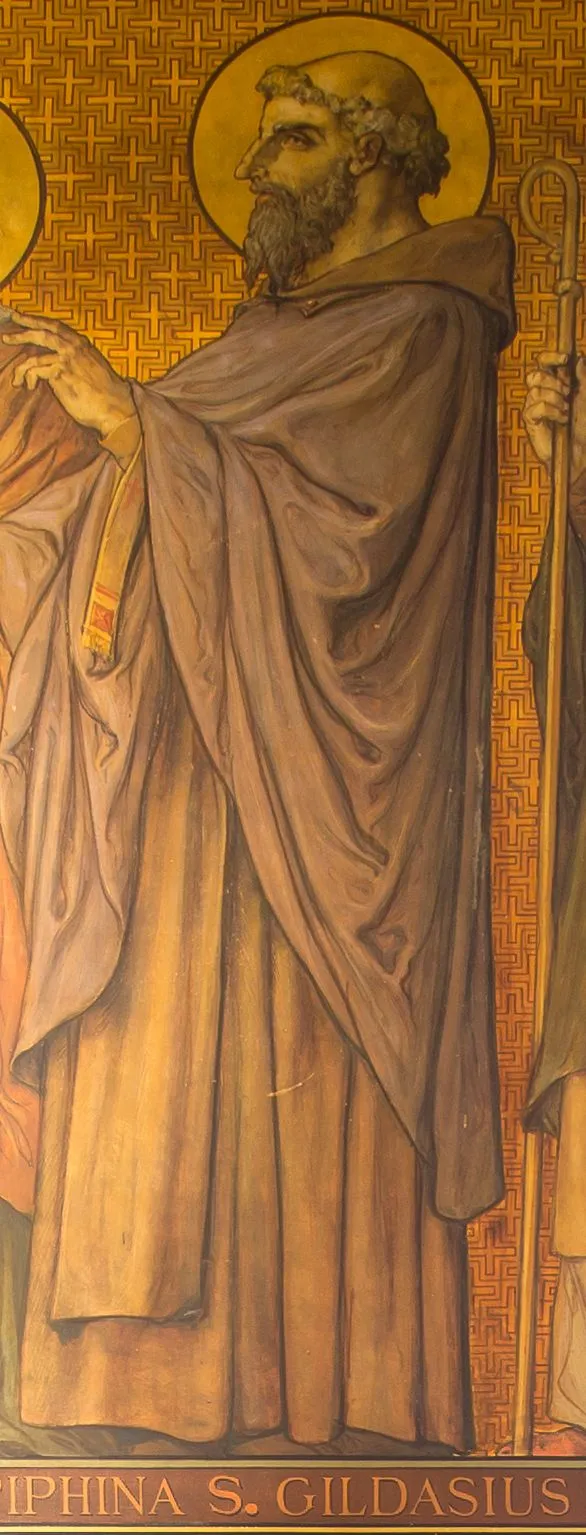
Saint Gildas, called the Wise, was a sixth-century British monk whose "De excidio Britanniae," On the Ruin of Britain, is one of the very few writings to survive from Britain in his century. 124 Trained in Wales under Saint Illtud, he ended his life in Brittany, where he founded the monastery of Rhuys on the coast of the Morbihan. 123 His book is mostly a sermon, and a fierce one: he turned on five British kings and on the clergy of his day, and blamed the island's ruin on their sins. 12
Two lives that do not agree
Almost everything told about Gildas comes from two biographies written centuries after him: one by an unknown Breton monk of Rhuys in the eleventh century, the other by Caradoc of Llancarfan, a Welshman, in the twelfth. 12 Both contain statements that are out of order or misleading, and some critics have rejected them as worthless. 1
Older scholars tried to solve the problem by inventing several saints named Gildas, with surnames like "Albanicus" and "Badonicus." 1 Columba Edmonds, writing in the 1909 Catholic Encyclopedia, sided with the larger number of authorities who held there was only one, and explained the discrepancies by the fact that the lives were written in different countries, long after their subject. 1 The Norwegian bishops' saints database reports that many modern scholars have gone back the other way, and now think the founder of Rhuys may have been a separate Breton saint, Gueltas. 2
From the Clyde to Llantwit
Both lives agree that he was born of a noble British family. Edmonds and katolsk.no place his birth on the banks of the Clyde, possibly at Dumbarton, and give his father's name as Cau or Nau. 12 CatholicIreland.net says instead that he was born in the Clwyd valley in north Wales, around the year 500. 4
He is sometimes called Badonicus because, as he tells the reader himself, he was born in the year the Britons won their famous victory over the Saxons at Mount Badon, which Edmonds dates to 493 or 516. 1 Edmonds puts his birth about 516; katolsk.no about 500. 12
He was educated in Wales under Saint Illtud, as a companion of Saint Samson; katolsk.no names Saint Pol Aurelian as another of his fellow pupils. 12 CatholicIreland says he then lived as a hermit on Flatholm, an island in the Bristol Channel off Glamorgan, and may have had Irish disciples there, Saint Finnian of Clonard among them. 4 katolsk.no gives the Flatholm hermitage as Caradoc's account. 2
Ireland and Rome
Having become a monk, he crossed to Ireland and was ordained a priest there. He is said to have lived for a time at Armagh and then to have crossed to North Britain, where his teaching was confirmed by miracles. 1 On a later visit to Ireland, at the invitation of King Ainmire, he strengthened the faith of many and built monasteries and churches. 12
The Irish annalists associate him with Saint David and Saint Cadoc in giving a particular liturgy, a Mass, to what they called the second order of Irish saints. 1 katolsk.no adds that no text of that Celtic liturgy survives. 2 He is also said to have made a pilgrimage to Rome. 12
An island off Brittany, and Rhuys
On the way home from Rome, says Edmonds, his love of solitude led him to the island of Houat, off Brittany, where he lived a life of prayer, study and austerity. 1 katolsk.no and CatholicIreland put the island in the Gulf of Morbihan, the one still called the Île aux Moines. 24 CatholicIreland suggests he may have left Britain during the Yellow Plague of 547. 4
His retreat did not stay secret. The Bretons persuaded him to found a monastery at Rhuys, on the mainland, and crowds came to it. 1 The Roman Martyrology is careful here: it records as tradition, not fact, that he founded the monastery of Rhuys facing the sea and died on Houat. 3
katolsk.no tells the Rhuys life's account of his death on January 29, about 570: at his own wish his body was laid in a boat and pushed out to sea, and three months later, on May 11, the men of Rhuys found the boat in a cove with the body still whole and buried him at home. 2 Caradoc says instead that he died at Glastonbury, a claim the Irish hagiographer O'Hanlon dismissed by remarking that Glastonbury appropriated more saints than Gildas. 12
On the Ruin of Britain
Rhuys is where, by Edmonds's account, he wrote his famous letter to the British kings. 1 "De excidio Britanniae" falls into three parts: a preface, a sketch of British history from the Roman invasion to his own day, and a long letter of invective against five kings, Constantine, Vortipor, Cyneglas, Cynan and Maelgwn. 1 In the same letter he rebukes the clergy for sloth and simony. 1
katolsk.no is frank about its limits as history: it is vague, gives no dates and does not always keep events in order, yet for most of the fifth and sixth centuries it is almost the only source written by someone close to the events. 2 It notes that Gildas was writing as a preacher in the manner of an Old Testament prophet, not as a chronicler. 2 Edmonds calls the writings "clearly the work of a man of no ordinary culture and sanctity" and thoroughly acquainted with Scripture. 1 CatholicIreland notes his elegant Latin and his knowledge of Virgil and of the letters of Saint Ignatius of Antioch, and says it was his learning and style that earned him the name Gildas Sapiens. 4
He is regarded as the earliest British historian, and Bede and Alcuin both quote him. 1 Bede built his account of the Anglo-Saxon invasions on him. 2 CatholicIreland also credits him with a Penitential, whose list of offenses shows that the monasteries of his day had their problems, though its penalties are milder than those of the Irish penitentials. 4
Relics and cult
His relics were venerated at Rhuys until the tenth century, when they were carried for safety into Berry. 1 katolsk.no dates the move to about 920, in flight from the Normans. 2 katolsk.no quotes Dom Lobineau's account that the abbot of Rhuys left eight of the larger bones under the altar in the saint's tomb and took the rest to Bourg-Déols. 2 By the eighteenth century they were said to be kept in the cathedral of Vannes. 12 katolsk.no adds that monks from Fleury restored the abbey of Rhuys in the eleventh century. 2
What is Saint Gildas the patron saint of?
None of the sources consulted names a patronage for Saint Gildas. Edmonds says only that he is the patron of several churches and monasteries in Brittany and elsewhere. 1 The town of Saint-Gildas-de-Rhuys carries his name, and the diocese of Vannes still keeps his feast. 24 In art his attribute is a bell. 2
Saint Gildas's feast day
Saint Gildas's feast day is January 29. 12 The Roman Martyrology enters him on that day as an abbot, called the Wise. 3 A second feast, on May 11, commemorates the translation of his relics. 12 katolsk.no notes that he was already honored as a saint in the early eighth century, and that Irish martyrologies and Anglo-Saxon calendars of the ninth to eleventh centuries keep him on January 29. 2
Praying with Saint Gildas
Gildas is remembered for a hard book. He named five kings and listed what each had done, and he did not spare the clergy, his own kind. 12 It is not comfortable reading, and katolsk.no is right that he was preaching rather than recording. 2
His life suggests what that kind of speech cost and where it came from. The same man who wrote the invective went looking for islands, first in the Bristol Channel and then off Brittany, and lived on them in prayer, study and austerity until people came and asked him to found a monastery. 14
The Church has kept him for some thirteen centuries without settling where he was born, where he died, or even whether one man or two lies behind the name. 123 The Martyrology keeps the abbot of Rhuys by the sea, who lamented the misfortunes of his people and rebuked the wickedness of their princes and their clergy. 3
Saint Gildas the Wise, pray for us.
Sources
- 1.Columba Edmonds, "St. Gildas," The Catholic Encyclopedia, Vol. 6 (New York: Robert Appleton Company, 1909).
- 2."Den hellige Gildas den Vise (~500-~570)," Den katolske kirke (katolsk.no), Catholic Diocese of Oslo (in Norwegian).
- 3.Roman Martyrology, entry for January 29, "San Gilda, detto il Sapiente," as printed in "Santo del giorno," Conferenza Episcopale Italiana (in Italian).
- 4.Patrick Duffy, "Jan 29 - St Gildas (500-570) itinerant monk," CatholicIreland.net.
Saints to turn to next
Others in this collection who are turned to for some of the same things.