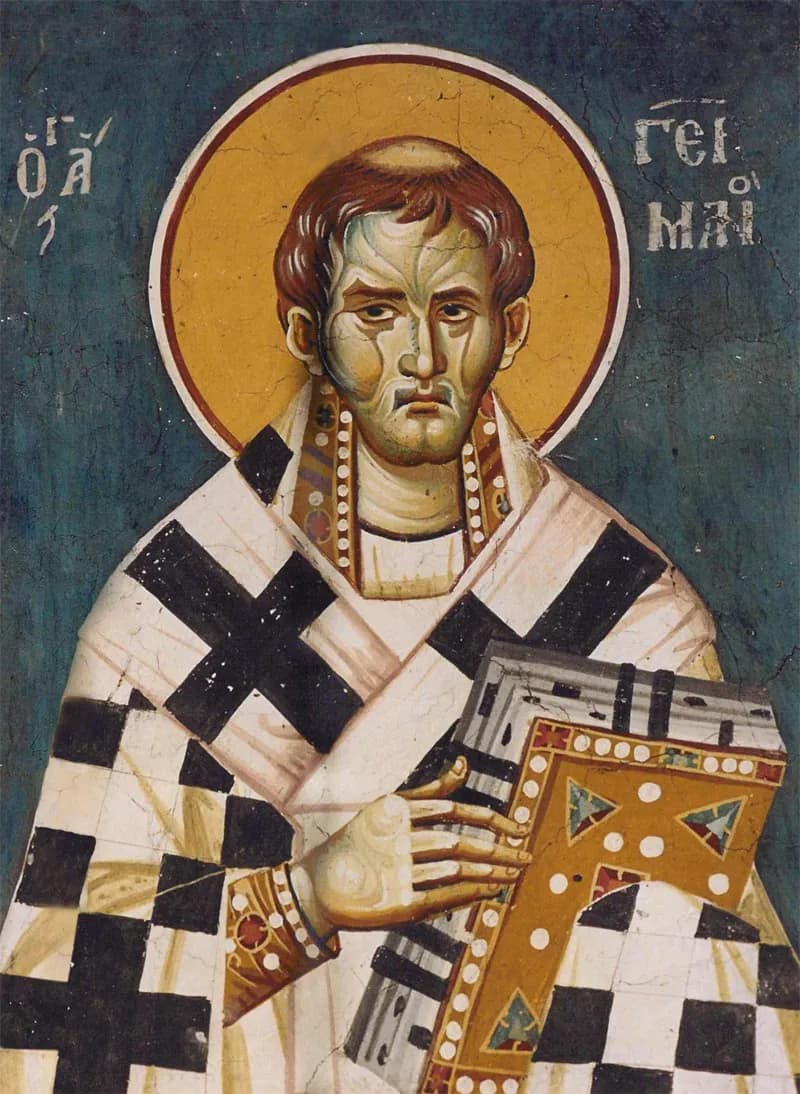
Saint Germanus of Constantinople
before 641 - 733 or 740
- Born
- Constantinople, toward the end of the reign of the Emperor Heraclius (610-641) 2
- Bishop of
- Cyzicus, before 712 2
- Known for
- Resisting the Emperor Leo III over the veneration of icons, and his homilies on the Virgin Mary 12
Saint Germanus of Constantinople was the patriarch who refused, in 730, to sign the Emperor Leo III's decree against holy images, and lost his see for it. 12 Benedict XVI notes that the Second Council of Nicaea in 787 named him with "a certain solemnity" among the great champions of icons. 1 One of his homilies on the death of the Virgin was quoted by Pius XII in the 1950 definition of the Assumption. 1 His feast is May 12. 123
A patrician's son
He was born in Constantinople toward the end of the reign of the Emperor Heraclius, who ruled from 610 to 641, the son of a patrician named Justinianus who held a series of high offices. 2 The 1909 Catholic Encyclopedia says he gave himself to the service of the Church and became a cleric of the cathedral of the capital. 2 It records, without giving the circumstances, that his father was put to death by a nephew of Heraclius. 2
Some time afterward he was made Bishop of Cyzicus, though the encyclopedia says the year is not known. 2 As bishop he attended a synod at Constantinople in 712, called by the Emperor Philippicus to restore the teaching that Christ had only one will and to condemn the Sixth Council of 681. 2 The encyclopedia says Germanus "is said to have bowed to the imperial will" along with most of the Greek bishops, and then adds, carefully: "If Germanus really yielded for a short time," he soon acknowledged again the two wills in Christ. 2
Patriarch of Constantinople
He became patriarch in 715 and held the see until 730. 12 Almost at once, the encyclopedia says, he called a synod of Greek bishops that proclaimed the two wills and two operations in Christ and condemned the leaders of the Monothelite party. 2 He also opened talks with the Armenian Monophysites, hoping to bring them back to unity with the Church, without success. 2
In 717 and 718 the city was besieged by the Saracens. 1 Benedict XVI describes a solemn procession through Constantinople carrying an image of the Mother of God and the relic of the True Cross, to ask for protection, and says the city was delivered and the enemy gave up the idea of taking it. 1 Germanus, Benedict says, saw in the rescue God's plain approval of the people's devotion to icons. 1
Leo III and the icons
The emperor came to the opposite conclusion. 1 Leo III, enthroned in 717, became convinced that the empire had to be put right by purifying its worship, and that the people were in danger of idolatry through their devotion to images. 1 The encyclopedia says he saw a volcanic eruption between the islands of Thera and Therasia as God's judgment on image worship, and in an edict of 726 called the venerators of images idolaters, appealing to the commandment against graven images. 2
Even before that, Germanus had been arguing the case with bishops who agreed with the emperor. 2 The encyclopedia tells of Bishop Constantine of Nacoleia, who came to the capital to dispute with him, seemed persuaded, and then failed to deliver a letter the patriarch had given him, for which he was excommunicated. 2 Germanus also wrote to Bishop Thomas of Claudiopolis setting out the principles behind the veneration of images. 2
He opposed the emperor openly and tried to change his mind, and the encyclopedia says Leo then tried to remove him. 2 Germanus turned to Pope Gregory II, who in 729 praised his zeal and steadfastness in a long letter. 2 Benedict XVI says Germanus appealed to the tradition of the Church and to images everyone recognized as miraculous, and that none of it moved the emperor. 1
Deposed
Benedict XVI dates the decisive meeting to January 7, 730, when the emperor came out openly against the veneration of images. 1 The encyclopedia says Germanus was summoned before a council and told to sign an imperial decree forbidding images. 2 He refused and was forced to resign, and a more pliant man, Anastasius, was put in his place. 2
The sources tell his last years differently. 12 The encyclopedia says he went back to his family's home and died there some years later, at a great age, in 733 or 740. 2 Benedict XVI says he was exiled to a monastery, where he died "forgotten by almost all." 1 His name returned in 787, when the Second Council of Nicaea decided in favor of icons and recognized what he had done. 12
The homilies on Mary
Benedict XVI is frank that Germanus "cannot be described as a great thinker," but says some of his homilies on the Virgin shaped the piety of whole generations in the East and in the West. 1 He mentions in particular the homilies on the Presentation of Mary in the Temple, which he says religious communities still read. 1 He also notes that Germanus took great care over the liturgy, and was for a time believed to have introduced the feast of the Akathistos, the ancient hymn to the Mother of God. 1
The most famous text is from his homilies on the Dormition, the falling asleep of the Virgin, the feast that corresponds to the Assumption. 1 Pius XII cited it in Munificentissimus Deus, the 1950 constitution defining the Assumption as dogma. 1 Benedict quotes it: "your spirit lives in eternity nor did your flesh suffer the corruption of the tomb. You, O Mother, are close to all and protect all, and although our eyes are unable to see you, we know, O Most Holy One, that you dwell among all of us." 1
The encyclopedia lists his surviving writings: a history of the councils, a dialogue on the end of life, a letter to the Armenians, three letters on the veneration of images, and nine discourses, which it says are written in "the extravagant rhetorical style of the later Byzantines." 2
What is Saint Germanus of Constantinople the patron saint of?
Saint Germanus of Constantinople's feast day
Saint Germanus of Constantinople's feast is May 12. 23 Benedict XVI says it is the day the Greek Church keeps him in its liturgy; the Catholic Encyclopedia says he is venerated as a saint in both the Greek and the Latin Church, with his feast on that day; and the Vatican News calendar lists him on May 12. 123
Praying with Saint Germanus of Constantinople
Benedict XVI drew three things from his life. 1 The first was that God has made himself visible: because the Son became man, it is right to paint his face, and to look for God in the faces of the saints and of every person in whom his holiness shines. 1 Germanus gave up his office rather than deny it. 12
The second was the beauty and dignity of the liturgy, which Germanus cared for. 1 The third was love for the Church, and Benedict quoted the opening of Germanus's small work on it: "The Church is the temple of God, a sacred space, a house of prayer, the convocation of people, the Body of Christ." 1 Benedict admitted that people are inclined to see the Church's sins first, and said that faith can still find its divine beauty. 1
There is also the question of 712. 2 The encyclopedia is not certain that he gave way to the emperor that year, and does not pretend to be. 2 If he did, the man who bent once was the same man who, eighteen years later and old, would not. 2
His Marian homily ends with a promise that Benedict quoted in full: "we believe with certainty that you continue to walk with us." 1
Saint Germanus of Constantinople, pray for us.
Sources
Saints to turn to next
Others in this collection who are turned to for some of the same things.