Saint Germanus of Auxerre
c. 380 - July 31, 448
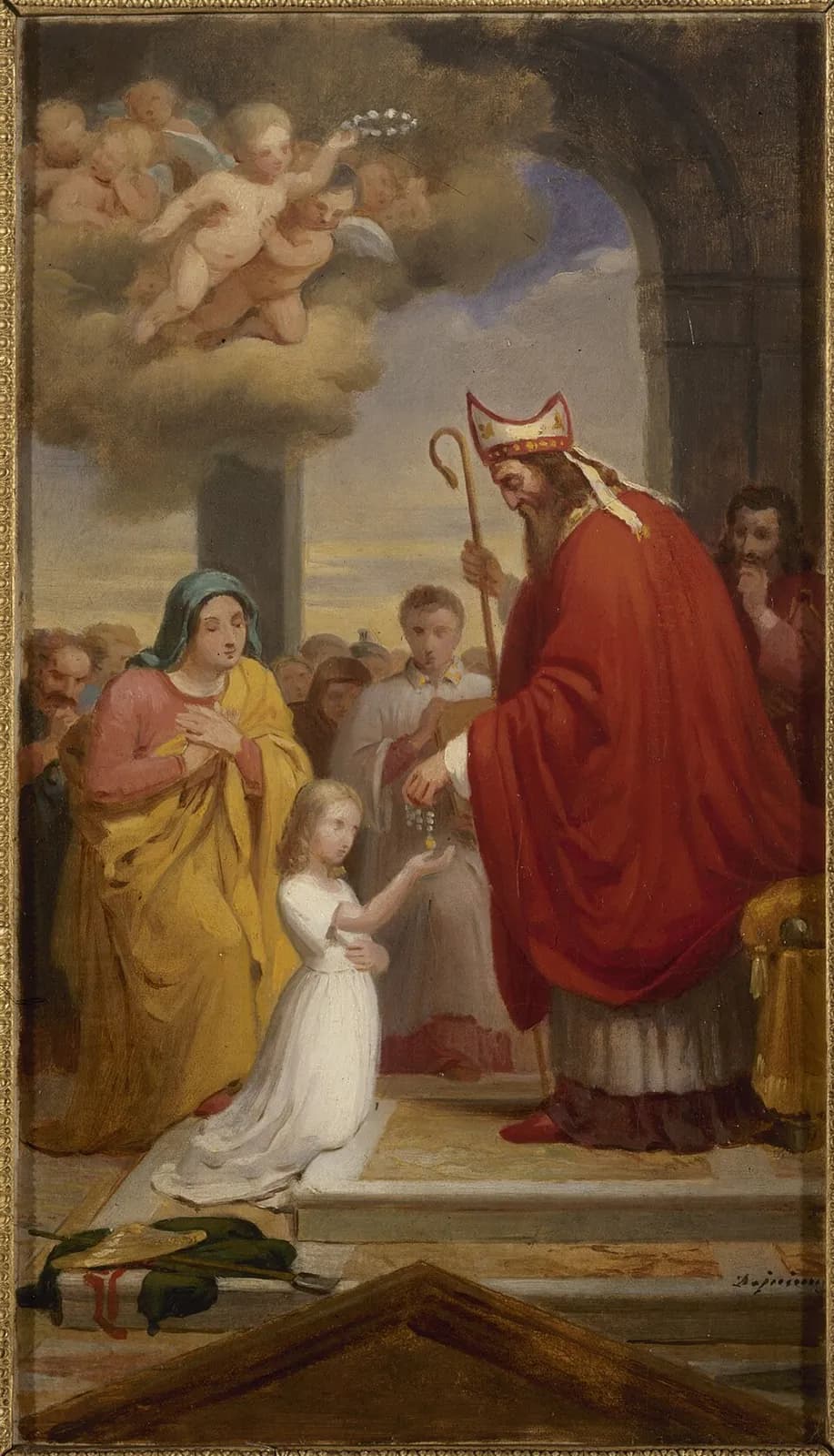
- Also called
- Saint Germain, the French form of his name 1
- Bishop of Auxerre
- Consecrated July 7, 418 1
- Missions to Britain
- 429, with Saint Lupus of Troyes, against Pelagianism; again in 447, with Severus of Trier 12
- Feast day
- July 31, in the Roman Martyrology 2
Saint Germanus of Auxerre was a Roman lawyer and provincial governor who was made a cleric against his will, became bishop of Auxerre in 418, and twice crossed to Britain, the first time to argue down the Pelagian heresy. 12 On the first of those journeys he blessed a small girl at Nanterre who grew up to be Saint Genevieve of Paris. 13 He died at Ravenna on July 31, 448, while pleading with the imperial court for the people of Brittany, and the Roman Martyrology commemorates him on that day. 12
A lawyer and a governor
He was born at Auxerre, in Gaul, about 380 according to the Catholic Encyclopedia, in 378 according to Catholic Culture. 12 His parents, Rusticus and Germanilla, belonged to one of the noblest families in the country, and they gave him the best schooling it had, at Arles and Lyons. 1 He then went to Rome to study eloquence and civil law, and practiced for some years before the tribunal of the prefect "with great success." 1
His talents brought him to the notice of the court. He married a woman named Eustachia, who was well regarded there, and the emperor sent him home as one of the six dukes who governed the provinces of Gaul. 1 Butler, in the life Catholic Culture reprints, says more loosely that the emperor "placed him high in the army." 2 He lived at Auxerre and, the encyclopedia says, "gave himself up to all the enjoyments that naturally fell to his lot." 1 Butler is blunter: "In his youth Germanus gave little sign of sanctity." 2
The tree and the tonsure
What he enjoyed most was hunting. Butler writes that "his one passion was the chase." 2 He had a habit of hanging his trophies on a certain tree that had once been a place of pagan worship, and the bishop of Auxerre, Saint Amator, objected. Germanus ignored him. One day when the duke was away, Amator had the tree cut down and the trophies burned. 1
Germanus was angry enough to want the bishop dead, and Amator fled. 1 What Amator did next is the strange part. He went to the prefect Julius and asked permission to make the duke a cleric, and when it was granted he came back, knowing his own life was near its end. When Germanus came to the church, Amator had the doors barred and, in the encyclopedia's words, "gave him the tonsure against his will, telling him to live as one destined to be his successor." He ordained him deacon on the spot. 1 Butler adds that it had been revealed to Amator that this man would follow him, and that he tonsured him "almost by main force." 2
Both sources say the effect was immediate. "A wonderful change was instantly wrought in Germain," says the encyclopedia, "and he accepted everything that had happened as the Divine will." 1 He turned to prayer, study and works of charity. Amator died soon afterward, and Germanus was unanimously chosen in his place and consecrated on July 7, 418. 1
Bishop of Auxerre
He gave his goods to the poor, and Butler says he made over his lands to the Church and "adopted a life of humble penance." 12 The encyclopedia notes that his education now served him well in governing the diocese. 1 He built a large monastery dedicated to Saints Cosmas and Damian on the banks of the Yonne and withdrew there when he could. 1
He did not stop being useful to his city in the old way. Returning from Britain, he went to Arles to see the prefect and obtained the remission of taxes that were weighing on the people of Auxerre. 1
Britain and the Pelagians
In 429 the bishops of Britain appealed to the continent for help against the Pelagian heresy, which was spreading on the island. 1 The encyclopedia cites the chronicler Saint Prosper, who was in Rome two years later, for what followed: Pope Celestine commissioned the Church in Gaul to send help, and Germanus and Saint Lupus, bishop of Troyes, were chosen to go. 1 Butler has Germanus picked by the pope directly. 2
On the way they stopped at Nanterre, a village near Paris. The people came out to meet them, Germanus preached, and he noticed a thoughtful child in the crowd. 3 He had her brought to him, learned that she wanted to give herself to God, and told her parents what she would become. Before he left the next morning he blessed her and gave her "a medal engraved with a cross," telling her to wear it instead of pearls and gold. 3 The child was Genevieve, the future patron of Paris. 13 Later, when her enemies were plotting to drown her, it was Germanus's intervention that overcame their hostility. 3
One of the early Lives of Saint Patrick says Patrick was among Germanus's companions on this journey. The encyclopedia reports the claim and leaves it there. 1
In Britain the two bishops preached, as Butler puts it, "in the fields and highways throughout the land." 2 The encyclopedia, citing tradition, places the main debate with the Pelagian party at Saint Albans and says it ended in "the complete discomfiture of the heretics"; Butler sets the meeting near Verulam. 12 Germanus credited the outcome to Saint Alban and gave thanks at his shrine; back in Auxerre he built a church in the martyr's honor. 12 He stayed in Britain for some time and set up several schools for training clergy. 1
The Alleluia victory
The best-known story about him is a battle in which nobody on his side struck a blow. The Britons, threatened by raiders, were led by the bishop. In the account Catholic Culture prints, Germanus passed the word that everyone should repeat his call, and as the enemy closed in, "the bishops three times chanted the Alleluia." The whole army shouted it back, the cry echoed between the mountains, and the raiders ran, "thinking that the surrounding rocks and the very sky itself were falling on them." 2 The passage ends by calling it "a victory gained by faith and not by force." 2
The sources place it differently. Butler sets it near the end of the first visit, against Picts and Scots, and says the Britons who shouted were newly baptized. 2 The encyclopedia tells it under the second visit, against "a marauding body of Saxons and Picts," and introduces it with the words "he is said to have." 1 That second journey came in 447, when he was asked to return and went with Severus, bishop of Trier, which the encyclopedia calls Trèves. 12
Ravenna
He came home to another crisis. The people of Armorica, the present Brittany, had rebelled and were about to be punished. Germanus went to them, and at his request the punishment was put off until he could lay their case before the emperor. 1 He set out for Italy, reached Milan on June 17, 448, and went on to Ravenna, where the empress-mother Galla Placidia and the city's bishop, Saint Peter Chrysologus, received him with honor. The pardon was granted. 1
He died there on July 31. 1 The year is 448 in Butler, in Catholic Culture and in the heading of the encyclopedia's article; the body of that article, a few lines after dating his arrival in Milan to 448, prints 450. 12 As he had asked, his body was taken back to Auxerre and buried in the oratory of Saint Maurice, which he had built. A large church later replaced it and became the Benedictine abbey of Saint-Germain, a gift, the encyclopedia says, of Queen Clotilda, the wife of Clovis. 1
Centuries afterward Charles the Bald had the shrine opened and the body was found intact. It stayed in the abbey until 1567, when the Huguenots took Auxerre, broke open the shrine and threw out the relics. Some were said to have been gathered up and taken to the abbey of Saint Marion, but the encyclopedia cautions that their authenticity "has never been canonically recognized." 1
What is Saint Germanus of Auxerre the patron saint of?
He is the patron saint of his own city. The Catholic Encyclopedia says he "has always been the patron of Auxerre," and Catholic Culture lists Auxerre and the Italian town of San Germano Vercellese. 12 Neither source names a trade, an illness or a cause. In England, the encyclopedia adds, he was honored before the Reformation in Cornwall and at Saint Albans. 1
Saint Germanus of Auxerre's feast day
Saint Germanus of Auxerre's feast day is July 31, the day of his death. 1 Catholic Culture lists him among that day's commemorations from the Roman Martyrology, which describes him as "a man most renowned for his birth, faith, learning, and glorious miracles, who freed England completely from the heretical doctrines of the Pelagians." 2 July 31 is also the memorial of Saint Ignatius of Loyola, which is the celebration Catholic Culture lists first for the day. 2
Praying with Saint Germanus of Auxerre
Germanus did not seek out the Church. A bishop he had threatened locked him in a building and cut his hair. 1 Nothing in the story suggests he had been looking for a change, and both sources stress that he had given little sign of wanting one. 12 The encyclopedia says only that he took what had happened as the will of God and began at once to live differently. 1
What is noticeable afterward is how little of the old man was thrown away. The lawyer went to argue with the Pelagians. The governor went to Arles about his city's taxes and to Ravenna about a rebel province. The soldier, if Butler is right about his "old skill in arms," led an army and won its battle with a word from the Easter liturgy. 12 His conversion redirected his training. It did not erase it.
He was also a man who noticed people. In a crowd at Nanterre he picked out one child, spent time with her and her parents, and came back the next morning before leaving. 3 Later, when she was in danger, he had not forgotten her. 3
His last journey was for people who had no claim on him, rebels from another province, and he died before he could go home. 1 The Martyrology remembers the learning and the miracles. 2 The encyclopedia's plain account leaves a different impression, of a capable man who kept being asked for help and kept going. 1
Saint Germanus of Auxerre, pray for us.
Sources
- 1.Andrew MacErlean, "St. Germain," The Catholic Encyclopedia, vol. 6 (New York: Robert Appleton Company, 1909).
- 2."Memorial of St. Ignatius of Loyola, Priest; Other Commemorations: St. Germanus, Bishop (RM)," Liturgical Year, July 31, Catholic Culture; includes a life excerpted from Alban Butler, Lives of the Saints (Benziger Bros., 1894).
- 3.Andrew MacErlean, "St. Genevieve," The Catholic Encyclopedia, vol. 6 (New York: Robert Appleton Company, 1909).
Saints to turn to next
Others in this collection who are turned to for some of the same things.