Saint Gerard Sagredo
d. 1046
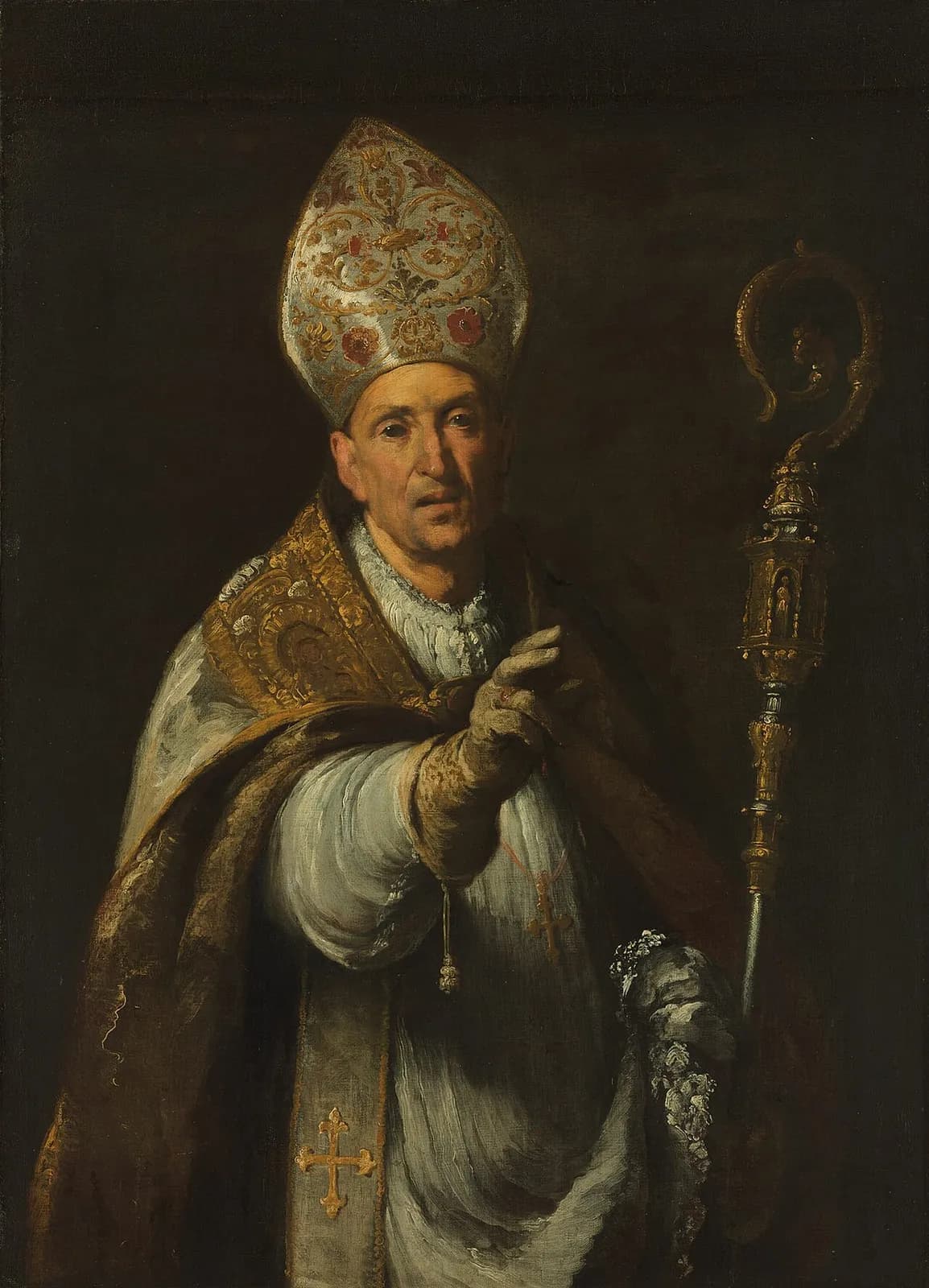
- Canonized
- 1083, by Gregory VII at the request of King Ladislaus, according to the Lexikon 3
Saint Gerard Sagredo was a Benedictine monk from Venice who set out for Jerusalem, was stopped in Hungary by King Stephen, and stayed for the rest of his life: as tutor to the king's son Emeric, as a hermit, and from 1030 as the first bishop of Csanád. 23 In 1046, during a pagan rising after Stephen's death, he was attacked at Buda and killed on the hill above the Danube that Hungarians still call by his name, Gellért. 23 The Roman Martyrology keeps him on September 24. 1
A monk of San Giorgio
The sources do not agree on when he was born. The Magyar Katolikus Lexikon, the Hungarian Catholic encyclopedia, says it was in Venice some time after 977; Butler's Lives of the Saints says about the beginning of the eleventh century. 23 They differ over his family too. The Lexikon makes him a Morosini and says the Sagredo family later claimed him as its own, while Butler says only that he is "sometimes surnamed Sagredo." 23
He was given to God young. According to a late Life, which the Lexikon dates to the middle of the fourteenth century, he fell seriously ill at the age of five and his parents offered him to Saint George; he became an oblate at the Benedictine monastery of San Giorgio Maggiore, founded in 982. 3 Butler says simply that he consecrated himself there "at an early age." 2 The Lexikon goes on: he became prior, was sent abroad to complete his studies, and on the death of his abbot was elected to succeed him against his own protests. 3
Around 1018, partly to escape the feuds of Venetian politics, he left. He lived for a while as a hermit near Pola, in Istria, and then set out for Jerusalem, meaning, the Lexikon says, to study there after the example of Saint Jerome. 3 Butler agrees that he left the monastery to go on pilgrimage. 2
In Hungary
He never reached Jerusalem. Passing through Hungary he came to the notice of King Stephen, the first Christian king of the Hungarians, who kept him there and made him tutor to his son, Emeric. 23 The Martyrology remembers him first of all for that: he was the teacher of Saint Emeric, the young prince. 1 The Lexikon suggests he may have been one of the sources behind the Admonitions, the instructions on kingship that Stephen addressed to his son. 3
In 1024, the Lexikon says, when the family of the doge Otto Orseolo arrived in Hungary after being driven out of Venice, Gerard withdrew to Bakonybél, in the Bakony hills, where he wrote theological treatises and homilies that have since been lost. 3
First bishop of Csanád
In 1030, after the king had defeated the chieftain Ajtony, he founded a new diocese on the conquered land, at Marosvár, later called Csanád, and called Gerard out of his hermitage to be its first bishop. 3 Butler describes his flock bluntly: most of the people were heathen, and those who bore the name of Christian were "ignorant, brutish and savage," yet Gerard "laboured among them with much fruit." 2
He organized the diocese, preached to the people, built churches, founded a school and a monastery, and spread devotion to the Mother of God, the Lexikon says, while keeping his monastic way of life and treating his own clergy strictly. 3 Butler adds that "so far as possible" he joined the contemplative life to his work as a bishop, and found in it fresh energy for his duties. 2 He was known as a preacher. In the preface to his homilies he mentions that his diocese bordered the lands of the Pechenegs and complains that conditions were so rough he could hardly get parchment. 3
One book survives, an unfinished Deliberation on the Hymn of the Three Young Men from the book of Daniel. 23 The Lexikon describes it as a pre-scholastic work in the manner of a catena, full of pointed remarks on its own times: tyrannical rulers, arrogant laymen, corrupt clergy and dangerous heresy. 3
After Stephen
King Stephen supported him as long as he lived. 2 When the king died in 1038, Butler writes, the country fell into anarchy among rival claimants to the crown, and a revolt against Christianity began. 2 The Lexikon follows Gerard through the struggle. In 1042 he refused to crown the usurper Samuel Aba at Easter, rebuked his cruelty from the pulpit, and foretold his fall. 3
Martyrdom at Buda
In 1046 princes of the royal house returned to claim the throne, and a pagan rising broke out in their camp. 3 Gerard was on his way to Buda to greet Prince Andrew, one of those claimants. 3 Butler says that while saying Mass at a small place on the Danube he foresaw that he would be martyred that day, and the Lexikon that he had celebrated Mass in the church of Saint Sabina at Diósd and foretold that he and his companions would die. 23
The accounts of his death agree on the outline and differ on the order. In Butler, a band of soldiers led by a determined pagan attacked his party as it reached Buda to cross the river: they stoned him, overturned his carriage and dragged him to the ground. He raised himself to his knees and prayed, as Saint Stephen the first martyr had prayed, "Lord, lay not this sin to their charge. They know not what they do." Then he was run through with a lance, and his body was thrown from the cliff into the Danube. 2 The Lexikon has him dragged up the hill, thrown down from the height in his carriage, then run through with a lance and stoned to death. 3 The Martyrology says that he died stoned near the Danube in a revolt of some local pagans. 1
Butler gives the date as September 24, 1046. 2 The Lexikon dates his death to August 29 of that year. 3 The hill, called Kelenhegy then, is Gellért Hill today, and a statue of him has stood there since 1904. 3
His relics and his cult
His death, Butler writes, "had a profound effect," and he was venerated as a martyr. 2 The Lexikon says he was buried on the Pest side of the river and that in 1053 his successor moved his remains to Marosvár. 3 In 1083, at the request of King Ladislaus, Pope Gregory VII canonized him, according to the Lexikon; Butler records that in the same year his relics were enshrined together with those of Stephen and Emeric. 23
Venice did not forget him. In 1333, Butler says, the republic obtained the greater part of his relics from the king of Hungary and carried them to the church of Our Lady at Murano, where he is honored as the protomartyr of Venice. 2 The Lexikon says some of his relics went abroad and others were lost in the years of Turkish rule. 3 His cult is kept across Hungary, especially in Budapest and in the Diocese of Szeged-Csanád, and he is shown among the Hungarian saints in a chapel of St. Peter's Basilica in Rome. 3
What is Saint Gerard Sagredo the patron saint of?
Saint Gerard Sagredo's feast day
Praying with Saint Gerard Sagredo
Gerard meant to go to Jerusalem and ended up in a country he had only meant to cross. 23 He spent the rest of his life there, teaching a prince, praying alone, and then building a diocese among people Butler did not hesitate to call savage. 23
He seems to have wanted quiet all his life. He left an abbacy, lived as a hermit near Pola and later at Bakonybél, and had to be called out of his solitude to be made a bishop; even then, Butler says, he kept as much of the contemplative life as the office allowed. 23 The work found him anyway, and he did it, short of parchment, on a frontier with the Pechenegs. 3
His last recorded words, in Butler's account, were those of the first martyr asking forgiveness for the men who were killing him. 2
Saint Gerard Sagredo, pray for us.
Sources
- 1.Roman Martyrology, entry for September 24, "San Gerardo Sagredo, vescovo," as printed in "Santo del giorno," Conferenza Episcopale Italiana (in Italian).
- 2."St Gerard, Bishop of Csanad, Martyr (A.D. 1046)," from Butler's Lives of the Saints (Christian Classics, 1995), Hungarian Saints, archive of the Catholic Church in Hungary (katolikus.hu).
- 3."Gellért, Szt.," Magyar Katolikus Lexikon, compiled at the Pauline Library, Budapest, 1980-2013 (in Hungarian).
Saints to turn to next
Others in this collection who are turned to for some of the same things.