Saint Genesius of Rome
d. 286 or 303
- Historical record
- The Acts date from the seventh century and are of "very doubtful" value; his existence is questioned 12
Saint Genesius of Rome is the actor of the legend who, playing a man being baptized in a comedy mocking Christians before the emperor Diocletian, rose from the mock baptism a believer and was beheaded for refusing to take it back. 12 He is honored as the patron of actors, and a church in his name stood in Rome by the eighth century. 12 The sources are frank that the story may not be true: the 1909 Catholic Encyclopedia says his "very existence" is called into question, and the Norwegian bishops' saints database traces the legend to a different martyr, Genesius of Arles. 12
The play before the emperor
The encyclopedia gives the legend in a few lines. Genesius was "the leader of a theatrical troupe in Rome," and performing one day before Diocletian, he wished "to expose Christian rites to the ridicule of his audience," and so "pretended to receive the Sacrament of Baptism." 1 Then the play turned: "When the water had been poured upon him he proclaimed himself a Christian." 1
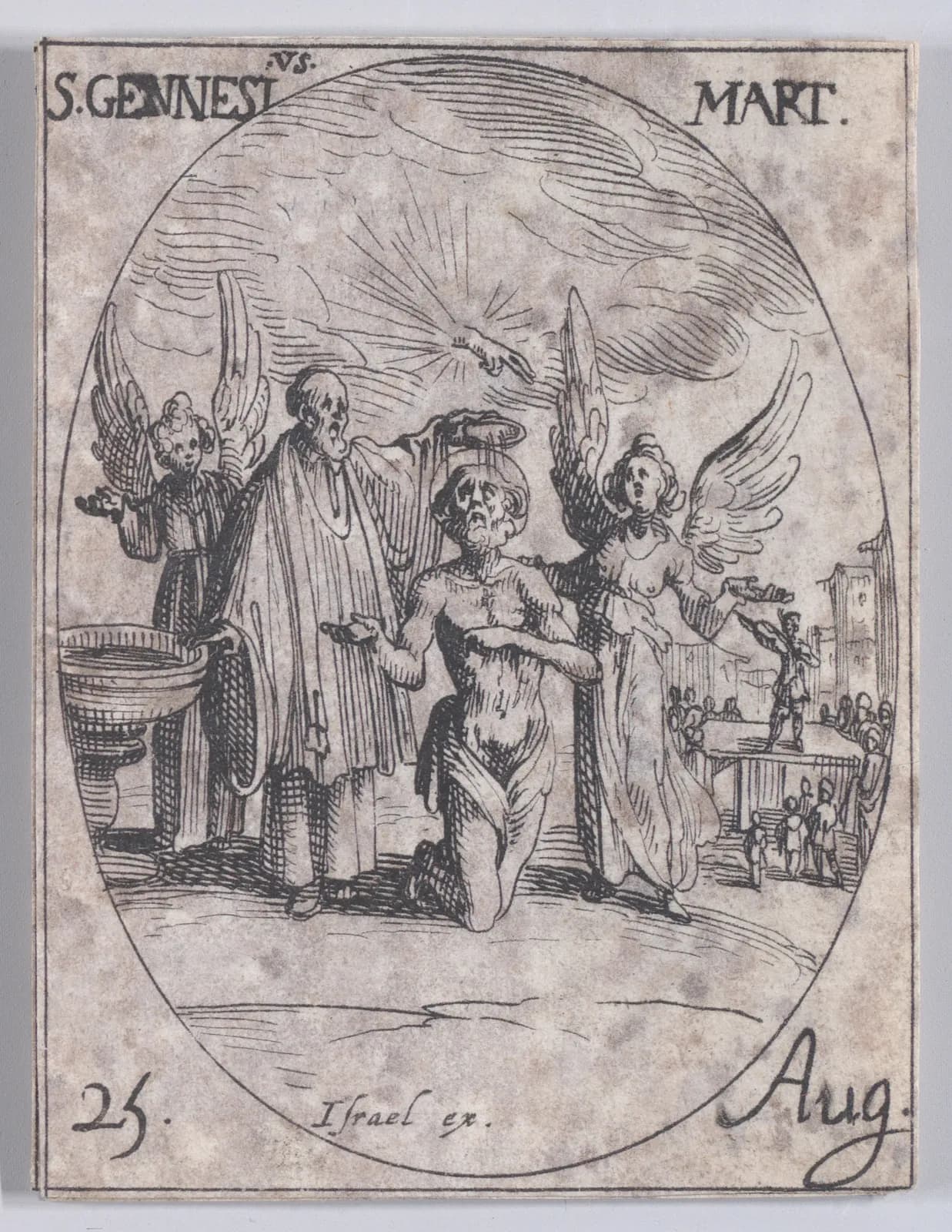
katolsk.no tells it the same way, as a satire on baptism in which Genesius played the candidate and was suddenly converted on stage. 2 Callot's etching at the top of this page shows the moment: a priest pours the water, angels stand by, and in the background the stage and its audience are still there.
Diocletian, the encyclopedia says, "at first enjoyed the realistic play, but, finding Genesius to be in earnest, ordered him to be tortured and then beheaded." 1 In katolsk.no's version, Genesius confessed Christ before the emperor so steadily that he was handed to the praetorian prefect Plautian, who had him stretched on the rack to force him to sacrifice. When he still would not give way, he was beheaded. 2 Both sources give the year as 286 or 303, and both say he was buried on the Via Tiburtina. 12
What the sources make of it
Neither source treats the story as history. The encyclopedia is direct: "The historic value of the Acts, dating from the seventh century, is very doubtful, though defended by Tillemont." 1 It goes further: "The very existence of Genesius is called into question, and he is held to be a Roman counterpart of St. Gelasius (or Gelasinus) of Hierapolis (d. 297)." 1
katolsk.no notes that the same story, or one very like it, is told of three other actors said to have been martyred, Ardalion, Gelasius of Heliopolis and Porphyrius, and that all of them are probably purely legendary figures. 2 It adds that Gelasius of Heliopolis is probably identical with Genesius of Rome. 2 The encyclopedia calls the same figure Gelasius of Hierapolis. 1
The legend is old, whatever else it is. katolsk.no points out that the calendar of Carthage in the sixth century already remembers Genesius the actor, so the story goes back at least that far. 2
Genesius of Arles
katolsk.no offers an explanation. The legend of Genesius of Rome, it says, is built on a real saint, Genesius of Arles, who lived in southern France at the end of the third century. 2 He is named in the martyrology attributed to Saint Jerome and in the writings of Prudentius, Venantius Fortunatus, Hilary and Gregory of Tours, so there is little doubt that he was a genuine martyr of the persecution under Diocletian and Maximian. 2
The encyclopedia gives his story too. He was a native of Arles, a soldier who became known for his skill in writing and was made secretary to the magistrate. When the decree of persecution was read in his presence, "the young catechumen cast his tablets at the feet of the magistrate and fled. He was captured and executed, and thus received baptism in his own blood." 1 A church and altar dedicated to him at Arles were known in the fourth century. 1
His cult spread to Narbonne, to Spain, to Africa and finally to Rome, where a church was built in his honor. 2 Because of that church, katolsk.no says, he came to be mistakenly taken for a Roman martyr buried there, and so was described, as in the Old English Martyrology, as Genesius of Rome; the legend of the actor grew from there. 2 On this reading there are not two saints but one: an unbaptized clerk who threw down his tablets rather than write against Christians, remembered in Rome as an unbaptized actor who would not finish playing a Christian for laughs.
The church at Rome and the stage
However the story began, the cult at Rome is real. The encyclopedia says he was venerated at Rome in the fourth century, that a church was built in his honor very early, and that Gregory III repaired and beautified it in 741. 1 katolsk.no gives the same restoration and dates Gregory III's pontificate to 731-41. 2 His relics are said to be divided among San Giovanni della Pigna, Santa Susanna and the chapel of Saint Lawrence. 12 In the ninth century a monastery at Schienen, near Lake Constance, was named for him. 2
The stage never let him go. The legend "was dramatized in the fifteenth century," the encyclopedia says, and later set to music by Löwe and Weingartner. 1 katolsk.no adds Lope de Vega, Jean de Rotrou and Henri Ghéon. 2 In the Tuscan town of San Miniato, of which he is patron, a festival of Christian theater is held each year around August 26, with the winning play performed in the town square. 2
What is Saint Genesius the patron saint of?
Saint Genesius's feast day
Saint Genesius's feast day is August 25, as both the encyclopedia and katolsk.no give it. 12 The current Roman Martyrology, as the Italian bishops print it, enters on August 25 only Genesius of Arles, the catechumen clerk who refused to act against Christians and was baptized in his own blood, and does not mention an actor. 34 For readers who take katolsk.no's view, that is the same saint. 2
Praying with Saint Genesius
The story is about a man who went through the motions of a sacrament as a joke and found that the sacrament was not joking. 12 Anyone who has said prayers without meaning them can feel the edge of that.
If katolsk.no is right, the real man behind the legend was a clerk with a stylus rather than an actor with a script, and what he refused to do was write. 24 The two stories have the same center. Someone is handed a part in the machinery against Christians, a text to read or a record to keep, and stops in the middle of it.
Actors have taken him as their own for a long time, and the stage has kept telling his story, from the fifteenth century to Ghéon. 12 He is remembered, in a profession built on playing other people, for the moment he stopped playing, and San Miniato still stages a play for him every summer. 2
Saint Genesius of Rome, pray for us.
Sources
- 1.Francis Mershman, "Genesius," The Catholic Encyclopedia, Vol. 6 (New York: Robert Appleton Company, 1909).
- 2."Den hellige Genesius av Roma (d. ~303)," Den katolske kirke (katolsk.no), Catholic Diocese of Oslo (in Norwegian).
- 3.Roman Martyrology, entry for August 25, "San Genesio, martire," as printed in "Santo del giorno," Conferenza Episcopale Italiana (in Italian).
- 4."Ginés (o Genesio) de Arlés, Santo," with the Roman Martyrology entry for August 25, Catholic.net (in Spanish).
Saints to turn to next
Others in this collection who are turned to for some of the same things.
- Saint Ansgar801 - February 865CourageConversionWork and vocation
- Saint Bonifacec. 675 - June 5, 754CourageWork and vocationConversion
- Saint Francis SolanoMarch 10, 1549 - July 14, 1610Work and vocationCourageConversion
- Saint Gaspar del BufaloJanuary 6, 1786 - December 28, 1837CourageConversionWork and vocation