Saint Geminianus of Modena
d. 397
- Died
- January 31, 397, according to the Archdiocese of Modena; the 1911 Catholic Encyclopedia gives 349 13
- Earliest witness
- A letter of Saint Ambrose to Pope Siricius about the Council of Milan of 390 3
Saint Geminianus was bishop of Modena in the second half of the fourth century, a contemporary of Saint Ambrose, and the Roman Martyrology remembers him for bringing his church back from the Arian heresy to the true faith. 234 The city built its cathedral around his tomb and still keeps his feast as its great day. 56 The most famous story about him, in which he turns back Attila the Hun at the gates of Modena, is one his own archdiocese says cannot be true. 3
One letter and two Lives
The Archdiocese of Modena-Nonantola begins its account of him with a warning: the sources are scarce. 3 Only one comes from his lifetime. In 390 a council met at Milan to condemn the monk Jovinian, and Saint Ambrose wrote to Pope Siricius about it; from that letter, the archdiocese says, it can be inferred that Geminianus was there when the acts were drawn up. 3 The archdiocese's history of the see places him as Ambrose's contemporary and as a suffragan at that council, and says he succeeded Antonius, a bishop of Modena known for certain in 350. 4
Everything else is later. There are two medieval Lives, a short one probably written at the end of the ninth century or the beginning of the tenth, and a longer one from around the middle of the eleventh, and there is the Relatio, the account of the moving of his body in 1106. 3 The short Life, the archdiocese says, shows a bishop who lives a holy life and works miracles, has close dealings with the emperor, and does everything he can to protect his city from barbarians and natural disasters; the longer one fills in a Modena that had grown since, with its citizens, its suburbs, its people and its canons. 3
A tradition that goes back only to the sixteenth century makes him a native of Cognento, near Modena, from a family of some standing. 3 The archdiocese thinks he was probably chosen bishop by the acclamation of the local Christian community and consecrated at Milan, the metropolitan see of the province to which Modena then belonged. 3 It dates his death to January 31, 397. 3
A different date in 1911
The 1911 Catholic Encyclopedia tells it differently. Umberto Benigni's article on the Diocese of Modena calls Geminianus "this great bishop and protector of the city," says that he sheltered Saint Athanasius in 334, and has him dying in 349. 1 That would put his death a year before the archdiocese's date for his predecessor, and four decades before the council at Milan. 14 The two accounts cannot both be right, and this page gives both. The archdiocese's dates are the ones it uses for its patron today, and they are the ones followed here. 35
The Martyrology does not give a year at all. Its entry is a single sentence: at Modena, Saint Geminianus, bishop, who brought his church back from the Arian heresy to the right faith. 2
The emperor's daughter and the king of the Huns
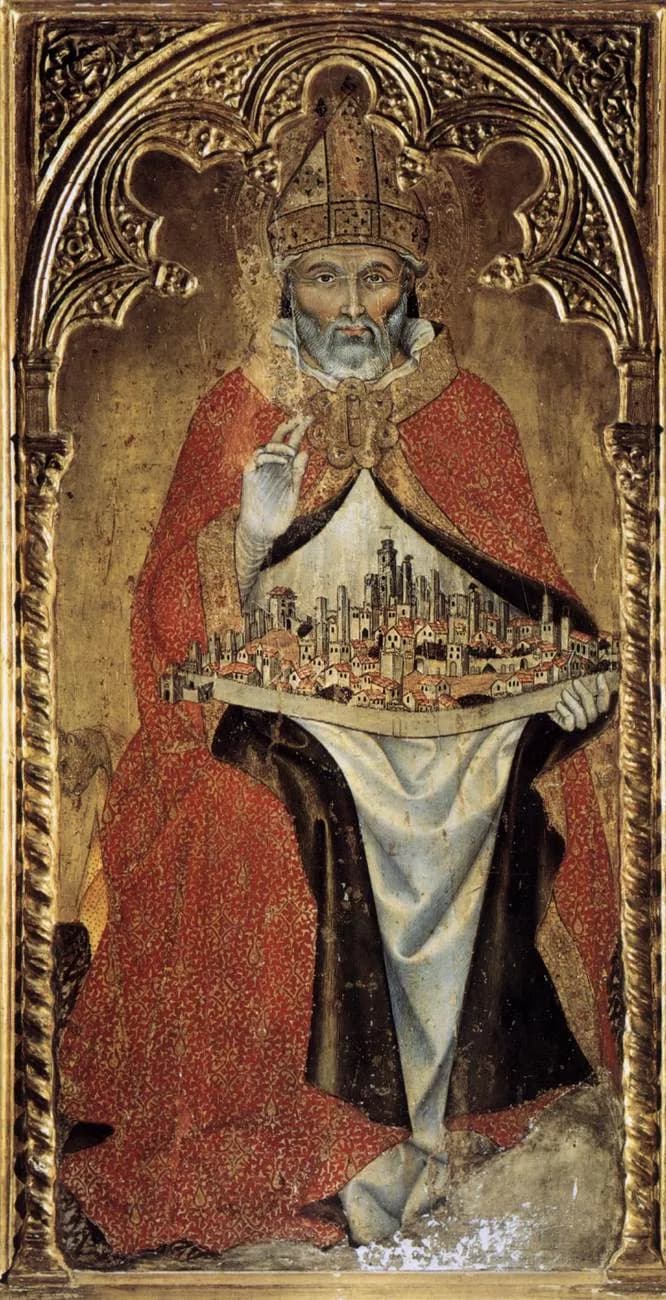
No picture of him survives from the first seven centuries after his death, though the archdiocese notes that his cult spread early and grew up around his relics. 3 The oldest images belong to the building of the cathedral. Over the Porta dei Principi, a side door carved around 1110, a lintel tells six scenes from the longer Life: Geminianus is summoned to the court of the Emperor Jovian at Constantinople and there frees the emperor's daughter from a demon. 3
The other great story is Attila. In the legend the Huns reach the gates of Modena. Geminianus announces himself as the servant of God, and Attila answers that he is the scourge of God. The bishop invites the Huns into the city and strikes them blind until they have marched out of the walls again. 3 The archdiocese tells this and then sets it aside: Attila was king of the Huns from 434 to 453, at least forty years after Geminianus died, and the two never met. 3 What the story shows, it suggests, is the real need of bishops in those centuries to defend their cities from raids, at a time when they held political and military responsibility as well as religious authority. 3 The 1911 encyclopedia gives the sparing of Modena in 452 to a later bishop, "St. Geminianus II," and even then only as something he "is said" to have done. 1
Two more miracles belong to Modena itself. On the anniversary of his death, a flood filled the city while the people were gathered in the cathedral; the water rose to the height of the doors and windows, yet not a drop touched those praying, and when they called on him it drew back. In the other, a boy fell from the Ghirlandina, the cathedral's bell tower, landed unhurt, and said that an old man with a white beard had caught him by the hair. 3 Through the fourteenth century his image was painted again and again on the outside walls of the cathedral, and fragments of those frescoes are now in the city's museums. 3
The house of Geminianus
Modena's cathedral was founded on June 9, 1099, when the clergy and people decided together to rebuild the old church that held his tomb, even though the see was then without a bishop. 56 John Paul II, writing for the nine hundredth anniversary, quoted the chapter archives: the people set out to renew, rebuild and raise up the church of so great a patron, to the glory of the Trinity and in honor of the Virgin Mary and of Geminianus. 6 The cathedral, built as the Domus clari Geminiani, the house of the renowned Geminianus, was dedicated to the Assumption, and his remains were moved into it from the earlier cathedral in 1106. 56 Pope Paschal II was present for the recognition of the body that year; the oldest written account of the cathedral records that everyone stretched out their hands to heaven and gave thanks. 6 It was consecrated in 1184. 5
That year Lucius III visited too. A stone on the cathedral's south side records the blessing he spoke as he left the city early one July morning: may this city be blessed by God the Father almighty, by the Son and the Holy Spirit, by the blessed ever-Virgin Mary, by blessed Peter the apostle and by blessed Geminianus. 7 John Paul II read it aloud to the people of Modena in 1988, the day he prayed at the tomb. 67
What is Saint Geminianus the patron saint of?
Saint Geminianus is the patron saint of the city and the Archdiocese of Modena. 45 Since a decree of the archbishop in 1986 he has shared the title with Pope Saint Sylvester I, formerly the patron of the Abbey of Nonantola, whose territory was joined to Modena's that year to form the present archdiocese. 4 John Paul II named the pair together in his homily in the city in 1988. 8 He wrote in 1999 that the people of Modena invoke Geminianus for his power over demons and venerate him as the Servant of the Gospel and the Father of the Faith. 6
Saint Geminianus's feast day
Praying with Saint Geminianus
Very little of him is left: his presence at a council, inferred from someone else's letter; a date of death; a sentence in the Martyrology about a church brought back to the faith. 23 The archdiocese does not pretend otherwise. It treats what came after as evidence of another kind, an early cult that grew up around his relics and a city that rebuilt its cathedral for his tomb. 36
John Paul II found the center of it in his tomb. Writing to Modena, he called Geminianus a man of much prayer and piety, and asked that the faith this servant of the Gospel of Christ handed on to the people of Modena be witnessed to and passed on to the next generations. 6 He had stopped to pray at the tomb himself in 1988, renewing, he wrote, what Paschal II had done in 1106 and Lucius III in 1184. 6
The legends, read as the archdiocese reads them, say something too. The bishop at the gate in front of the Huns never happened. The people who told the story lived when a bishop was the authority that answered for a city's safety, and they told it about the bishop they already prayed to. 3 The flood that stopped short of the people in the cathedral and the boy caught in midair are the same kind of story, told about the same man, in the same building. 3
Saint Geminianus of Modena, pray for us.
Sources
- 1.Umberto Benigni, "Modena," The Catholic Encyclopedia, Vol. 10 (New York: Robert Appleton Company, 1911).
- 2.Roman Martyrology, entry for January 31, "San Gimignano, vescovo," as printed in "Santo del giorno," Conferenza Episcopale Italiana (in Italian).
- 3."San Geminiano Vescovo," Arcidiocesi di Modena-Nonantola (in Italian).
- 4."Storia," Arcidiocesi di Modena-Nonantola (in Italian).
- 5."Duomo di Modena," Arcidiocesi di Modena-Nonantola (in Italian).
- 6.John Paul II, Letter to Archbishop Benito Cocchi of Modena-Nonantola for the ninth centenary of the Cathedral of Modena, May 28, 1999 (in Italian).
- 7.John Paul II, Address to the citizens of Modena, June 3, 1988 (in Italian).
- 8.John Paul II, Homily at Modena, June 4, 1988 (in Italian).
Saints to turn to next
Others in this collection who are turned to for some of the same things.