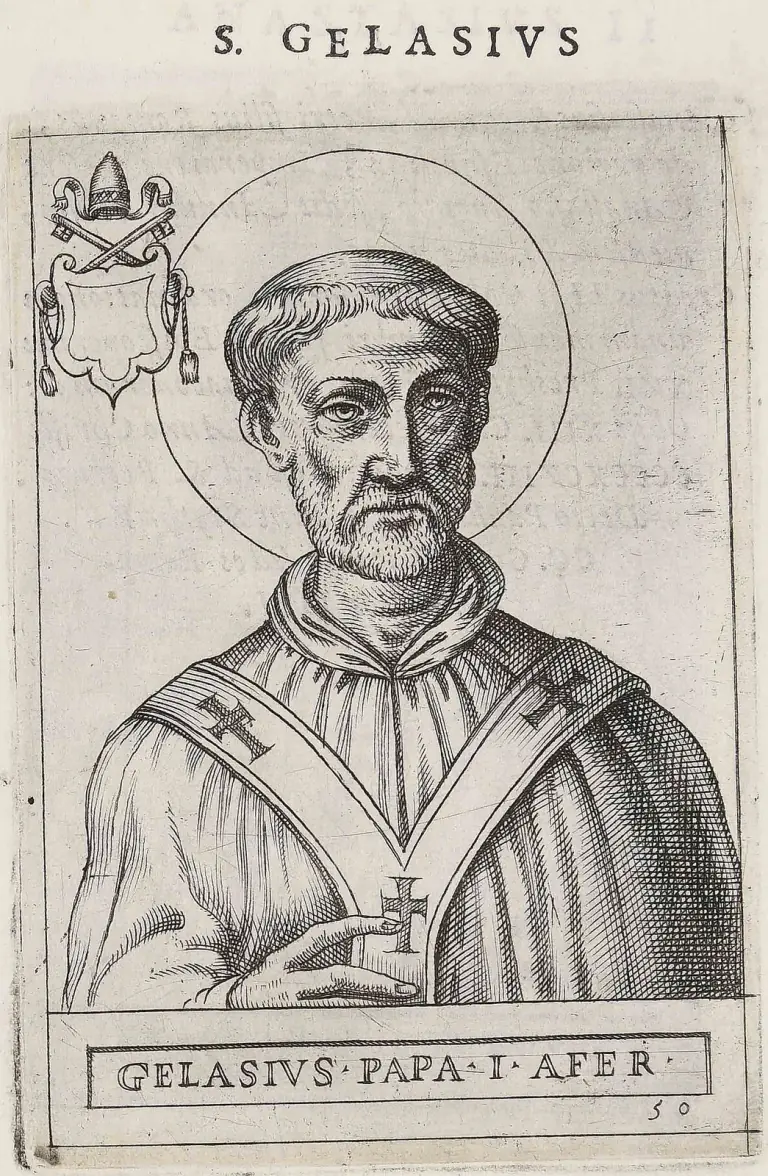
Saint Gelasius I
Died November 496
- Known for
- The letter to the emperor Anastasius on the two powers; holding firm in the Acacian schism; ending the Lupercalia 124
- Called
- "Father of the poor" 2
Saint Gelasius I was pope for four and a half years, from 492 to 496, and wrote to the emperor in Constantinople that the world is ruled chiefly by two powers, the sacred authority of bishops and the power of kings, and that the bishops' is the weightier. 13 He held the Roman line in a schism with the East that had begun before him and outlasted him, kept a hungry city fed in years of war, and died having given away everything he had. 124 His feast is November 21. 14
An African, a Roman, or both
The first fact about Gelasius is already disputed. In his letter to the emperor Anastasius he calls himself Romanus natus, born a Roman. 1 The Liber Pontificalis, the old chronicle of the popes, calls him "by nationality an African, son of Valerius." 3 J.F.X. Murphy, writing in the Catholic Encyclopedia, reports two ways of reconciling them: that he was of African descent but born in Rome, or that he was African by birth and a Roman citizen. 1 The Norwegian bishops' saints database (katolsk.no) takes the first view, and adds that his father Valerius was a priest. 2
Nothing is known of his early life. 2 He first appears in 483, when Pope Felix III brought him into the papal chancery, and katolsk.no says Felix decided almost nothing without consulting him. 2 He drew up documents for Felix, which, as Murphy notes, has led some scholars to confuse the writings of the two men. 1 When Felix died on March 1, 492, Gelasius was elected the same day. 12
The Acacian schism
He inherited a quarrel with Constantinople. In the 480s the patriarch Acacius had drawn up the Henoticon, a formula of union which, in Cornelius Clifford's words in the encyclopedia, passed over the teaching of the Council of Chalcedon "in silence," and the emperor Zeno had imposed it on the East. 5 Pope Felix excommunicated Acacius, and Acacius answered by striking the pope's name from the diptychs, the lists of names read at the liturgy. 5 Acacius died in 489, but his schism, Clifford says, "outlived him some thirty years." 5
Gelasius would not bend. The new patriarch, Euphemius, was orthodox and wanted peace, but katolsk.no says Gelasius insisted there could be none until Acacius's name was taken out of the diptychs, and spent letter after letter defending a sentence the East thought uncanonical. 2 Murphy calls this firmness a refusal to make any peace "that compromised in the slightest degree the rights and honor of the Chair of Peter." 1 The emperor Anastasius was irritated, and katolsk.no adds that the hard line made Gelasius enemies in Rome as well. 2
He could also restore people. Misenus, a bishop Felix had sent to Constantinople and then excommunicated for giving way there, was received back at a Roman synod. 25 The Liber Pontificalis says Gelasius did it "with weeping," after "the laws of penance had been fulfilled." 3 katolsk.no dates the synod to May 13, 495, and says it is the first occasion on which a pope is known to have been called the Vicar of Christ; Loomis, in a note to her translation, dates it to March 495. 23 The schism itself did not end until 519, under Pope Hormisdas. 15
The letter on the two powers
In 494 Gelasius wrote to Anastasius the letter for which he is best known. 23 Murphy quotes its central sentence: "There are two powers by which chiefly this world is ruled: the sacred authority of the priesthood and the authority of kings. And of these the authority of the priests is so much the weightier, as they must render before the tribunal of God an account even for the kings of men." 1 The rendering Loomis prints in her notes goes on: "You know, therefore, that you are dependent upon their decision and that they will not submit to your will." 3
The Roman Martyrology reads the letter more gently. It says that Gelasius, to keep imperial authority from harming the unity of the Church, explained the prerogatives of the temporal and the spiritual power with real depth and argued that each needed its freedom from the other. 4 katolsk.no calls this teaching his most original contribution, says it shaped political thought in the West through the whole of the Middle Ages, and notes that he was still being cited as an authority at the First Vatican Council in 1870. 2
A pope in a hungry city
Italy in those years belonged to Arian Goths. Theodoric was besieging Odoacer in Ravenna when Gelasius was elected; there were refugees, broken supply lines and too few clergy. 2 Gelasius got on well with Theodoric, who did not interfere in the affairs of the Church, and katolsk.no says he relieved famine by sending food from the papal estates and by asking the king for help. 2 The Liber Pontificalis says simply that "he delivered the city of Rome from the peril of famine," and calls him "a lover of the clergy and of the poor." 3
Loomis prints part of a letter he wrote to Firmina, a lady of rank, asking her to restore lands belonging to Saint Peter that the armies had seized: they were needed, he wrote, for the hungry people flooding into Rome from the devastated provinces. 3 He spent his own fortune the same way and was called the father of the poor. 2 Murphy credits him with enforcing the old rule that a church's revenues be split four ways, with one share for the poor, and says he pressed it on his bishops again and again. 1
He also fought a festival. The Lupercalia, a pagan rite in which young men ran through the streets striking women they met, had been revived by a group of Romans led by the senator Andromachus after a plague. 2 Gelasius forbade Catholics any part in it and wrote a treatise against it. 12 Loomis quotes one of its questions about the city's old gods: "why did they not give you tranquil seas so that the ships might reach here with grain in winter and the city suffer less with want?" 3 Murphy says the pope abolished the festival "after a long contest." 1
What he wrote, and what he did not
Murphy calls him, on report, "the most prolific writer of all the pontiffs of the first five centuries," of whose work forty-two letters, fragments of forty-nine more, and six treatises survive. 1 The Liber Pontificalis says he wrote hymns "after the manner of the blessed Ambrose" and prefaces and prayers for the liturgy; Loomis notes that the hymns are all lost. 3
Two famous documents carry his name and are probably not his. The Gelasian Sacramentary, Murphy says, "belongs properly to the next century," and the list of canonical Scripture once credited to him is more probably the work of Pope Damasus. 1 katolsk.no goes further: neither the Decretum Gelasianum nor the Gelasian Sacramentary in any of its forms is his, though eighteen Mass formularies preserved in the Leonine Sacramentary go back to him. 2
How others saw him
Murphy describes a man given to prayer, penance and study, who liked the company of monks and was "a true father to the poor, dying empty-handed as a result of his lavish charity." 1 The witness most often quoted is Dionysius Exiguus, who knew Gelasius through the priests he had trained. Loomis summarizes him: Gelasius spent all he had on the poor, died in poverty, and looked on his office as a chance to serve rather than to rule. 3
katolsk.no does not hide the other side. It says his own writings leave the impression of an arrogant, narrow-minded and rough pope, and then sets beside them Dionysius's picture of his humility, his love of Scripture and his generosity, which it takes as the measure of how his contemporaries revered him. 2
He died in November 496. Murphy gives the date as November 19 and the burial as November 21, "though many writers give this as the day of his death"; katolsk.no is one of them. 12 He was buried in Saint Peter's, and the see stood empty for seven days. 3 Where exactly his grave lay is not known. 2
What is Saint Gelasius I the patron saint of?
Saint Gelasius I's feast day
Saint Gelasius I's feast day is November 21. Murphy states it: "The feast of St. Gelasius is kept on 21 Nov., the anniversary of his interment." 1 The Liber Pontificalis records that he was buried in Saint Peter's on that day. 3 The current Roman Martyrology, as the Italian bishops print it, enters him on November 21, at Rome beside Saint Peter's, as a pope outstanding in learning and holiness who, to help the poor, himself died very poor. 4 The 1897 English Martyrology kept him on the same day, "distinguished by his learning and sanctity." 6 katolsk.no gives November 21 as well. 2
Praying with Saint Gelasius I
Gelasius is not an easy saint to warm to from his letters, and one of the sources says so plainly. 2 He was unbending with the East for the whole of his short reign, and the peace he would not buy on easier terms came only after his death. 15
The same man spent his fortune on refugees, wrote to a noblewoman to get back land that could feed them, and asked a king for grain. 23 The Martyrology puts the two sides of him in a single sentence, the teacher of the two powers and the pope who, moved by the needs of the poor, died very poor himself. 4
His one famous sentence was about the weight of a bishop's account before God, an account he said a bishop must give even for kings. 1 Dionysius Exiguus, who never met him, still learned from the priests he trained to remember him as a pope who thought of his office as service. 3
Saint Gelasius I, pray for us.
Sources
- 1.John F.X. Murphy, "Pope St. Gelasius I," The Catholic Encyclopedia, vol. 6 (New York: Robert Appleton Company, 1909).
- 2."Den hellige pave Gelasius I," Den katolske kirke, the saints database of the Catholic Church in Norway, katolsk.no (in Norwegian).
- 3.The Book of the Popes (Liber Pontificalis), vol. 1, "LI. Gelasius (492-496)," translated with notes by Louise Ropes Loomis (New York: Columbia University Press, 1916), Internet Archive.
- 4.Roman Martyrology, entry for November 21, "San Gelasio I, papa," Santo del giorno, Conferenza Episcopale Italiana (in Italian).
- 5.Cornelius Clifford, "Acacius," The Catholic Encyclopedia, vol. 1 (New York: Robert Appleton Company, 1907).
- 6.The Roman Martyrology, November 21 (Baltimore: John Murphy Company, 1897), Internet Archive.
Saints to turn to next
Others in this collection who are turned to for some of the same things.