Saint Gall
Irish-born; died c. 630 or c. 646
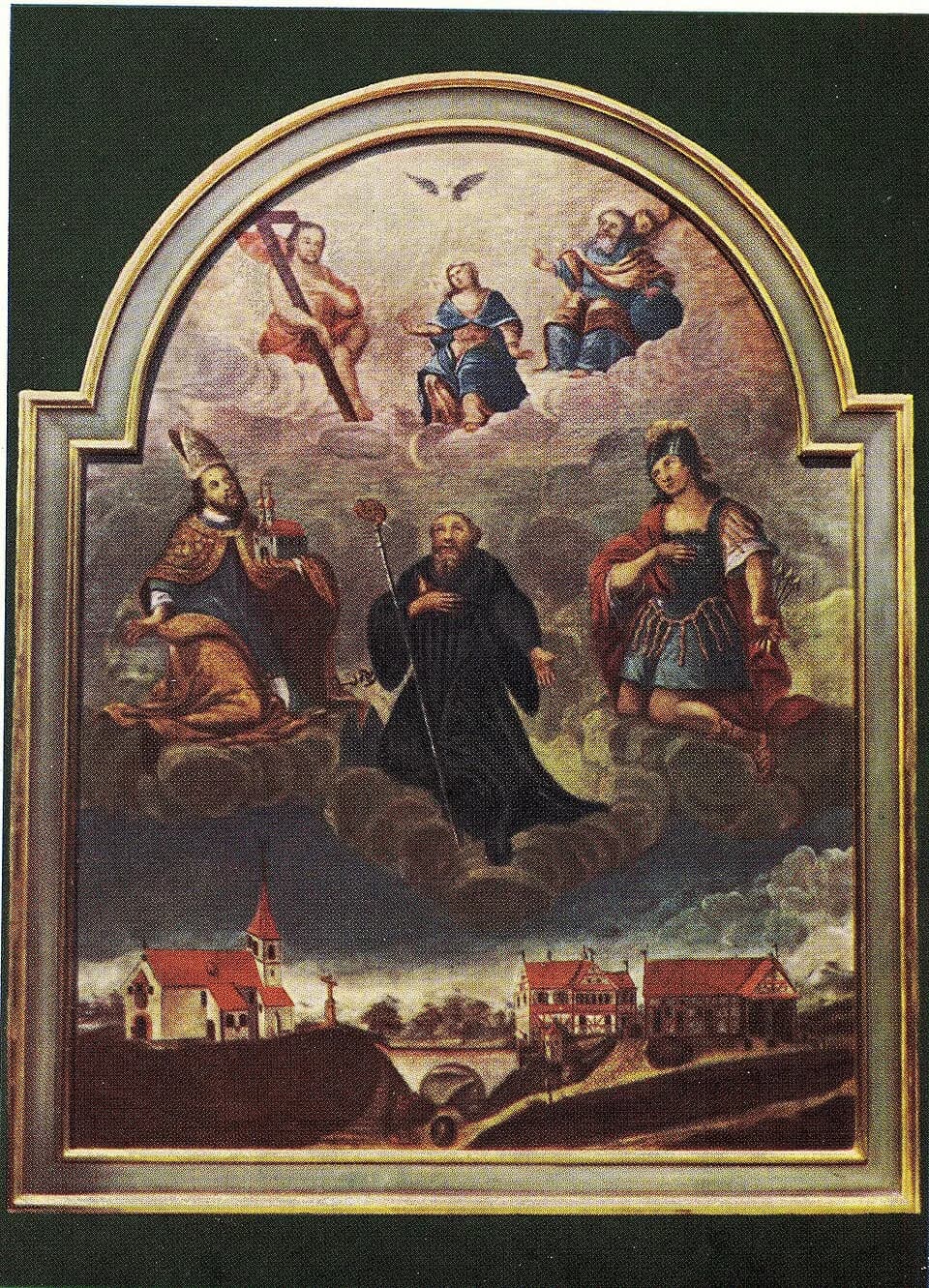
- Patron saint of
- No source consulted assigns him a patronage. Ott ranks him, after Maurice, among the most popular saints in Switzerland 7
- Also called
- Gallus, and in the oldest manuscripts Gallo, Gallonus, Gallunus, Callo and other forms 1
- Left Ireland
- With Columban as one of his twelve companions: in 573 according to Duffy, reaching Gaul in 576 according to Franciscan Media, and in France probably by 585 according to Edmonds 356
Saint Gall was an Irish monk, one of the twelve who left with Columban, and the one who stayed behind when his master crossed the Alps into Italy in 612. 134 He lived the rest of his life as a hermit with a few companions in the wilderness west of Bregenz, by the river Steinach, and the great Abbey of St. Gall grew up over his cell after he was dead. 12 The stories of his quarrel with Columban and of the bear that carried his firewood come from Lives of him, the oldest no earlier than the end of the eighth century, and the 1909 Catholic Encyclopedia is careful to say so. 1
One of the twelve
He was "an Irishman by birth", and the oldest manuscripts spell his name a dozen ways: Gallo, Gallonus, Gallunus, Callo, even Chelleh. 1 Patrick Duffy, writing for the Irish bishops' site Catholicireland.net, says he came from Leinster and was brought by his parents to Bangor in County Down to be trained in Comgall's monastery. 5 That is the house Columban left too, and Gall appears in the list of companions the Catholic Encyclopedia gives for him: "St. Attala, Columbanus the Younger, Cummain, Domgal, Eogain, Eunan, St. Gall", and five more. 3 A Franciscan Media article adds that Deicolus, later the founder of Lure, was among them and was Gall's brother. 6
The sources do not agree on when they set out. Duffy gives 573; Franciscan Media has them arriving in Gaul in 576; the encyclopedia's article on Columban says they reached France "probably in 585." 356 They settled with Columban at Luxeuil in the Vosges. 1
Up the Rhine to Bregenz
When Columban was expelled from Burgundy, the ship meant to carry the Irish monks home ran aground, and they went up the Rhine instead. 4 Benedict XVI, in his 2008 audience on Columban, traces the route: "After a first stop in Tuggen near Lake Zurich they went to the region of Bregenz, near Lake Constance, to evangelize the Alemanni." 4 Albert Poncelet's encyclopedia article on Gall dates that voyage to 610 and says plainly that Gall "followed his magister." 1
At Bregenz the monks found an oratory of Saint Aurelia into which the people had brought three brass images of their gods. Columban "commanded St. Gall, who knew the language, to preach to the inhabitants, and many were converted. The images were destroyed." 3 Duffy tells it with Gall doing the destroying himself: he broke the images into pieces and threw them into the lake. 5
The quarrel with Columban
In 612 Columban moved on into Italy. Benedict XVI puts it in a sentence: "Only one monk whose name was Gallus stayed behind; it was from his hermitage that the famous Abbey of St Gall in Switzerland subsequently developed." 4 Poncelet says the same and no more, as part of what he calls the authentic history. 1
The Lives tell what happened between them, and they do not flatter Columban. Gall was "prevented by illness from following Columbanus to Italy" and "was placed under interdict by the displeased Columbanus, and in consequence could not celebrate Mass until several years later, after the death of his old master." 1 Duffy gives the same story more sharply: Gall "pleaded a fever, but Columbanus felt he was malingering and lacked obedience, so he forbade him to say Mass again while he, Columbanus, lived." 5 He records too that the rift may have begun earlier, over fishing (Gall caught more fish) or over plans for the future. 5
It did not end there. According to Duffy, before Columban died at Bobbio in 615 he asked that his pastoral staff be sent to Gall "as a sign of forgiveness." 5 Neither encyclopedia article mentions the staff. 13
A hermit by the Steinach
What can be said with confidence is short. Gall "remained in Swabia, where, with several companions, he led the life of a hermit, in a desert to the west of Bregenz, near the source of the river Steinach." 1 After his death a church was put up there, an "ecclesia Sancti Galluni" with a priest in charge. 1 Alston's article on the abbey says he died "about 646"; Duffy says around 630. 25
The Lives add a good deal, and Poncelet warns that while some of it "is perhaps true", another part "is certainly legendary". 1 In them Gall had been ordained a priest in Ireland before he ever left. 1 He freed Fridiburga, the betrothed of King Sigebert, from a demon, and the grateful king gave him land near Arbon for a monastery. 1 He twice refused to become Bishop of Constance and helped secure the election of a deacon named John instead. 1 When the monks of Luxeuil offered him their abbacy after the death of Eustace, he turned that down as well. 1 Duffy reports the refusals the same way: he "chose to remain a hermit." 5 The Lives have him die at ninety-five, at Arbon, while on a visit, with his body brought back to the monastery. 1
The bear belongs to these Lives. "The saint is ordinarily represented with a bear; for a legend, recorded in the Lives, relates that one night, at the command of the saint, one of these animals brought wood to feed the fire which Gall and his companions had kindled in the desert." 1 Duffy tells it as "one story about him." 5 It is a legend and both sources say so, but it is the reason almost every image of him has a bear in it.
The abbey that took his name
Gall did not found the abbey. Duffy is blunt about it: the monastery "was a later Benedictine foundation built to guard his relics." 5 Poncelet says the church at his cell became "a real monastery" before the middle of the eighth century under its first abbot, Otmar, and that it was called the Abbey of St. Gall "not from the name of its founder and first abbot, but of the saint who had lived in this place and whose relics were honoured there." 1 Ott's article on Otmar dates his appointment to 720. 7 Alston's article on the abbey dates the foundation itself to "about 613", while also naming Otmar, Charles Martel and Pepin as its principal founders. 2
What grew there was one of the chief houses of Europe. Alston describes its schools, its scriptorium, a library whose ninth-century catalog still survives with "over four hundred" of its manuscripts still at St. Gall, and a school of chant founded by a Roman singer sent north by Pope Adrian I. 2 The town around it took his name too. 23 Edmonds, writing about Columban, puts it in one line: "The canton and town still bearing the name of St. Gall testify how well one disciple succeeded." 3
What is Saint Gall the patron saint of?
None of the sources consulted for this page assigns Saint Gall a patronage. 125 This page therefore does not claim one for him.
What the sources do record is how much he was loved where he lived. Ott, writing in 1911 about Otmar, calls Otmar "next to St. Maurice and St. Gall, the most popular saint in Switzerland." 7 Duffy notes that in Alsace his feast was the marker for harvesting apples and for bringing the cows down from pasture to the stable for winter. 5
Saint Gall's feast day
The feast of Saint Gall is October 16. 15 Poncelet calls it "the day ascribed to him in some very ancient martyrologies", and notes that the martyrologist Ado, "it is not known for what reason", puts it on 20 February instead. 1 Duffy adds that his name is in martyrologies of the early ninth century. 5
He shares the day with better-known saints. Vatican News's calendar for October 16 lists Hedwig, Margaret Mary Alacoque and Gerard Majella. 8 It does not list Gall, but that calendar is selective, and its silence says nothing either way about where he is kept.
Praying with Saint Gall
The center of his story is a man who did not go. Columban crossed the Alps with most of his monks, and Gall stayed behind with a few, either sick or, as his abbot believed, pretending to be. 145 The sources do not settle which, and they let the reader see that someone could be judged harshly by the abbot he had followed out of Ireland.
The punishment was real. For a priest to be forbidden the Mass by his own abbot, and to keep that prohibition until the abbot was dead, is a long obedience, and the Lives say he kept it. 1 If Duffy's account of the staff is right, the last word between them came from Columban's deathbed, and it was forgiveness. 5
What he did with the rest of his life was very little that left a mark at the time: a cell by a river, a few companions, a fire at night. 1 He turned down a bishopric and an abbacy, by the Lives' account, and stayed where he was. 15 Everything that carries his name now, the abbey, the library and the city, was built by other people after his death, around the place where he had prayed. 12
The bear is a legend, and the encyclopedia calls it one. 1 It has lasted more than a thousand years in pictures of him all the same, an animal carrying wood to a hermit's fire in the dark.
Saint Gall, pray for us.
Sources
- 1.Albert Poncelet, "St. Gall," The Catholic Encyclopedia, Vol. 6 (New York: Robert Appleton Company, 1909).
- 2.George Cyprian Alston, "Abbey of St. Gall," The Catholic Encyclopedia, Vol. 6 (New York: Robert Appleton Company, 1909).
- 3.Columba Edmonds, "St. Columbanus," The Catholic Encyclopedia, Vol. 4 (New York: Robert Appleton Company, 1908).
- 4.Benedict XVI, General Audience on Saint Columban, June 11, 2008.
- 5.Patrick Duffy, "Oct 16 - St Gall (550-630) hermit and missionary," Saint of the Day, Catholicireland.net, October 16, 2012.
- 6.Brian O'Neel, "Saint Who? Deicolus of Lure," Franciscan Spirit, Franciscan Media, May 19, 2020.
- 7.Michael Ott, "St. Othmar," The Catholic Encyclopedia, Vol. 11 (New York: Robert Appleton Company, 1911).
- 8."16 October," Saint of the Day, Vatican News.
Saints to turn to next
Others in this collection who are turned to for some of the same things.