Saint Gabriel the Archangel
Archangel
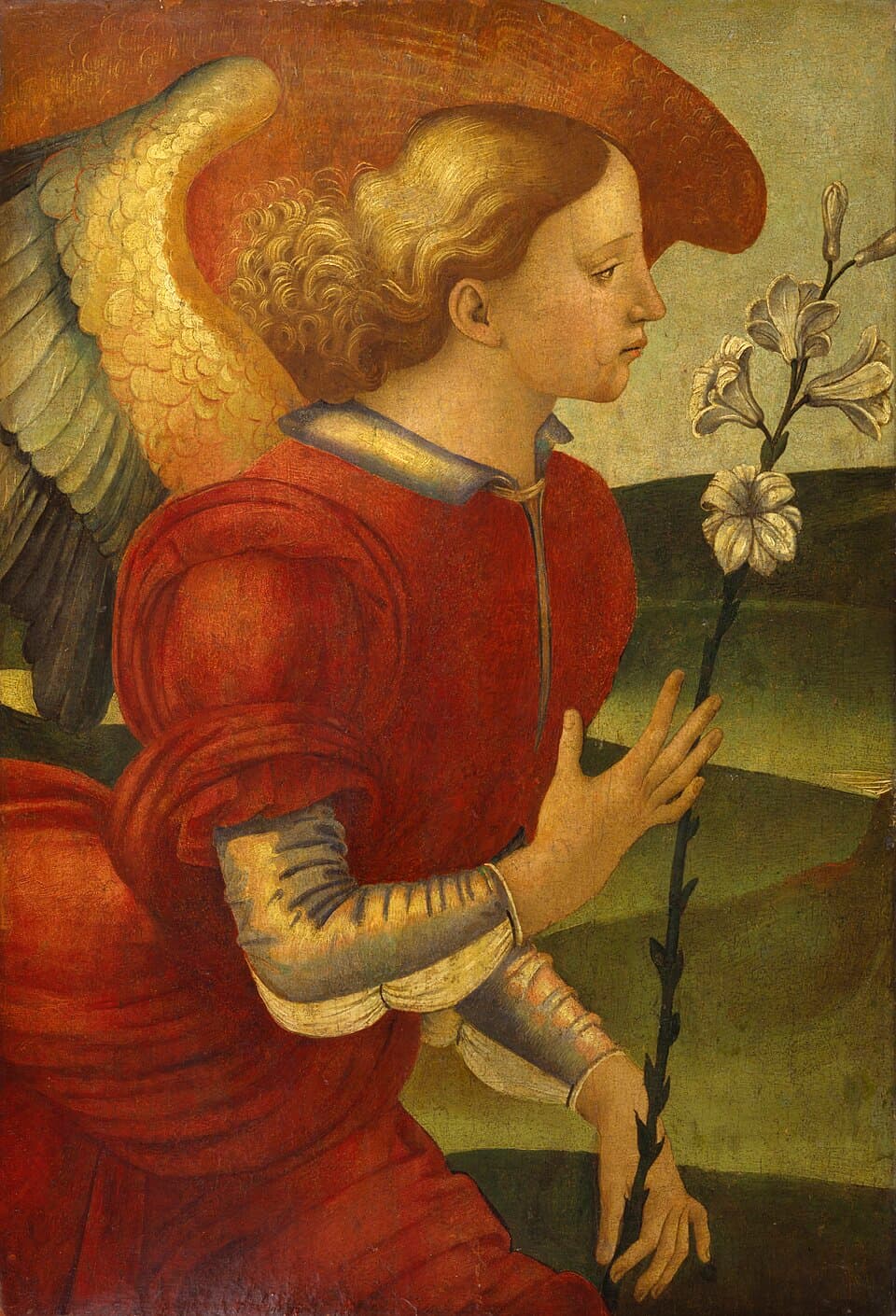
- Patron saint of
- Broadcasters and communicators 2; telecommunications and those who work in it, by an apostolic brief of Pius XII in 1951 4
- Name
- "Fortitudo Dei," the strength of God 1
- Calls himself
- "I am Gabriel, who stand before God" (Luke 1:19) 8
Saint Gabriel the Archangel is the angel who brought the news of the Incarnation: sent "to a town of Galilee called Nazareth," to a virgin named Mary, to tell her she would bear a son and name him Jesus. 8 He appears in Scripture only four times, twice to the prophet Daniel and twice in the first chapter of Luke, and every time he comes to explain something or to announce it. 1 Franciscan Media puts the three archangels in a line: "Michael protects; Gabriel announces; Raphael guides." 2
The strength of God
The Catholic Encyclopedia gives his name as "Fortitudo Dei," the strength of God, and counts him one of the three archangels mentioned in the Bible. 1 Michael and Raphael are the other two; no other angel in Scripture is named. 2 Benedict XVI, preaching on their shared feast, pointed out that all three names end in "El," which means "God": "God is inscribed in their names, in their nature." 5
The encyclopedia makes a small observation about the passages where Gabriel appears that is worth checking for yourself: words like "great," "might," "power" and "strength" keep turning up in them. 1 For an angel whose name is strength, it reads like a signature.
Daniel by the Ulai
His first appearance is in the eighth chapter of Daniel. The prophet has seen a vision of a two-horned ram and a he-goat, and while he is trying to make sense of it a figure like a man stands in front of him, and a human voice cries out over the river Ulai: "Gabriel, explain the vision to this man." 6 Daniel falls on his face in terror. Gabriel touches him, stands him up, and walks him through it: the ram is the kings of the Medes and Persians, the goat the king of the Greeks. 6
The encyclopedia reads the vision as the fall of the Persian Empire to Alexander the Great, the division of his kingdom among his generals, and the rise of Antiochus Epiphanes from one of them. 1 It did not settle Daniel. The chapter ends with him ill for days, back at work for the king, and still "appalled at the vision, which I could not understand." 6
At the time of the evening sacrifice
The second appearance, in Daniel 9, comes as an answer to prayer. Daniel has been confessing his own sin and the sin of his people, and pleading for Jerusalem: "O Lord, hear! O Lord, pardon!" 7 While he is still praying, Gabriel, "the one whom I had seen before in vision," arrives "in rapid flight at the time of the evening sacrifice," which the NAB's note puts between three and four in the afternoon. 7
What Gabriel says first is the part people remember: "When you began your petition, an answer was given which I have come to announce, because you are beloved." 7 Then he delivers the prophecy of the "seventy weeks" 7, which the encyclopedia describes as the years that would pass before the coming of Christ. 1
Daniel 10, and a disagreement
The sources do not agree on whether there is a third appearance in Daniel. Franciscan Media says Gabriel turns up in Daniel's visions "announcing Michael's role in God's plan" 2, which is the tenth chapter, where an unnamed angel tells Daniel that Michael came to his help. The 1909 encyclopedia is more careful: in chapter 10 "it is not clear whether the angel is Gabriel or not." 1 It counts four certain appearances in all, two in Daniel and two in Luke. 1
Zechariah in the sanctuary
Luke opens with an old priest named Zechariah, married to Elizabeth, both "righteous in the eyes of God" and both childless. 8 Chosen by lot to burn incense in the sanctuary, he sees an angel standing at the right of the altar, and is afraid. 8 The angel tells him not to be: his prayer has been heard, Elizabeth will bear a son, and he is to name him John. 8
Zechariah asks for proof. He is an old man and his wife is advanced in years. 8 The answer is the only time in Scripture Gabriel says who he is: "I am Gabriel, who stand before God. I was sent to speak to you and to announce to you this good news." 8 For his doubt Zechariah is struck speechless until it happens, and comes out to the waiting crowd unable to say a word. 8 His voice comes back only at the naming, when he writes on a tablet, "John is his name." 8
The NAB's note on the passage makes the link back to Daniel explicit. The angel of the Lord is identified as Gabriel, the same angel who in Daniel 9 announced the seventy weeks and the coming of an anointed one. 8
Nazareth
Six months later Gabriel is sent again, to Nazareth, to a virgin betrothed to a man named Joseph, and greets her: "Hail, favored one! The Lord is with you." 8 Mary is "greatly troubled" and wonders what kind of greeting it is. 8 He tells her not to be afraid, that she will conceive and bear a son, call him Jesus, and that he will be called Son of the Most High. 8 She asks how, since she has had no relations with a man. He tells her the holy Spirit will come upon her and gives her a sign, her relative Elizabeth, pregnant in her old age, "for nothing will be impossible for God." 8 She answers, "May it be done to me according to your word," and the angel leaves. 8
The NAB points out that the two scenes are built as a pair: in each the parent is troubled, is told not to fear, hears the announcement, objects, and is given a sign. 8 The difference is in how the question is received. Zechariah is punished for his doubt; Mary, the note says, "in spite of her doubt, is praised and reassured." 8
Benedict XVI described the scene this way: Gabriel "knocks at Mary's door and, through him, God himself asks Mary for her 'yes'." 5 Gabriel brings the request. The answer is hers.
The angel of the Incarnation
Across all four appearances, the encyclopedia concludes, Gabriel is "the angel of the Incarnation and of Consolation," and so in Christian tradition he is the angel of mercy, while Michael is the angel of judgment. 1 It adds that Jewish tradition read the two the other way around, made Gabriel the angel of judgment, and credited him with the destruction of Sodom and of Sennacherib's army. 1
Christian tradition has also supposed, the encyclopedia says, that Gabriel was the angel who appeared to Joseph and to the shepherds, and the one who strengthened Christ in the garden. It calls this "not unreasonable" and leaves it at that. 1 Luke names him only twice. 1
His words to Zechariah, "who stand before God," have led some to place him among the highest ranks of angels. The encyclopedia gives the more usual explanation, citing Thomas Aquinas: it refers to his rank as one of the highest of God's messengers. 1
What is Saint Gabriel the patron saint of?
Franciscan Media lists Saint Gabriel as the patron saint of broadcasters and communicators. 2 The patronage has a date and a document behind it. According to Vatican News, Pius XII in a 1951 apostolic brief declared the archangel the heavenly patron of telecommunications, of the telegraph, the telephone, radio and the seeing of distant events, and of the people who work in those fields or study them. 4 Vatican News adds that Gabriel was afterward also declared patron of Vatican Radio. 4
Franciscan Media also lists patronages Gabriel shares with Michael and Raphael: death, Germany, grocers, police officers and first responders, and radiologists. 2
Saint Gabriel's feast day
Saint Gabriel is honored on September 29, together with the archangels Michael and Raphael. 23 Benedict XVI ordained six bishops on that day in 2007 and called it "the Feast of the three Archangels who are mentioned by name in Scripture." 5
It was not always a shared day. Franciscan Media records that the memorials of Gabriel and Raphael were added to the Roman calendar in 1921, and that the 1970 revision of the calendar joined their individual feasts to Michael's. 2 Vatican News says the archangels were once kept on many different dates, and that after the reforms of the Second Vatican Council they are remembered together on September 29. 4 The 1909 encyclopedia, written before Gabriel had a place on the universal calendar, refers to "the Hymn for Lauds on 24 March." 1 The Annunciation itself is kept on March 25. 4
Praying with Saint Gabriel
Gabriel's visits to Daniel were answers to a man trying to understand. Daniel studied a vision he could not make sense of, and later prayed for his city until the evening sacrifice. 67 The answer, Gabriel told him, had been given the moment he began to pray. 7 And the first time, after the explanation, Daniel still could not understand what he had seen and went back to work for the king anyway. 6
Gabriel came to Zechariah and to Mary in the middle of their ordinary lives. Zechariah was taking his turn at the incense; Mary was a betrothed girl in a Galilean town. 8 Both were troubled, both were told not to be afraid, and both asked a question. 8 Zechariah lost his voice for months over his. 8 Mary's was answered, and then she had to decide. 8
The message Gabriel carried was never his own. He says of himself only that he stands before God and was sent. 8 Benedict XVI told the bishops he was ordaining that they, too, could take up Gabriel's role: "to bring Christ's call to men." 5 Pius XII, according to Vatican News, saw the same office in the people who carry voices and pictures across distances. 4
Saint Gabriel the Archangel, pray for us.
Sources
- 1.Hugh Pope, "St. Gabriel the Archangel," The Catholic Encyclopedia, Vol. 6 (New York: Robert Appleton Company, 1909).
- 2."Saints Michael, Gabriel, and Raphael," Saint of the Day, Franciscan Media.
- 3."St. Gabriel, Archangel," Saint of the Day, 29 September, Vatican News.
- 4."S. Gabriel, arcángel," Santo del día, 29 September, Vatican News (Spanish edition).
- 5.Benedict XVI, Homily at the Holy Mass with Episcopal Ordinations, St. Peter's Basilica, September 29, 2007 (Libreria Editrice Vaticana).
- 6.Daniel 8, New American Bible (Libreria Editrice Vaticana).
- 7.Daniel 9, New American Bible (Libreria Editrice Vaticana).
- 8.Luke 1, New American Bible (Libreria Editrice Vaticana).
Saints to turn to next
Others in this collection who are turned to for some of the same things.