Saint Felix III
Died March 1, 492
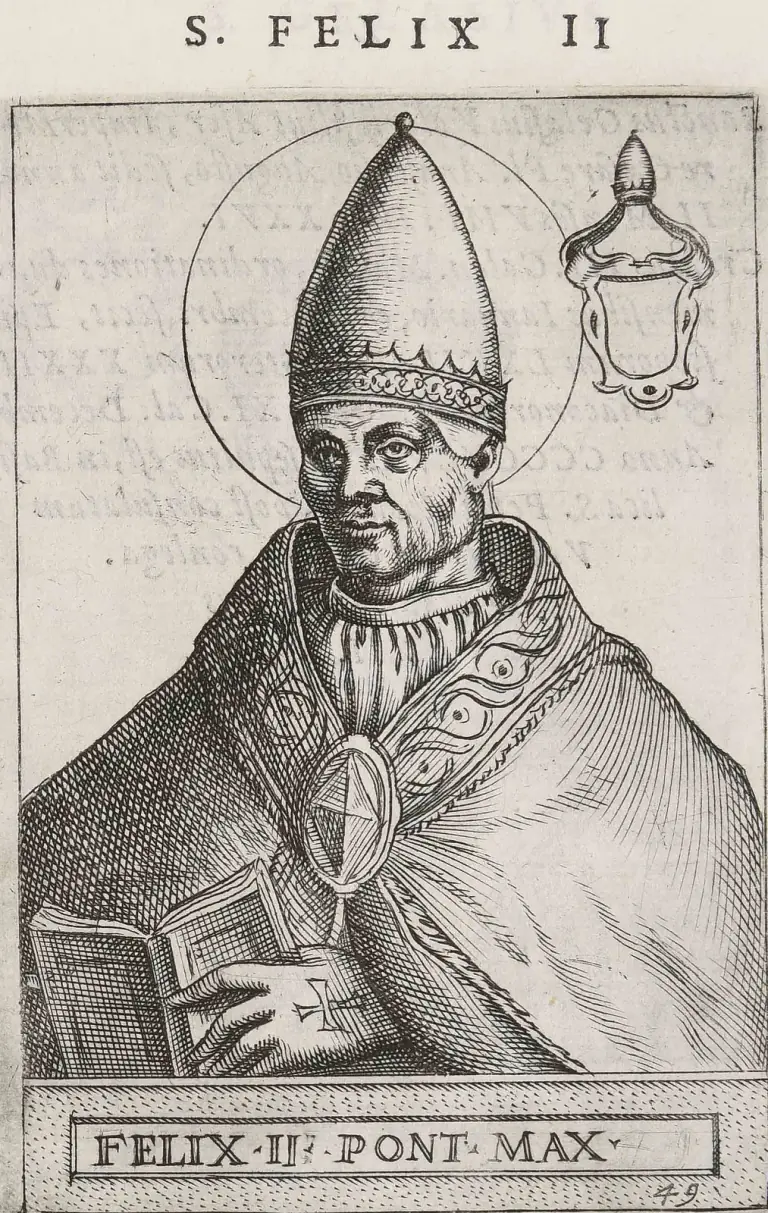
Saint Felix III was pope from 483 to 492. In 484 he excommunicated Acacius, patriarch of Constantinople, and the Acacian schism that followed divided Rome from the Eastern Church for some thirty-five years. 125 He was a Roman of senatorial family who had been married and had children, and Pope Saint Gregory the Great was his descendant. 1239 His feast is March 1. 24
Felix II or Felix III
His number needs explaining before anything else. In the 350s, while Pope Liberius was in exile for refusing to condemn Saint Athanasius, the emperor Constantius had the Roman archdeacon Felix consecrated in his place. 8 Johann Peter Kirsch, in the Catholic Encyclopedia, calls him "Pope (more properly Antipope)" and says that later legend, the Liber Pontificalis among it, turned him into a saint and a confessor of the faith. 8 Because that Felix was once counted among the popes as Felix II, the two later popes of the name each carry two numbers. 2
The current Roman Martyrology and the Catholic Encyclopedia call the pope of 483 Felix III. 14 The Norwegian bishops' saints database (katolsk.no) calls him Felix II and puts III in parentheses, treating the higher number as the mistaken one. 2 Cornelius Clifford, writing on Acacius, splits the difference with "Felix II (or III)." 5 This page follows the Martyrology.
A Roman family
The Liber Pontificalis, the old chronicle of the popes, calls him "by nationality a Roman, son of Felix, priest of the parish church of Fasciola," the church now called Santi Nereo ed Achilleo. 3 Ambrose Coleman, in the Catholic Encyclopedia, says he was born of a Roman senatorial family. 1 katolsk.no names it as the gens Anicia and calls his father a nobleman. 2
Felix was married. katolsk.no says he was a widower with at least two children, and that his wife died before he became a priest. 2 Louise Ropes Loomis, in the notes to her translation of the Liber Pontificalis, reports epitaphs found in the basilica of Saint Paul that are probably those of his father, his wife and two of his children; the wife, Petronia, died in 472, "while her husband was only a deacon." 3
Coleman says that nothing certain is known of Felix before he became pope. 1 Pope Simplicius died on March 10, 483, and katolsk.no says Felix was elected on March 13. 2 The prefect Basilius, who served the Germanic king Odoacer, ruler of Italy since 476, played a decisive part in the election, as Simplicius had wished, and announced a law forbidding the pope, under pain of excommunication, to sell church property. 2
The quarrel with Acacius
He inherited a crisis in the East. The Council of Chalcedon in 451 had taught that Christ has two natures, and the Monophysites, who held to one, fought hardest in Alexandria. 3 In 482 the emperor Zeno, at the suggestion of the patriarch Acacius, issued the Henoticon, a formula meant to reconcile Catholics and Monophysites. 15 Clifford says it did not so much repudiate Chalcedon as pass it over "in silence." 5 At Alexandria the Monophysite Peter Mongus had seized the see, and the Catholic claimant, John Talaia, came to Rome asking for help. 125
In 483 Felix sent two bishops, Misenus of Cumae and Vitalis of Truentum, to Constantinople to summon Acacius to Rome to answer for his conduct. 35 katolsk.no says his letter to Zeno announced his election, the first time a pope is known to have done so, and warned the emperor to let the Catholic Church govern itself by its own rules. 2 The letter summoning Acacius rested its authority on the words of Christ to Peter in Matthew 16:19, about binding and loosing. 2
The legates failed. Coleman says they were detained and imprisoned, then, under threats and promises, held communion with the heretics at a liturgy where Peter Mongus's name was distinctly read from the diptychs, the lists of the living and the dead prayed for at Mass. 1 Clifford puts it down to the charm of the patriarch, who "sent them back stultified to Rome." 5 The Liber Pontificalis says they were bribed, and Loomis notes that the pope's own documents accuse them of disobedience and of taking bribes. 3
The excommunication of 484
Felix answered with a synod. Coleman says seventy-seven bishops met in the Lateran basilica and excommunicated Acacius and the two legates; katolsk.no dates the synod to July 28, 484. 12 Clifford quotes the sentence: Acacius was condemned "S. Spiritus judicio et apostolica auctoritate," by the judgment of the Holy Spirit and apostolic authority, and was never to be released from the bonds of the anathema. 5 Vitalis and Misenus were deposed; Loomis notes that Misenus was pardoned years later by Pope Gelasius, while Vitalis died first. 3
An envoy named Tutus carried the sentence to Constantinople, and he too, Clifford says, fell under the patriarch's spell. 5 katolsk.no adds that some monks in the city made the excommunication public in a rather crude way, by pinning it to Acacius's vestments while he was saying Mass. 2 Acacius ignored it and struck the pope's name from the diptychs. 125 katolsk.no calls the result the first great split between Rome and the Eastern Church. 2 On October 5, 485, a second synod approved a letter in which the pope confirmed his sentence, for the good, it said, of the people of Constantinople. 2
katolsk.no says Felix leaned heavily on his archdeacon Gelasius, who would succeed him, and that in the sharp letter to Zeno after the synod Gelasius's hand can already be felt. 2
A schism that outlived him
Acacius died in 489, still in his see. 125 Coleman says his successor, Phravitas, assured Felix that he would not hold communion with Peter Mongus, and that the pope, learning this was a deception, let the schism stand. 1 After Peter Mongus and Zeno had both died, the next patriarch, Euphemius (Coleman calls him Euthymius), who held to Chalcedon, wrote in 491 asking to restore communion. 12 Felix praised his orthodoxy and refused to move until Acacius's name, and in Coleman's account his successor's too, came out of the diptychs. 12
The schism outlasted Felix by a generation. Coleman says it was not healed until 518, in the reign of Justinian; Clifford and katolsk.no end it in 519, under Pope Hormisdas and the emperor Justin. 125 katolsk.no judges Felix harshly: authoritarian and rough, a pope whose intransigence kept the schism alive, and it says every Eastern attempt at reunion foundered on Rome's clear rejection of the Monophysite heresy, and also on needless stubbornness. 2
The lapsed in Africa
In North Africa the Arian Vandal kings Genseric and Huneric had persecuted the Church for more than fifty years, and many Catholics had been forced to accept Arian rebaptism. 12 When the persecution eased, numbers of them wanted to come back, and Coleman says that those who had stayed firm turned them away. 1 They appealed to Felix, who held a synod in 487 and wrote to the bishops of Africa setting out the conditions for receiving them. 1
katolsk.no says, at one point, that he followed the usual papal policy of mildness toward weak brothers who had given way under the storm. 2 Describing the decision itself, dated March 13, 487, it calls it unusually strict: the clergy among the lapsed could be given Communion only on their deathbeds, and lay people only after many years of hard penance. 2
Death and burial
The Liber Pontificalis credits him with building a basilica of Saint Agapitus beside Saint Lawrence's, whose site, Loomis says, is now unknown. 3
He died on March 1, 492. 2 Coleman gives his reign as eight years, eleven months and twenty-three days; the Liber Pontificalis as eight years, eleven months and seventeen days. 13 He was buried in the basilica of Saint Paul on the Ostian Way, near his father, his wife and his children, says katolsk.no. 23 Loomis notes that he is the only pope buried at Saint Paul's, and that he may have chosen it to lie with his family. 3 The see stood empty five days. 3
The ancestor of Gregory the Great
A century later his descendant became pope. Benedict XVI, introducing Gregory the Great in 2008, said the family had given the Church two popes, "Felix III (483-492), the great-great grandfather of Gregory, and Agapetus (535-536)." 9 katolsk.no says one of Felix's sons became Gregory's grandfather. 2 The Martyrology calls Felix simply Gregory's ancestor. 4
Gregory himself tells a story of Felix appearing after his death. In his Dialogues he writes of his aunt Tharsilla, who lived a life of prayer with two of her sisters: "To this woman, Felix, my great-grandfather, sometime Bishop of this see of Rome, appeared in vision, and shewed her the habitation of everlasting light." 7 Felix said to her, "Come with me, and I will entertain you in this dwelling place of light," and shortly afterward she died. 7 The editor of the 1911 English edition notes that Gregory's Latin word is atavus and that the exact relationship is uncertain. 7
What is Saint Felix III the patron saint of?
Saint Felix III's feast day
Saint Felix III's feast day is March 1. The current Roman Martyrology, as the Italian bishops print it, enters him that day, at Rome beside Saint Paul's on the Ostian Way, as a pope who was an ancestor of Pope Saint Gregory the Great. 4 katolsk.no gives March 1 as both the day of his death and his memorial. 2 The 1897 English Martyrology kept him on February 25: "At Rome, the birthday of pope St. Felix III., great grandfather of St. Gregory the Great, who relates of him that he appeared to St. Tharsilla, his niece, and called her to the kingdom of heaven." 6
Praying with Saint Felix III
Felix is a hard saint to like from the record, and the fullest of the sources does not try. 2 The terms he set for Constantinople amounted to total submission, and the break he made outlived him by a quarter of a century. 125
What he would not do was let the faith of Chalcedon be passed over in silence for the sake of peace with an emperor. 25 He sent envoys who failed him, and judged them; one of them, Misenus, was received back with tears by the next pope once his penance was done. 3
He was also a husband and a father, who outlived his wife and was laid beside her and their children at Saint Paul's. 23 Tharsilla, a woman of his family who spent her life in prayer, saw him at the end of it, and her nephew Gregory wrote it down. 7
Saint Felix III, pray for us.
Sources
- 1.Ambrose Coleman, "Pope St. Felix III," The Catholic Encyclopedia, vol. 6 (New York: Robert Appleton Company, 1909).
- 2."Den hellige pave Felix II (III)," Den katolske kirke, the saints database of the Catholic Church in Norway, katolsk.no (in Norwegian).
- 3.The Book of the Popes (Liber Pontificalis), vol. 1, "L. Felix III (483-492)," translated with notes by Louise Ropes Loomis (New York: Columbia University Press, 1916), Internet Archive.
- 4.Roman Martyrology, entry for March 1, "San Felice III, papa," Santo del giorno, Conferenza Episcopale Italiana (in Italian).
- 5.Cornelius Clifford, "Acacius," The Catholic Encyclopedia, vol. 1 (New York: Robert Appleton Company, 1907).
- 6.The Roman Martyrology, February 25 (Baltimore: John Murphy Company, 1897), Internet Archive.
- 7.Gregory the Great, Dialogues, Book IV, chapter 16, "Of the departure of the holy virgin Tarsilla," with the editor's note (London: Philip Lee Warner, 1911), as transcribed by the Tertullian Project.
- 8.Johann Peter Kirsch, "Felix II," The Catholic Encyclopedia, vol. 6 (New York: Robert Appleton Company, 1909).
- 9.Benedict XVI, General Audience of May 28, 2008, "Saint Gregory the Great (1)."
Saints to turn to next
Others in this collection who are turned to for some of the same things.