Saint Eutychius of Constantinople
About 512 - April 5 or 6, 582
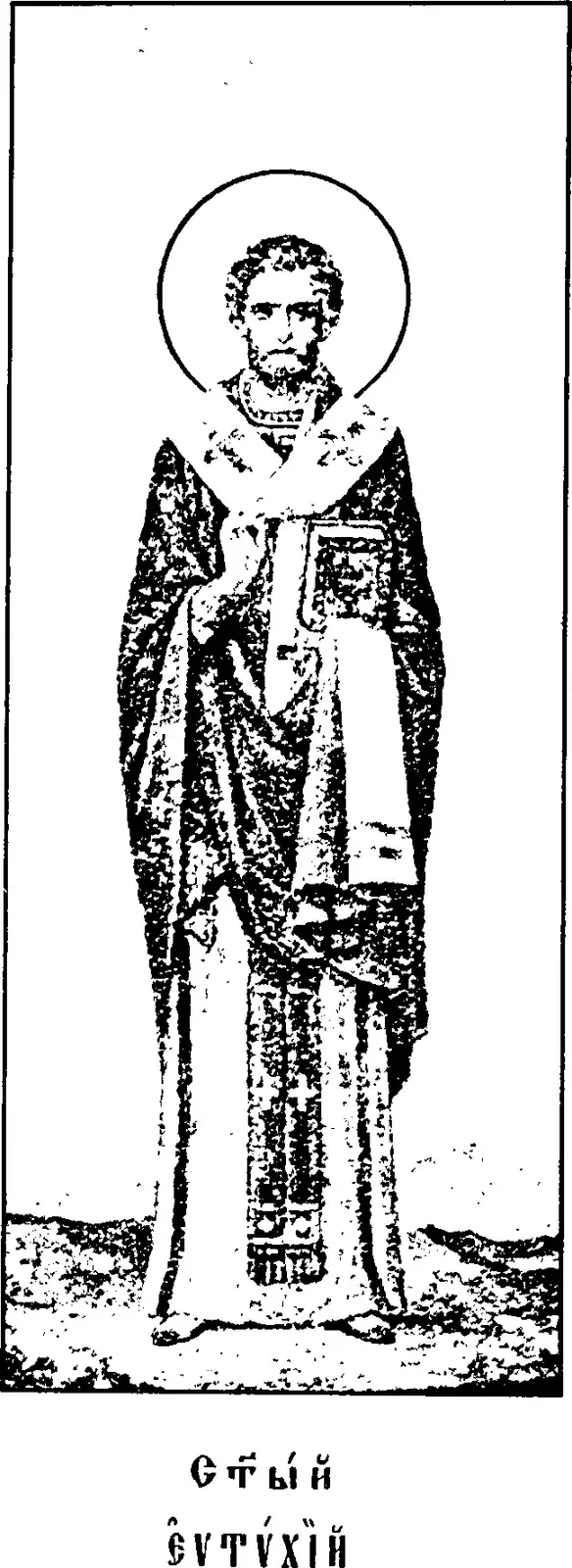
- Patriarch
- Of Constantinople, 552-565 and again 577-582 1
- Exiled
- By the Emperor Justinian in 565, for twelve years and five months 1
Saint Eutychius of Constantinople was the patriarch who presided at the Second Council of Constantinople in 553, and who twelve years later was arrested in church and sent into exile for refusing to back the Emperor Justinian's last doctrinal edict. 147 Recalled in 577, he spent his final years in an argument with the pope's envoy, Gregory, the future Pope Gregory the Great, over whether the risen body can be touched; Gregory's own account of it survives. 123
From Amasea to the patriarchate
He was born about 512 in the village of Theion in Phrygia, according to Catholic.net, and became a monk at Amasea in Pontus. 18 In 552 his bishop sent him to Constantinople as his representative, and he lodged at the Church of the Mother of God in the quarter called Urbicius, the Norwegian bishops' saints database (katolsk.no) says. 1 There the Patriarch Mennas came to see him as his successor, and when Mennas died on August 24, 552, Justinian, on whom the monk from Amasea had made a strong impression, had him chosen in his place before the month was out. 1
He took over a church in the middle of a quarrel. 14 To win back the Monophysites of Egypt and Syria, Justinian had issued an edict condemning three long-dead theologians suspected of Nestorianism: Theodore of Mopsuestia, certain writings of Theodoret of Cyrus, and a letter of Ibas of Edessa, the so-called Three Chapters. 14 The East accepted it; the West suspected an attack on the Council of Chalcedon and resisted it, and Pope Vigilius, held at Constantinople by the emperor, was caught between the two. 14
The Second Council of Constantinople
On January 6, 553, the new patriarch presented his profession of faith to Vigilius, and with the other Eastern bishops urged him to call a general council under his own presidency. 14 Thomas Shahan, writing in the Catholic Encyclopedia, says Vigilius was willing but wanted it held in Italy or Sicily so that Western bishops could come; Justinian refused, and opened the council on his own authority. 4 katolsk.no adds that the profession was meant to reassure the pope of Eutychius's loyalty to the four ecumenical councils. 1
The council met on May 5, 553. 14 Vigilius would not attend, and Eutychius presided, sharing the chair, katolsk.no says, with Apollinarius of Alexandria and Domninus of Antioch. 14 Over eight sessions it condemned the Three Chapters; Shahan counts 165 bishops at the last session, on June 2, and fourteen anathemas. 4 katolsk.no says Eutychius drafted the decree against the Three Chapters himself, and that up to then he had stood entirely with the emperor. 1 The pope gave way only that winter, after months of ill-treatment; Shahan notes that he did it in a letter addressed to Eutychius, dated December 8, 553. 14
In 562 Eutychius consecrated the rebuilt Hagia Sophia. 1
Deposed and exiled
In his old age Justinian took up one more theory in the hope of reconciling the Monophysites: the teaching of Julian of Halicarnassus that the body of Christ on earth was by nature incorruptible and not subject to suffering, a party its enemies called the Aphthartodocetae. 15 Dom John Chapman, in the Catholic Encyclopedia, dates the emperor's edict making it obligatory to 565; katolsk.no puts it in 564. 15 Eutychius would not accept it. 16 Butler, in a footnote to his life of Gregory, says Justinian spoiled his reputation by persecuting the Church and banishing Eutychius. 6
On January 22, 565, the emperor had him arrested in church, katolsk.no says, and taken first to a monastery called Choracudis and the next day to the monastery of Saint Osias near Chalcedon. 1 Eight days later a synod met to judge him. 1 He refused to appear before what katolsk.no calls a ridiculous list of charges, and was condemned in his absence, deposed and sent to the island of Principus in the Sea of Marmara. 1 Later that year he was moved to his old monastery at Amasea, where he spent twelve years and five months. 1 John III Scholasticus took his place in Constantinople. 1
The return, and the argument with Gregory
John III died in 577, and on October 3 of that year the Emperor Justin II recalled Eutychius to his see. 1 He was popular, katolsk.no says, and was welcomed back. 1 In those last years he wrote a treatise on the resurrection that taught, as Gregory put it, that the risen body would be "impalpable, and more subtle than the wind and air." 123
Gregory was then in Constantinople as the pope's envoy, the apocrisiarius, and he answered with the Gospel: the risen Christ showed the disciples his hands and feet and told them to handle him, "for a spirit hath not flesh and bones as ye see Me have." 12 Eutychius replied that the Lord did this to take away the disciples' doubt. 2 "This is a very extraordinary thing that you assert," Gregory answered, "that doubting should arise to ourselves from the same quarter, whence the hearts of the disciples were cured of doubting." 2 Eutychius granted that the body Christ showed was palpable, but held that afterward it was refined into a subtle quality; he cited Paul, that flesh and blood cannot inherit the kingdom of God, and Gregory answered that Paul meant flesh as sin, not flesh as nature. 2 Eutychius assented to that, Gregory writes, "yet still he denied that the body could rise again a palpable body." 2
The two men, by Gregory's own admission, "began to recoil from one another with the greatest animosity." 2 The Emperor Tiberius II heard them both in a private audience, judged against the book and ordered it burned. 23 Gregory fell gravely ill afterward, and Eutychius fell ill and died soon after; the Catholic Encyclopedia's article on Gregory puts the strain of the dispute behind both illnesses. 23
What he said at the end
Gregory did not see the end himself. 2 He was in bed with a violent fever, and what he knew came from friends who went to greet the old patriarch: before their eyes, they told him, Eutychius would take hold of the skin of his hand and say, "I confess that we shall all rise again in this flesh," which, they said, he had always denied before. 2 After his death Gregory dropped the matter, he writes, "lest I should seem to be darting words at his ashes," since almost no one held the view any longer. 2
Later tellings make the ending tidier. 136 Butler says that "the good bishop being docile and humble, retracted his mistake," and that he made the gesture with his hand "in presence of the emperor," who had come to visit him. 6 katolsk.no says the effect of the Gospel text on the old man was great, that he humbly withdrew his teaching in public, and that he made his profession at his deathbed in the presence of Tiberius II. 1 The Catholic Encyclopedia says he recanted his error on his deathbed. 3 The current Roman Martyrology keeps it to one clause: dying, he professed the resurrection of the flesh. 7
He died in April 582, at about seventy, on the 5th or the 6th according to katolsk.no, and was buried in the Church of the Holy Apostles; John IV the Faster succeeded him. 16 katolsk.no says his relics were taken to Venice in 1246, that a life of him was written under the Emperor Maurice by the priest Eustathius, his disciple, and that besides his letter to Vigilius a sermon on Easter and the Eucharist survives. 1
What is Saint Eutychius of Constantinople the patron saint of?
Saint Eutychius of Constantinople's feast day
Saint Eutychius of Constantinople's feast day is April 6, kept as the day of his death in both East and West, says katolsk.no. 18 The current Roman Martyrology, as the Italian bishops print it, commemorates him that day at Constantinople as a bishop who presided at the Second Ecumenical Council of Constantinople, fought hard there in defense of the true faith, and, after a long exile, professed the resurrection of the flesh as he died. 7
The Roman book did not always have him. 69 The 1897 English edition of the Roman Martyrology has no entry for him on April 6, and Butler, writing in the eighteenth century, says only that he "is ranked by the Greeks among the saints." 69
Praying with Saint Eutychius of Constantinople
Eutychius served one emperor faithfully and was thrown out by him, and the sources do not soften either half. 14 He chaired the council Justinian wanted and wrote its decree; a dozen years later he would not accept the emperor's theory about the body of Christ, and spent twelve years in a monastery far from his see for it. 15
The argument with Gregory is the part of his life told by someone who was in the room, and it was told by his opponent. 2 Gregory does not flatter him and does not pretend the quarrel was friendly. 2 Yet the last thing he records is not his own victory but an old man in his sickbed, taking hold of the skin of his hand in front of his visitors and saying he believed it would rise. 2
Whether that was a public retraction, as Butler and katolsk.no tell it, or something quieter, as Gregory heard it secondhand, the sources do not settle. 126 What they agree on is that a patriarch who had been right against an emperor came, at the end of his life, to accept correction from the pope's envoy, and that the Church remembers him for both. 127
Saint Eutychius of Constantinople, pray for us.
Sources
- 1."Den hellige patriark Eutykios I av Konstantinopel (~512-582)," Den katolske kirke, the saints database of the Catholic Church in Norway, katolsk.no (in Norwegian).
- 2.Saint Gregory the Great, Morals on the Book of Job, Book XIV, sections 72-74, in Library of the Fathers, vol. II (Oxford: John Henry Parker, 1845), Internet Archive.
- 3.Gilbert Huddleston, "Pope St. Gregory I ('the Great')," The Catholic Encyclopedia, vol. 6 (New York: Robert Appleton Company, 1909).
- 4.Thomas Shahan, "Second Council of Constantinople," The Catholic Encyclopedia, vol. 4 (New York: Robert Appleton Company, 1908).
- 5.John Chapman, "Monophysites and Monophysitism," The Catholic Encyclopedia, vol. 10 (New York: Robert Appleton Company, 1911).
- 6.Alban Butler, "St. Gregory the Great, Pope and Confessor," March 12, in The Lives of the Fathers, Martyrs, and Other Principal Saints, Vol. III (Derby: Richardson and Son, for the Catholic Book Society), Internet Archive.
- 7.Roman Martyrology, entry for April 6, "Sant'Eutichio, vescovo," Santo del giorno, Conferenza Episcopale Italiana (in Italian).
- 8."Eutiquio de Constantinopla, Santo," Santoral, Catholic.net (in Spanish).
- 9.The Roman Martyrology, April 6 (Baltimore: John Murphy Company, 1897), Internet Archive.
Saints to turn to next
Others in this collection who are turned to for some of the same things.