Saint Eustochia Calafato
March 25, 1434 - January 20, 1485
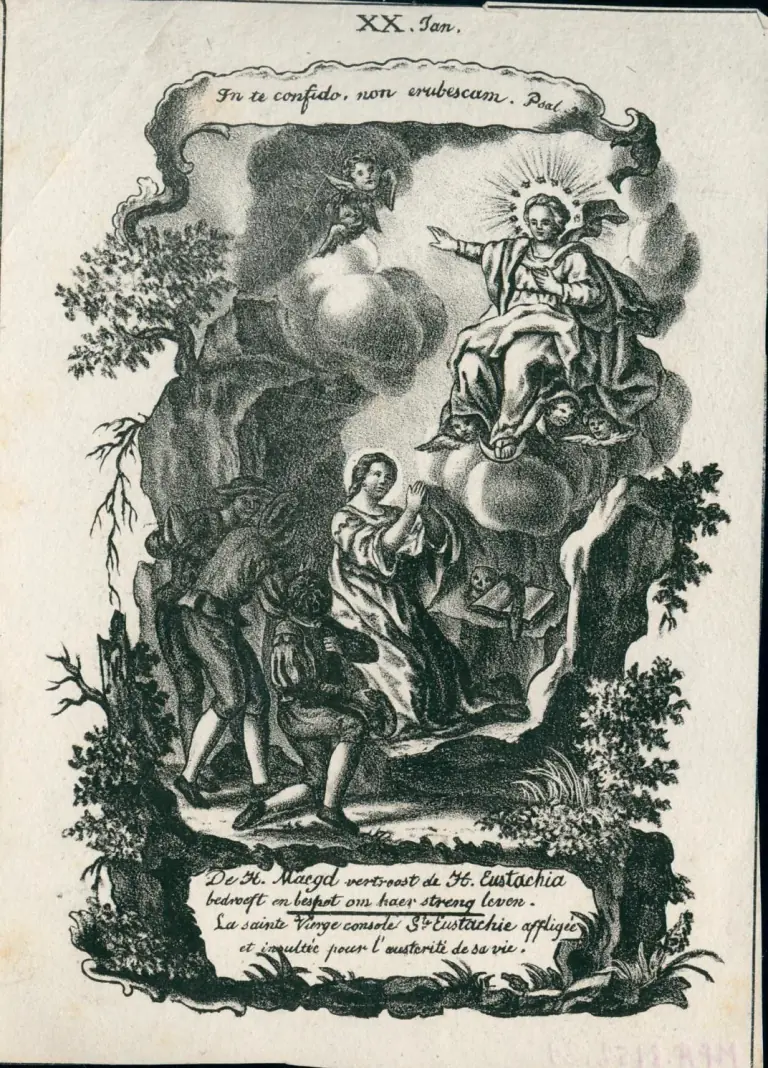
- Patronage
- None of a group stated; venerated at Messina as the city's protector, especially against earthquakes 3
Saint Eustochia Calafato was a rich merchant's daughter of Messina who fought her family to become a Poor Clare, then left her convent because it was not poor enough, and founded the monastery of Montevergine, where she was abbess until her death in 1485. 134 Her body, never corrupted, still stands upright in its church, and John Paul II canonized her in her own city in 1988. 123 Her feast is January 20. 5
Smeralda
She was born at Messina on March 25, 1434, a Holy Thursday, and baptized Smeralda. 13 Her father, Bernardo Cofino, was a wealthy merchant who also carried goods by sea, and was known to everyone as Calafato, which became the family name. 13 Her mother, Mascalda Romano, was a Franciscan tertiary, and from her, the decretal letter of canonization says, the girl learned early that nothing must be put before the love of God. 13
Her father betrothed her without her knowledge. Pettiti says she was eleven and the man a widower of thirty-five; he died suddenly two years later, and the decretal letter says his death settled her purpose. 13 Morabito adds that a vision of the crucified Christ in a church decided her. 3 She asked to enter the Poor Clares of her city.
Her family would not have it. Her father tried everything to turn her from it, and her brothers threatened to burn down the convent if the nuns took her in, so the nuns refused. 13 Pettiti says the way opened when her father died in Sardinia on one of his voyages. 3 Her persistence won, and in 1449 she entered the monastery of Santa Maria di Basicò in Messina and took the name Eustochia. 13
Basicò
She gave herself to prayer and to the Passion of Christ, chose a space under a staircase for her cell, slept little and on the bare ground, wore a hair shirt, and took on the nursing of the sick sisters. 13 Basicò was one of the most important houses in Sicily, home to the daughters of the nobility of Messina, and its rule had been softened by dispensations. 3 The decretal letter says plainly that its discipline did not satisfy her, and that poverty was not kept as perfectly as she wanted. 1
She tried with other sisters to reform it and failed. 1 She then obtained permission from Rome to found a new community that would keep the Franciscan poverty more strictly. 14 The sources differ on how it began. The decretal letter says that at the end of 1460 she moved, with her faithful companion Jacopa Pollicino and her own sister Mita, into an old infirmary fitted out as a monastery; the Irish Franciscans likewise speak of an old hospital attached to the monastery. 14 Morabito dates the papal decree, from Callistus III, to October 18, 1457, names the house Santa Maria Accomandata, and says her mother went with her from the start. 3
It was hard. The superiors and sisters she left disapproved, and Morabito says the Observant Franciscan friars refused to say Mass for the new community until Rome intervened and the archbishop of Messina ordered them, under pain of excommunication, to take on its spiritual care. 3 Pettiti says the sisters were left without a priest for eight months. 3
Montevergine
Vocations came, and the house grew too small. In 1464, by the decretal letter's date and the Irish Franciscans', the sisters settled at Montevergine in Messina, where they found hospitality with a community of Franciscan tertiaries; Morabito dates the move to 1463 and credits the generosity of one Bartolomeo Ansalone. 134 The monastery still exists. 3 Her mother joined the community and, the decretal letter says, gladly became her own daughter's disciple. 1
She was elected abbess and governed with prudence and a mother's care. 1 She urged peace and unity on her sisters, corrected them gently, and refused special treatment when she was ill so as not to trouble them. 1 She wanted to nurse the sick herself, seeing in them the image of the Redeemer. 1 Morabito says she wrote a book on the Passion for her community. 3
The decretal letter describes her prayer: long nights before the tabernacle, from which she drew back a little out of reverence, thinking herself unworthy to come close; tears before Communion; a tender love for the Virgin, whom she chose as her mother on entering religion. 1 She said that nothing had brought her to the love of God so much as meditating on the Passion, and she asked God either to take her out of this life or to give her the wounds of Christ. 1 She took on the heaviest work of the house, such as carrying the great water jars, in imitation of Christ carrying the cross. 1
John Paul II, preaching at her canonization, said that for her the cloister was not a flight from the world. From her cell at Montevergine she extended her prayer and penance to the whole world, wanting to be close to every brother and sister, to ease every pain, and to ask pardon for everyone's sins. 2
Death and the body at Montevergine
On November 30, 1484, she collapsed at supper, and other illnesses followed. 1 She knew she was dying and waited for it in prayer. 1 She died in the evening of January 20, 1485, calling the name of Jesus. 1 Her last counsel to her sisters, Morabito writes, was to take the Crucified for their Father, for he would teach them everything. 13 By then, the Irish Franciscans say, there were some fifty nuns. 4 Pettiti gives the year of her death as 1491. 3
The decretal letter says a sweet fragrance spread at once, and that she was buried two days later with no sign of corruption. 1 Morabito quotes the archbishop of Messina's report to Rome in 1690, that her body was whole and incorrupt and could be stood upright on its feet. 3 It stands today in the apse of the church of Montevergine, where crowds come on January 20. 3 John Paul II called her the "santa in piedi," the standing saint. 3
Messina venerated her as its protector, especially against earthquakes, and in 1777 the city senate vowed to go to Montevergine every year on January 20 and August 22. 3 The cause opened at Messina in 1640. 1 Pius VI confirmed her immemorial cult on September 14, 1782, and John Paul II canonized her at Messina on June 11, 1988, after a miracle that took place in the city in 1965. 12
What is Saint Eustochia Calafato the patron saint of?
None of the sources consulted for this page names Saint Eustochia Calafato as the patron saint of a group or a cause, and the page does not supply one. Morabito says the people of Messina have long invoked her as the protector of their city, especially against earthquakes. 3
Saint Eustochia Calafato's feast day
Saint Eustochia Calafato's feast day is January 20, the day of her death. 15 The current Roman Martyrology enters her on that day at Messina, as an abbess of the Order of Saint Clare who worked with great ardor to restore the ancient discipline of religious life and to promote the following of Christ on the model of Saint Francis. 5 Morabito says the Franciscan martyrologies also keep her on January 20. 3
The calendar of the Irish Franciscans places her on January 19. 4
Praying with Saint Eustochia Calafato
She had to fight to enter religious life, and then found that the convent she had fought her way into was not what she had wanted. 13 She left it, which cost her the good will of her superiors, her sisters and the friars, and for months the Sacraments. 3
Her poverty was not a rule for its own sake. The decretal letter says she understood it, like Francis, as the freedom needed to cling to the Crucified and follow him more easily. 1
She chose a space under the stairs for her cell, carried the water jars, and asked to be thought of as nothing by the sisters she had gathered. 13 She drew back from the tabernacle because she did not feel worthy to come near it. 1
What she left her daughters was simple: take the Crucified for your Father, and he will teach you everything. 3
Saint Eustochia Calafato, pray for us.
Sources
- 1.John Paul II, Decretal letter "Omnis anima" on the canonization of Eustochia Calafato, Messina, June 11, 1988 (in Latin).
- 2.John Paul II, Homily at the canonization of Eustochia Smeralda Calafato, Messina, June 11, 1988 (in Italian).
- 3.Gianpiero Pettiti and Giuseppe Morabito, "Sant' Eustochia (Smeralda) Calafato, Vergine clarissa," Santi, beati e testimoni (santiebeati.it) (in Italian).
- 4."St. Eustochia Calafato (1434-1485), Poor Clare, Virgin," 19 January, Franciscan Saints, Irish Franciscans (franciscans.ie).
- 5.Roman Martyrology, entries for January 20, Santo del giorno, Conferenza Episcopale Italiana (in Italian).
Saints to turn to next
Others in this collection who are turned to for some of the same things.
- Saint Agnes of Bohemiac. 1200-1205 - March 1281 or 1282Poverty and simplicityPrayer
- Saint Aidan of Lindisfarnec. 590 - August 31, 651Poverty and simplicityPrayer
- Saint Alexius of RomeFifth century, by traditionPoverty and simplicityPrayer
- Saint Alonso de OrozcoOctober 17, 1500 - September 19, 1591PrayerPoverty and simplicity