Saint Eusebius, Pope
Died in Sicily, 309 or 310
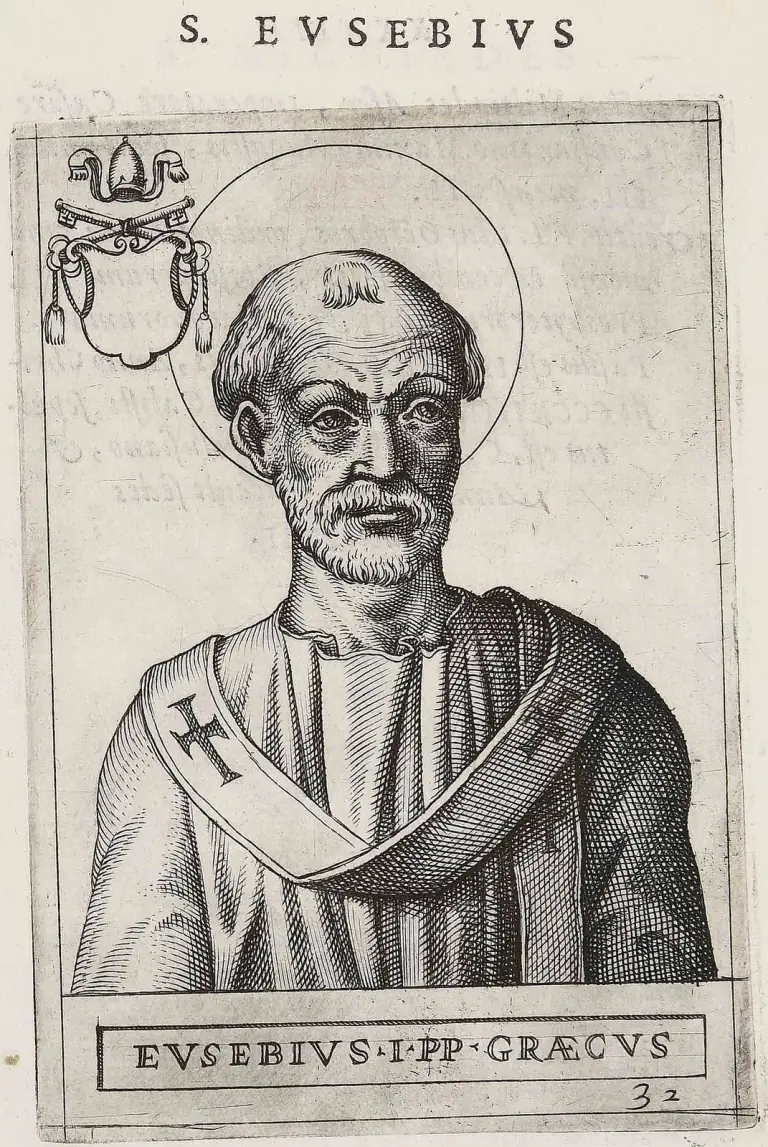
- Born
- A Greek, formerly a physician, says the Liber Pontificalis 4; the son of a physician, says katolsk.no 2
- Pope
- Four months, April 18 to August 17, in 309 or 310 1
Saint Eusebius was bishop of Rome for about four months in 309 or 310, and spent them in a fight over how to receive back Christians who had denied the faith in the persecution of Diocletian. 1 He held that they could return, but only after penance; a rival named Heraclius opposed him, the quarrel turned to rioting, and the emperor Maxentius exiled both men. 15 Eusebius died in Sicily. 13 His feast is August 17. 3
Four months in Rome
Eusebius succeeded Pope Marcellus. 1 The Liber Pontificalis, the old book of papal lives, calls him "by nationality a Greek, previously a physician." 4 The Norwegian bishops' saints database (katolsk.no) makes him the son of a physician instead, born at Cassano in Italy, and says nothing is known of his earlier life. 2
His reign was short. Johann Peter Kirsch, in the Catholic Encyclopedia, follows the Liberian Catalog of the popes: four months, from April 18 to August 17, in 309 or 310. 1 katolsk.no adds that 308 and 309 have also been proposed for the year, though the days and months are given in the catalog. 2 The Liber Pontificalis gives him years instead, two in one version and six in another; Louise Ropes Loomis, its translator, notes simply that "Eusebius was pope for four months only, from April to August." 4
The quarrel over the lapsed
The persecution under Diocletian had ended, and many who had given way under it wanted to come back to the Church. 15 The question of the terms had already divided the Roman Church under Marcellus, and katolsk.no says it brought the Church to the edge of schism and had already sent Marcellus into exile. 12 Eusebius held to the position the Roman Church had taken after the Decian persecution of 250 and 251: the lapsed were not to be shut out forever, but were to be readmitted only after doing proper penance. 1
He was opposed by a faction led by one Heraclius. 1 Which way Heraclius leaned is debated. Kirsch says it "has not been ascertained" whether he and his followers wanted a stricter rule or a laxer one, but thinks the laxer "by far more probable": a party of the lapsed and their friends demanding to be restored at once. 1 Vatican News describes it the same way, as lapsi led by Heraclius who wanted readmission without penance. 6 katolsk.no reads it the other way, as a faction opposed to taking apostates back at all. 2
The quarrel became violent. Kirsch thinks Heraclius's party probably tried to force their way into worship and were resisted by the faithful gathered around Eusebius. 1 The disorder brought in the civil power, and Maxentius exiled both the pope and Heraclius. 12 Eusebius was sent to Sicily, where he died soon afterward. 1
What Damasus wrote
Almost all of this is known from one poem. Some decades later Pope Damasus, who wrote verse epitaphs for the martyrs and popes of the Roman catacombs, set one over the tomb of Eusebius. 15 James Spencer Northcote and William Brownlow, in their English account of the catacombs drawn from the work of the archaeologist Giovanni Battista De Rossi, translate it: "Heraclius forbad the lapsed to grieve for their sins. Eusebius taught those unhappy ones to weep for their crimes. The people were rent into parties, and with increasing fury began sedition, slaughter, fighting, discord, and strife." 5
It goes on: both men were "banished by the cruelty of the tyrant, although the pope was preserving the bonds of peace inviolate. He bore his exile with joy, looking to the Lord as his Judge, and on the shore of Sicily gave up the world and his life." 5 Its heading reads, "Damasus, Bishop, set up this to Eusebius, Bishop and Martyr." 5
The poem had survived only in medieval copies, which did not say where it came from, and Northcote and Brownlow note that Baronius refused to believe it concerned this pope, since no other record of the episode survived. 5 Then De Rossi found it in the Catacomb of Callistus in 1856. 25 The marble was not Damasus's original but a later replacement, which De Rossi attributed to one of the sixth-century popes who repaired the catacombs; fragments of the original lay in the rubble of the same chamber. 15 Down its sides ran the name of the man who carved Damasus's inscriptions, Furius Dionysius Filocalus. 5
Burial in the Catacomb of Callistus
Miltiades, the next pope, had Eusebius's body brought back from Sicily, probably in 311. 1 By the Depositio Episcoporum, the Roman list of bishops' burials, it was laid on September 26 in a separate chamber of the Catacomb of Callistus. 1 The Liber Pontificalis gives the date of his burial as October 2. 4 Loomis notes that the tomb lies some distance from the large chamber where the popes of the third century are buried. 4
The Liber Pontificalis also places the finding of the True Cross in his reign. Loomis calls this an insertion alluding to a legend, and katolsk.no an obvious anachronism. 24
Martyr in exile
Eusebius was not executed. Kirsch says that his firm defense of the Church's discipline, and the exile he suffered for it, led to his being venerated as a martyr, and that Damasus gives him the title. 1 katolsk.no points out that neither the Liberian Catalog nor the Liber Pontificalis calls him one. 2 Vatican News lists him as pope and martyr; the current Roman Martyrology calls him a valiant witness of Christ who died an exile from his earthly homeland and so reached the heavenly one. 36
What is Saint Eusebius the patron saint of?
Saint Eusebius's feast day
Pope Saint Eusebius's feast day is August 17. The Roman Martyrology, in the text published by the Italian bishops, keeps that day as the anniversary of his death: in Sicily, Saint Eusebius, pope, a valiant witness of Christ, deported to the island by the emperor Maxentius, whose body was brought to Rome and laid in the cemetery of Callistus. 3 Vatican News and katolsk.no give August 17 as well. 26
Until the revision of the Martyrology he was kept on September 26, the day of his burial in Rome. 12 Kirsch, writing in 1909, says "his feast is yet celebrated on 26 September," and the 1897 English edition of the Martyrology has, on that day, "at Rome, of St. Eusebius, pope." 17
Praying with Saint Eusebius
His whole pontificate turned on one pastoral question: what to do with people who had failed. 1 Damasus put his answer in a single line: Eusebius "taught those unhappy ones to weep for their crimes." 5 The door was open, and the way through it was repentance. 1
It did not satisfy Heraclius and his party, and the argument ended in bloodshed in the city and two men sent into exile. 15 Damasus insists that the pope, even then, was "preserving the bonds of peace inviolate." 5
He did not see Rome again. The epitaph says he bore his exile with joy, looking to the Lord as his judge, and died on the shore of Sicily. 5 His body was later brought home, to a chamber of its own in the catacomb where so many of the popes before him lay. 14
Saint Eusebius, Pope, pray for us.
Sources
- 1.Johann Peter Kirsch, "Pope St. Eusebius," The Catholic Encyclopedia, vol. 5 (New York: Robert Appleton Company, 1909).
- 2."Den hellige pave Eusebius," Den katolske kirke (katolsk.no), Catholic Diocese of Oslo (in Norwegian).
- 3.Roman Martyrology, entry for August 17, "Sant'Eusebio, papa," as printed in "Santo del giorno," Conferenza Episcopale Italiana (in Italian).
- 4.The Book of the Popes (Liber Pontificalis), I: To the Pontificate of Gregory I, trans. Louise Ropes Loomis (New York: Columbia University Press, 1916), XXXII, "Eusebius," with the translator's notes, Internet Archive.
- 5.J. Spencer Northcote and W. R. Brownlow, Roma Sotterranea, compiled from the works of Commendatore de Rossi (London: Longmans, Green, Reader, and Dyer, 1869), "The Epitaph of St Eusebius," pp. 169-174, Internet Archive.
- 6."Santo del día, 17 agosto: s. Eusebio, papa y mártir," Vatican News (in Spanish).
- 7.The Roman Martyrology, September 26 (Baltimore: John Murphy Company, 1897).
Saints to turn to next
Others in this collection who are turned to for some of the same things.