Saint Euphrasia of Constantinople
c. 380 - c. 410
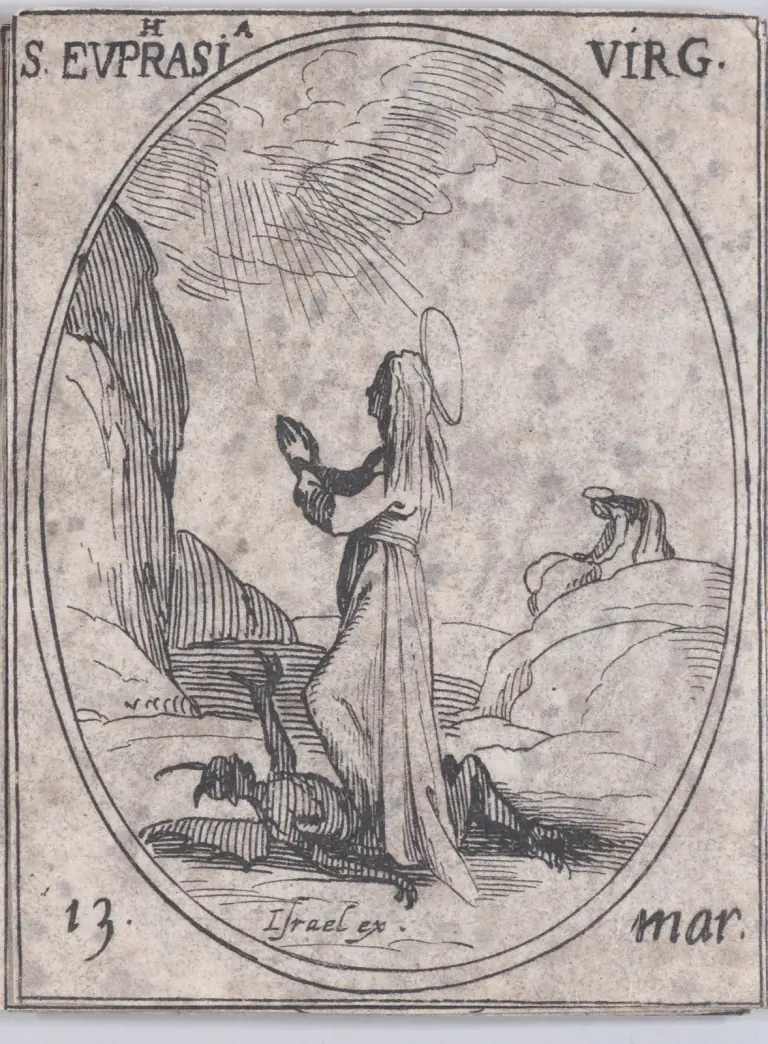
- Also called
- Eupraxia 1
Saint Euphrasia was the daughter of a senator of Constantinople related to the emperor, who was taken to Egypt as a small child and asked at seven to stay among the nuns of a convent there. 12 When the emperor later summoned her to marry, she wrote back asking him to give her whole inheritance to the poor and set her slaves free. 12 She died in the convent at about thirty and is remembered on March 13. 124
A child of the imperial family
Her father, Antigonus, was a senator of Constantinople and, as J.P. Kirsch puts it in the Catholic Encyclopedia, "a relation of Emperor Theodosius." 1 Alban Butler, writing in the eighteenth century from her ancient Life, makes him a nobleman of the court of "Theodosius the younger," nearly related to the emperor and given high office. 2 ACI Prensa says the emperor was Theodosius I. 3 Her mother was also named Euphrasia. 12
Kirsch puts her birth in 380. 1 Butler says that after she was born her parents agreed to live together as brother and sister, devoting themselves to prayer and almsgiving. 2 Antigonus died within the year. 12 ACI Prensa adds that the widow and her daughter came under the emperor's protection, and that when the girl was five he betrothed her to the son of a rich senator. 3
The convent in Egypt
The widow was pressed by suitors, Butler says, and to escape them she went privately with her little daughter to Egypt, where she owned a large estate. 2 Kirsch says she went to devote her life to God. 1 She settled near a convent and took up the nuns' way of life. 12
Butler describes the community: a hundred and thirty nuns who ate only herbs and pulse, after sunset, wore and slept on sackcloth, worked with their hands, and prayed almost without stopping. 2 The mother offered them a large yearly income in return for prayers for her husband, and the abbess refused it: "We have renounced all the conveniences of the world, in order to purchase heaven. We are poor, and such we desire to remain." 2 She would accept only enough for oil for the lamp and incense for the altar. 2
At seven Euphrasia begged to be allowed to stay. 12 Butler tells how the abbess put an image of Christ into the child's hands and she kissed it, saying, "By vow I consecrate myself to Christ." 2 Her mother left her with the abbess and went out of the monastery weeping. 2 ACI Prensa says she took the habit as a novice at eight. 3
Not long afterward the mother fell ill. Her last words to her daughter, as Butler gives them, were: "Fear God, honor your sisters, and serve them with humility. Never think of what you have been, nor say to yourself that you are of royal extraction. Be humble and poor on earth, that you may be rich in heaven." 2
The letter to the emperor
With both parents dead, the girl was an heiress, and the emperor sent for her to come to court and marry the young senator to whom she had been promised. 12 ACI Prensa says she was twelve and that it was Arcadius, son of Theodosius I, who sent for her to keep his father's promise. 3
She answered in her own hand. Butler's version of the letter begins: "Invincible emperor, having consecrated myself to Christ in perpetual chastity, I cannot be false to my engagement, and marry a mortal man, who will shortly be the food of worms." 2 She asked him to give her parents' estates to the poor, the orphans and the Church, to set all her slaves free and pay her servants what they were owed, and to cancel the debts of her tenants, "that I may serve God without let or hinderance." 2 She ended: "Pray for me, you and your empress, that I may be made worthy to serve Christ." 2
The emperor, Butler says, wept as he read it, and did all she asked. 2 Kirsch records simply that she declined the marriage and handed her whole fortune to the emperor to be used for charity. 1 Butler dates this "a little before his death, in 395," which sits awkwardly with his own statement that the emperor was Theodosius the younger. 2
Stones and humility
What the sources remember of her years in the convent is mostly humility. 23 Whenever she was tempted she told the abbess at once, Butler says, and the abbess would set her some hard, humbling labor. 2 Once, under a long temptation, she was told to carry heavy stones from one place to another, and she did it for thirty days together. 23
Her fasting grew until she ate only every two or three days, sometimes once a week. Butler insists that its merit lay in her humility, without which, he says, it would have been "a fast of devils." 2 She cleaned the other nuns' rooms and carried water to the kitchen. 2 When a kitchen servant called her a hypocrite for fasting longer than anyone but the abbess, Euphrasia fell at her feet and asked her pardon and her prayers. 2
Both Butler and ACI Prensa say she worked miracles. 23 ACI Prensa tells of sick people healed and possessed people freed through her, and names the abbess Sara and a fellow nun, Julia, who shared her cell. 3
Her death
Euphrasia died at about thirty. 12 Butler gives the year as 410, and ACI Prensa gives March 13, 410, after a fever. 23 Kirsch is more cautious and says only that she died after 410. 1 ACI Prensa adds that Julia died three days after her and the abbess a few days after that. 3
Kirsch notes that Saint John Damascene mentions her in his third oration on the holy images. 1 Butler says the passage he quotes is the prayer her mother made over her before an image of Christ: "Lord Jesus Christ, receive this child under your special protection." 2
What is Saint Euphrasia the patron saint of?
Saint Euphrasia's feast day
Saint Euphrasia's feast day is March 13. Kirsch gives it for the Latin Church, and July 25 for the Greek. 1 Butler tells her life under March 13 and says that "her name is recorded on this day in the Roman Martyrology." 2 The 1897 English edition of the Martyrology has, for that day, "In Thebais, of St. Euphrasia, virgin." 4 ACI Prensa still keeps her on March 13. 3
The current Roman Martyrology, as the Italian bishops print it, does not list her among the saints of March 13. 5
Praying with Saint Euphrasia
Euphrasia was born near the top of the world and spent her life cleaning other women's rooms. 12 Her mother had told her to forget that she was of royal blood, and to be poor on earth. 2 She seems to have taken it literally.
Her one act on the public stage was a letter. She was asked to come to court and marry, and she answered by giving away everything that would have made her worth marrying, down to the debts her tenants owed. 2 The emperor did as she asked. 12
The rest is small. She carried stones when she was tempted, she fasted, and when a servant called her a hypocrite she knelt and asked to be forgiven. 2 Butler, for all his admiration of her fasting, says the humility mattered more. 2
Saint Euphrasia of Constantinople, pray for us.
Sources
- 1.J.P. Kirsch, "St. Euphrasia (Eupraxia)," The Catholic Encyclopedia, vol. 5 (New York: Robert Appleton Company, 1909).
- 2.Alban Butler, "St. Euphrasia, V.," March 13, in The Lives of the Fathers, Martyrs, and Other Principal Saints, January, February, March (New York, imprimatur 1895), Project Gutenberg eBook #20450.
- 3."Cada 13 de marzo se celebra a Santa Eufrasia, joven virgen que renunció a sus privilegios por Cristo," ACI Prensa, March 2026 (in Spanish).
- 4.The Roman Martyrology, March 13 (Baltimore: John Murphy Company, 1897).
- 5.Roman Martyrology, March 13, Santo del giorno, Conferenza Episcopale Italiana (in Italian).
Saints to turn to next
Others in this collection who are turned to for some of the same things.
- Saint Agnes of Bohemiac. 1200-1205 - March 1281 or 1282Poverty and simplicityPrayerDiscernment
- Saint Benedict Joseph Labre1748 - April 16, 1783Poverty and simplicityPrayerDiscernment
- Saint Celestine V1215 (or 1210) - May 19, 1296DiscernmentPrayerPoverty and simplicity
- Saint ChadBirth date unknown - March 2, 672PrayerDiscernmentPoverty and simplicity