Saint Eulogius of Córdoba
Born before 819; beheaded at Córdoba, March 11, 859
- Buried
- In the cathedral of Oviedo 1
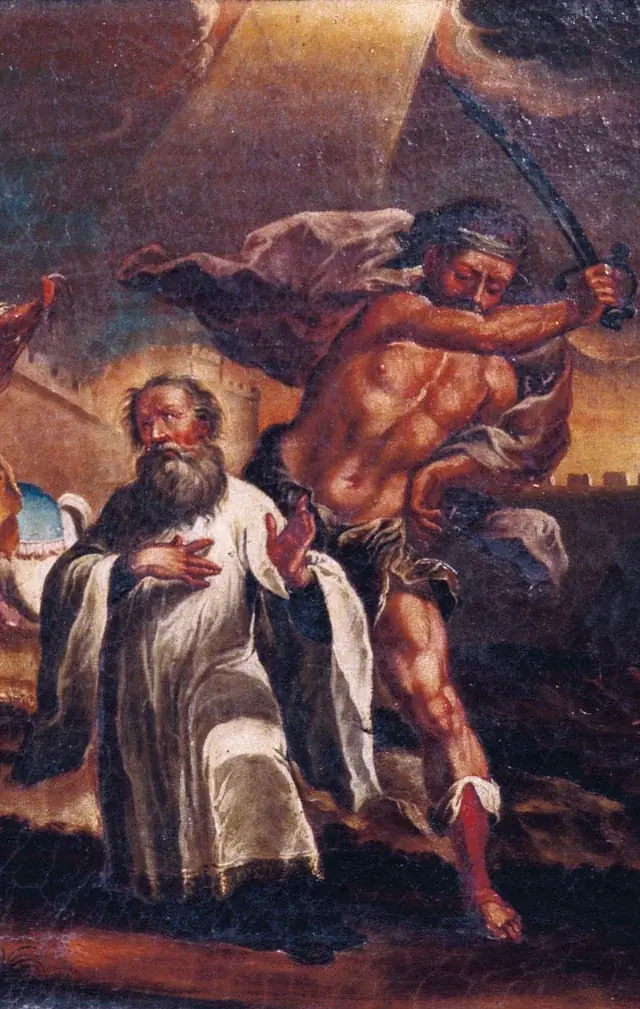
Saint Eulogius was a priest and scholar of Córdoba, in Muslim Spain, who in the 850s wrote the history of the Christians put to death in his city and was himself imprisoned for encouraging them. 12 Elected archbishop of Toledo, he was arrested before he could be consecrated, for having hidden a young convert named Leocritia from her family, and he was beheaded on March 11, 859. 123 His feast is March 11. 3
A Christian family in Córdoba
Eulogius came of a noble family that had held land at Córdoba since Roman times, Fidel Fita writes in the Catholic Encyclopedia; Butler calls it senatorian. 12 Nobody knows exactly when he was born. Fita reasons that it must have been before 819, since by 848 he was a priest, and priesthood was then given only to men of thirty. 1
The Muslim rulers of Spain, Fita says, tolerated the Christians and left them their own civil government, bishops, monasteries and property, but made them feel their subjection through taxes and military service. 1 Butler says they paid a tribute at every new moon. 2 Eulogius had five brothers and two sisters. 1 His youngest brother, Joseph, held a high office in the palace of the emir Abd al-Rahman II; one sister, Anulona, became a nun. 1
A scholar and his friend
He was educated at the church of Saint Zoilus in Córdoba, and Fita adds that he studied under the abbot Speraindeo. 12 There he made a lifelong friend, Paul Alvarus. 1 The two wrote each other so many letters in prose and verse that they filled volumes, Fita says, and later agreed to destroy them as too exuberant. 1 Alvarus married. Eulogius became a priest. 1 Butler says he was put at the head of the chief ecclesiastical school in Spain, which flourished at Córdoba, and that he often visited the monasteries and wrote rules of life for people who wanted to serve God. 2
Alvarus left a portrait of him, which Fita quotes: "Fair in feature, honest and honourable, he shone by his eloquence, and yet more by his works." 1 He read everything, Alvarus says, Catholic writers, heretics, philosophers, poets, historians, and above all sacred hymns, "in the composition of which he was a master." 1 Yet "he readily yielded to the judgment of others less learned than himself." 1 Fita gives an example: as a young man he planned to walk to Rome to pray at the tomb of Saint Peter, and gave it up on the advice of friends. 1
The persecution of 850
Butler is plain about how it began: some Christians spoke out publicly against Muhammad and his religion, which he calls "indiscreet," and a bloody persecution followed at Córdoba in 850. 2 A bishop named Reccafred sided with the persecutors, and at his urging the bishop of Córdoba and many priests were imprisoned, Eulogius among them, as one who encouraged the martyrs. 2
In prison he wrote his Exhortation to Martyrdom for two young women, Flora and Mary, who were beheaded on November 24, 851. 2 They promised to pray for their fellow prisoners once they were with God, and Butler says Eulogius and the others were released six days after their deaths. 2 More followed in 852 and 853, among them Aurelius and Felix with their wives, and the nuns Digna, Columba and Pomposa. 2 Butler records that a council at Córdoba in 852 forbade anyone to offer himself for martyrdom. 2
Eulogius wrote their history. Butler names his chief works: the Memorial of the Saints, in three books, and an Apology defending them as true martyrs, though no miracles were reported of them. 2 Fita says his writings are the main account of Spanish Christianity, inside and outside Muslim territory, from 848 to 859. 1
At some point he stopped saying Mass, and the two sources give different reasons. Fita says that in 850, after reading a passage of Saint Epiphanius, he chose to refrain for a time so as better to defend the martyrs' cause, and resumed at the request of his bishop, Saul of Córdoba. 1 Butler says that after his release he was made to live with Reccafred, "that wolf in sheep's clothing," and refused to say Mass so as not to be in communion with him. 2
Leocritia
The see of Toledo fell vacant. Fita says only that Eulogius was elected archbishop shortly before his death. 1 Butler says the archbishop died in 858, Eulogius was canonically elected, "some obstacle" kept him from being consecrated, and he did not outlive his election by two months. 2
Leocritia was a girl of a noble Muslim family who had been taught the Christian faith by a relative and secretly baptized. 2 When her parents found out, Butler says, they beat her day and night to make her give it up. 2 She got word to Eulogius and his sister Anulona that she wanted to go where she could practice her faith, and they helped her get away and hid her among friends. 2 They were found out and brought before the judge. 2
Butler says Eulogius offered to show the judge the way to heaven and to argue against the religion of Muhammad, and was threatened with flogging to death. 2 He was taken before the emir's council. One of its members drew him aside and urged a man of his learning not to throw his life away: one word, and he could go back to his religion afterward, with no questions asked. 2 Eulogius answered, smiling, "Ah! if you could but conceive the reward which waits for those who persevere in the faith to the end, you would renounce your temporal dignity in exchange for it." 2
He began to preach the Gospel to the council, and, Butler says, to keep its members from hearing him, they condemned him at once to be beheaded. 2 On the way to execution a palace servant struck him in the face, and Butler says he turned the other cheek. 2 He was beheaded outside the city gates on March 11, 859. 12 The current Roman Martyrology says he died by the sword for having openly proclaimed his faith in Christ. 3 Leocritia was beheaded four days later and her body thrown into the Guadalquivir, from which Christians recovered it. 2 Eulogius is buried in the cathedral of Oviedo. 1
What is Saint Eulogius the patron saint of?
Saint Eulogius's feast day
Saint Eulogius's feast day is March 11, the day he was beheaded. The current Roman Martyrology enters him on that day, at Córdoba in Andalusia, as a priest and martyr put to the sword for openly proclaiming his faith in Christ. 3 Butler places him on March 11 and says the Church honors him and Leocritia on the days of their deaths. 2 Fita gives the same date of death. 1
Praying with Saint Eulogius
Eulogius was a reader before he was anything else, by his best friend's account, and a humble one, ready to defer to people who knew less than he did. 1 He gave up his pilgrimage to Rome because friends advised against it. 1
He lived among the hardest questions his church faced: who counted as a martyr, whether a Christian should provoke the death that came, how to stay in communion with a bishop who sided with the persecutors. 12 The sources do not agree on all of his answers, and the council of his own church took a more cautious line than his writings did. 2
What ended his life was not a speech in the market. A girl who had been beaten for her faith asked for help, and he and his sister hid her. 2 At the end he was offered his life for one word, and answered with a smile. 2
Saint Eulogius of Córdoba, pray for us.
Sources
- 1.F. Fita y Colomé, "St. Eulogius of Cordova," The Catholic Encyclopedia, Vol. 5 (New York: Robert Appleton Company, 1909).
- 2.Alban Butler, "St. Eulogius of Cordova, P.M.," March 11, in The Lives of the Fathers, Martyrs, and Other Principal Saints, Vol. I (New York, 1895), Project Gutenberg eBook #20450.
- 3.Roman Martyrology, entries for March 11, Santo del giorno, Conferenza Episcopale Italiana (in Italian).
Saints to turn to next
Others in this collection who are turned to for some of the same things.