Saint Etheldreda
c. 630 - June 23, 679
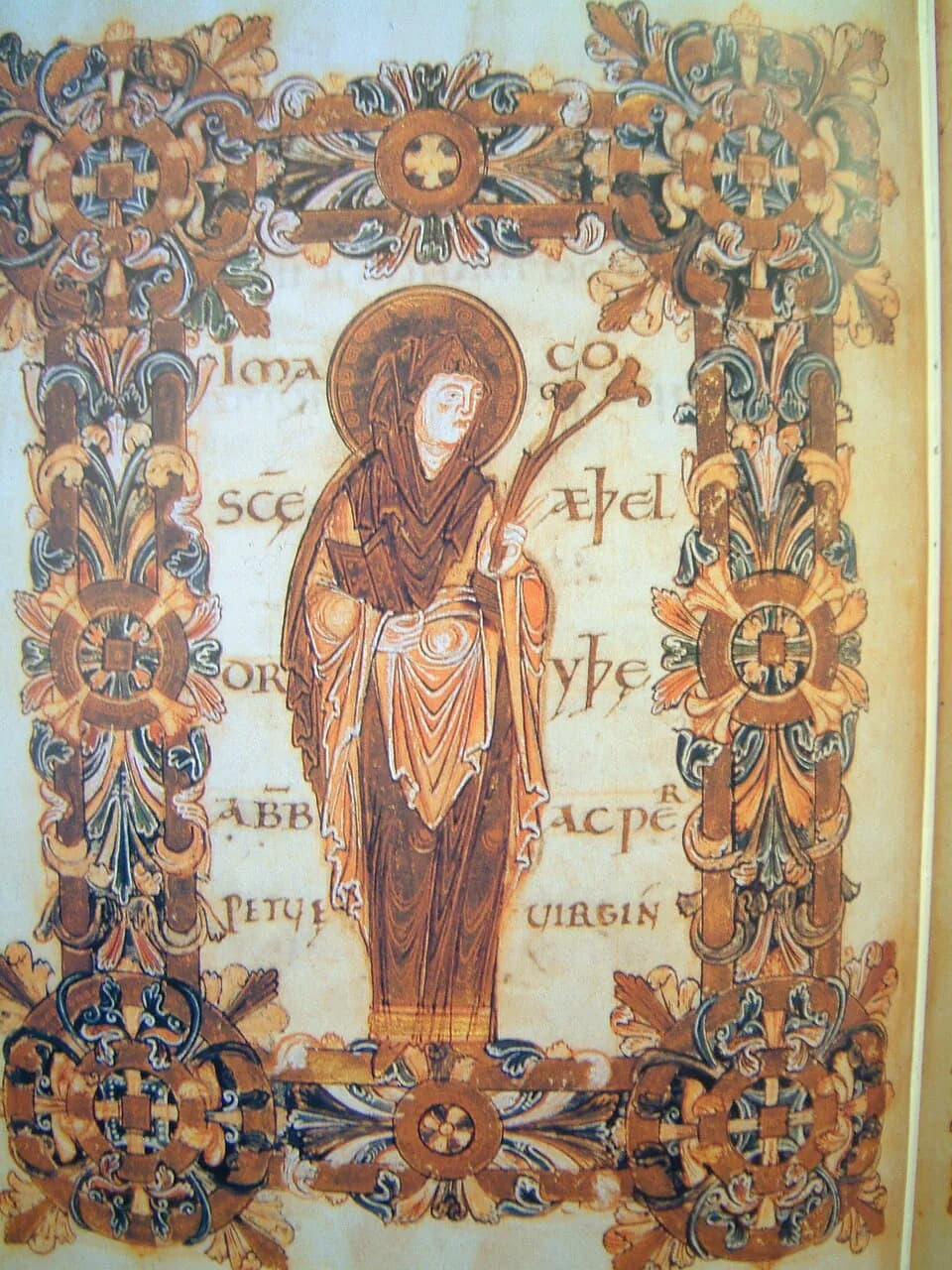
Saint Etheldreda, also called Audrey, was an East Anglian princess who was married twice, to two princes, without ever giving up her wish to be a nun, and who in 673 founded the monastery at Ely on land she had received at her first wedding. 123 She died there in 679, and her shrine at Ely drew pilgrims for centuries. 124 Her feast is June 23. 35
A king's daughter
She was born, probably about 630, to Anna, King of the East Angles; the Ely Place parish gives the year simply as 630. 123 The parish says she wanted from the beginning to be a nun. 3 Her family had other plans.
While still very young she was married to Tonbert, whom the encyclopedia calls "a subordinate prince" and its article on Ely calls Tonbert of the South Girvii. 12 From him she received the Isle of Ely: a "morning gift," in the encyclopedia's phrase, or, according to the Ely article, a district assigned to her in 649 "as a dowry." 12 Bede, quoted in that article, describes Ely as a country "in the nature of an island, enclosed either with marshes or waters," named for "the great abundance of eels" caught there. 2
The encyclopedia says she never lived with Tonbert as his wife, and after his early death she had five years to give herself to her vocation. 1
Queen of Northumbria
Her father then arranged a second marriage, "of political convenience," to Egfrid, son and heir of Oswy, King of Northumbria; the encyclopedia notes that Egfrid "is said to have been only fourteen." 1 The parish says she agreed to the marriage on condition that she could remain a virgin. 3
In Northumbria her friend and spiritual guide was Wilfrid of York, and through him she gave lands she had received from Egfrid at Hexham to found the minster of St. Andrew there. 1 When Egfrid became king he appealed to Wilfrid to enforce his rights as a husband against her religious vocation. 1 Wilfrid persuaded him at first to let her live for a time as a nun at Coldingham, a house founded by her aunt, Saint Ebba, in what is now Berwickshire. 1
In the end, the encyclopedia says, the danger of being carried off by force drove her to flee south with only two women for company. 1 They reached her own estate at Ely, "not, tradition said, without the interposition of miracles." 1
The monastery at Ely
In 673 she founded a monastery at Ely, on the site of the present cathedral, and gave it her whole principality of the isle. 2 The bishops of Ely, centuries later, drew their temporal power from that gift. 2 Her East Anglian relatives supplied the means to build. 1 The parish adds that she raised a fine church on the ruins of one begun through the efforts of Saint Augustine and laid waste by war. 3
The parish also says she "set free all the bondsmen on her lands" and lived for seven years "a life of exemplary austerity." 3 The Ely article suggests that under her and the abbesses after her there was probably a community of monks as well as one of nuns. 2
Wilfrid was in Rome obtaining privileges for her foundation from Pope Benedict II when she died, of a plague which, the encyclopedia says, she was believed to have foretold. 1 The date was June 23, 679. 12
Incorrupt, and a shrine
Devotion to her spread quickly, the parish says, as people received favors they credited to her prayers. 3 When her body was moved to a better tomb, it was found after fifteen years in wet earth to be "still in a perfect state of preservation," and when the Normans moved it again in 1106 it was again reported to be incorrupt. 3
Her body was venerated for centuries in the church that grew from her foundation. 1 The monastery gave the Church four abbesses who are honored as saints: Etheldreda, Sexburga, Ermenilda and Werburga. 2 The Danes destroyed it in 870, King Edgar and Bishop Ethelwold restored it in 970 as a house of monks, and in 1109 it became the cathedral of the new Diocese of Ely. 2
The Ely Place parish history says that pilgrims to her shrine wore badges to show they had made the journey, that she was invoked against infections of the throat and neck, and that the Blessing of Throats is still a major event in the parish each year. 4 At the Reformation, Thomas Goodrich, the first bishop of the new religion at Ely, destroyed her Great Shrine in the cathedral. 4
Her hand
A piece of her hand survived. The Ely Place history says it was removed in Norman times and hidden through the years of persecution on the Duke of Norfolk's estate, and that it now lies in a jeweled casket to the right of the high altar. 4 The church that holds it, St Etheldreda's in Holborn, was built as the London chapel of the bishops of Ely and is, the parish says, the oldest Catholic church in England. 4
The Rosminian Father William Lockhart bought the chapel at auction in December 1873. 14 After five years of restoration, Solemn High Mass was celebrated there on June 23, 1878, her feast, for the first time in more than two hundred years. 34 The encyclopedia in 1909 called it the first pre-Reformation church in Great Britain restored to Catholic worship. 1
At Ely itself, the Diocese of East Anglia reported in 2026, pilgrims visit "her hand, held up in blessing" in the Catholic church of St Etheldreda's near the cathedral. 6
What is Saint Etheldreda the patron saint of?
Saint Etheldreda is one of the patrons of the Diocese of East Anglia, which covers her native kingdom. 5 The Ely Place parish history says that in the Middle Ages she "was a patron of chastity and was invoked for help against infections of the throat and neck." 4 Both Catholic churches named for her, at Ely Place and at Ely, keep her as their patron. 36
Saint Etheldreda's feast day
Saint Etheldreda's feast is June 23, the day of her death, as the Ely Place parish prints it. 3 The Diocese of East Anglia lists her among the patrons of the diocese on June 23 and keeps the day as a memorial in its own calendar. 5 In 2026 her parish at Ely planned a sung Mass for the Saturday after her feast, June 27, with a new Mass setting written for her. 6
Praying with Saint Etheldreda
She did not get the life she wanted for a long time. Her family married her off twice, for land and alliances, and the sources say she held on to her vocation through both marriages. 13 When she finally fled, it was with two women and nothing else. 1
Once she had Ely, she gave it away. The whole principality went to the monastery, and the parish says the people bound to her land went free. 23 What she had been given as a bride she turned into a place of prayer.
Her story has some hard edges. Her second husband is said to have been fourteen, he asked her own spiritual guide to enforce his rights against her, and she ended up running for her life. 1 The sources do not smooth any of that over, and neither should anyone praying with her.
Bede wrote a hymn to her, and in 2026 her parish at Ely commissioned a motet on its words: "Behold, O bride of God, thy glory upon earth; the glory that awaits thee in the Heavens." 6
Saint Etheldreda, pray for us.
Sources
- 1.Ewan Macpherson, "St. Etheldreda," The Catholic Encyclopedia, Vol. 5 (New York: Robert Appleton Company, 1909).
- 2.Edwin Burton, "Ely," The Catholic Encyclopedia, Vol. 5 (New York: Robert Appleton Company, 1909).
- 3."St Etheldreda," Roman Catholic Parish of Ely Place, Diocese of Westminster.
- 4."Parish History," Roman Catholic Parish of Ely Place, Diocese of Westminster.
- 5.Diocese of East Anglia, Yearbook and Calendar 2023 (patrons of the diocese, and the diocesan calendar for June 23).
- 6."St Etheldreda's Premieres Mass Setting for Patron Saint," Catholic Diocese of East Anglia, April 20, 2026.
Saints to turn to next
Others in this collection who are turned to for some of the same things.