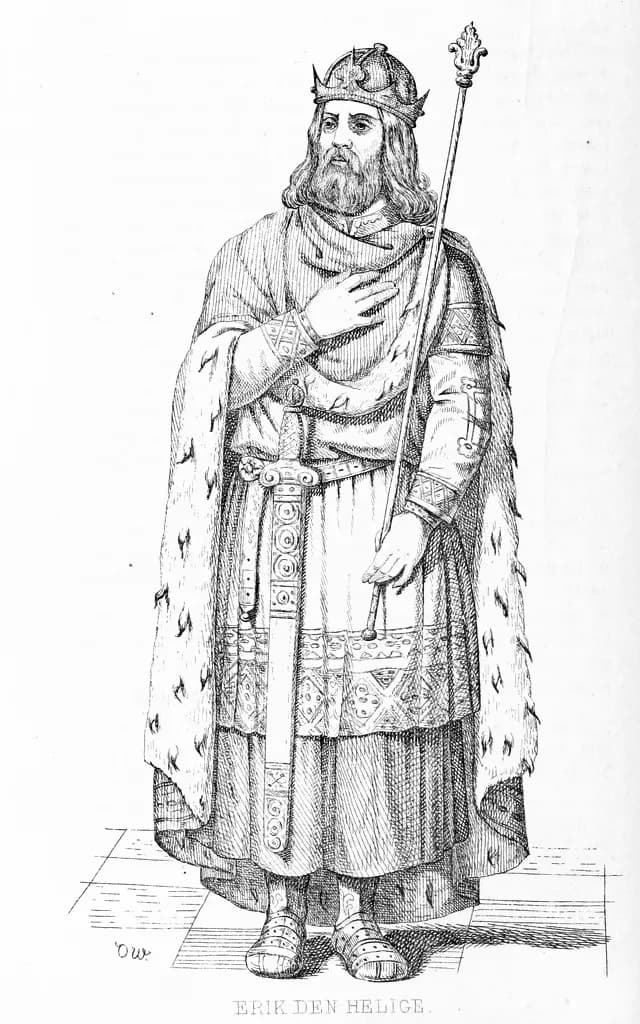
Saint Eric of Sweden
c. 1120 - 1160
- Born
- Erik Jedvardsson, about 1120, in Sweden, possibly in Västergötland 1
- King
- Listed as Eric IX; recognized over most of Sweden from about 1150 1
- Patron saint of
- Sweden, and the city of Stockholm since 1376 1
Saint Eric of Sweden was a twelfth-century king, Erik Jedvardsson, who was killed by his enemies at what is now Uppsala in 1160 and has been venerated as a martyr there ever since. 12 He was never formally canonized by a pope, yet the Roman Martyrology lists him as a king and martyr on May 18, and his bones still lie in Uppsala Cathedral. 125 Most of what is told about his life comes from a legend written for his feast about a century after his death. 1
What is known and what is legend
Very little about Eric is documented from his own lifetime. The Catholic Church in Norway, whose long biography is the fullest of the sources used here, says the first account of him, thought to date from the late 1160s, is lost, and that the surviving legend, found in the Uppsala breviary, is usually dated to about 1270. 1 It was written as readings for the office on his feast day. 1
According to the same account, Swedish historians dismissed that legend as pure invention until about 1900, and the judgment today is more careful: an older layer of the text seems to refer to real events. 1 The 1912 Catholic Encyclopedia gives him no article of his own and only a few sentences in its history of Sweden. 3 This page follows the legend where the sources do and says so.
Erik Jedvardsson
He was born about 1120 in Sweden, possibly in Västergötland, the son of a man named Jedvard of whom nothing is known. 1 The suggestion that his father was English rests, the Norwegian biography says, only on how unusual the name was in twelfth-century Sweden. 1 The encyclopedia calls him simply a Swede from the northern provinces. 3
Eric married Kristina, a granddaughter of King Inge the Elder on her mother's side, and through that marriage he claimed the Swedish crown. 1 In the list of Swedish kings he stands as Eric IX, but nothing is known about how he was chosen. 1 He probably controlled only part of the realm at first. From about 1150 he was acknowledged in most of Sweden, though Östergötland at least had other kings at the same time, and after King Sverker the Elder was murdered on Christmas Day 1156 Eric was elected his successor at Uppsala. 1 The encyclopedia says he "won universal recognition." 3
The king in the legend
The legend makes him a devout man who followed the ascetic practices of his day. It says he wore a hair shirt, which was long kept as a relic in the cathedral at Uppsala. 1 He is said to have lived simply and to have given up part of the income he was entitled to as king, spending it on the cathedral at Old Uppsala, the first large church in the country, which he may have completed. 1 He set up a chapter of monks there, brought from the monastery at Odense in Denmark. 1
He is also credited with having the old laws of the kingdom gathered into one book, and with the rule that a married woman has a share in the household's property. 1 The Roman Martyrology keeps both points in its short entry: it says that he governed his people wisely and protected the rights of women. 2
The Norwegian account does not hide the less flattering record. He gave privileges to one Cistercian monastery while his wife, Kristina, harassed the monks of another, Varnhem, until they left for Denmark for a time. 1
The expedition to Finland
The largest event of his reign was the expedition to Finland, which the sources call a crusade. 134 The Norwegian biography is frank about it. Pagan Finns were raiding into Sweden, Eric fitted out a punitive expedition, and calling it a crusade justified it at a time when Europe was full of enthusiasm for crusades. 1 In 1157 he crossed to southwestern Finland with an army and with Bishop Henry of Uppsala, his friend and fellow worker. 1 The purpose, that account says, was without doubt to strengthen Swedish interests there, and partly also to do missionary work. 1
The story goes that Eric offered the Finns peace and Henry offered them the Christian faith, and they refused both. 1 The Finns lost the battle that followed. 1 Henry baptized the defeated at the spring of Kuppis near Turku and stayed behind, while Eric went home. 1 The encyclopedia records the same expedition as "the Crusade to Finland led by St. Eric" and says that Henry died a martyr there. 4 The Martyrology says that Eric sent the bishop Saint Henry to Finland to spread the faith. 2
His death at Uppsala
Eric insisted that tithes be paid to support the Church, as they were in the rest of Europe, and some discontented nobles went over to a Danish prince, Magnus Henriksson, who had his own claim to the Swedish crown through his mother. 1
The sources tell the end three ways. The encyclopedia says only that after his return from Finland he "was killed in a battle (1160) with a Danish pretender Magnus Henriksson." 3 The Martyrology says he was attacked while taking part in the celebration of Mass and fell stabbed by his enemies. 2 The Norwegian biography gives the legend in full: he was at the office and Mass in the Church of the Trinity, on the spot where Uppsala Cathedral now stands, when word came that Magnus had arrived with a large army. He stayed until Mass was over, and by then it was too late to organize a defense. The fight was short. He was dragged from his horse, mocked and tortured, and killed with a blow through the neck as he lay half dead on the ground. 1
The legend dates this to May 18, 1160, Ascension Day. 1 The same biography notes that Ascension fell on May 5 that year, and thinks it most likely that the writer confused the day of his death with the day his relics were enshrined. 1 When the bones were examined scientifically in 1940, a neck vertebra showed a heavy sword cut and the leg bones bore marks of sharp weapons, which largely confirmed what the legend says of how he died. 1
A saint without a canonization
Magnus reigned for about a year before he was killed in turn, and in 1167 Eric's son Knut took the throne. 13 Knut promoted his father's cult and tried to have Pope Alexander III canonize him. Eric's Danish enemies told the pope that he had been a drunkard and had died drunk, and the pope refused. 1 Knut went ahead without him. On May 18, 1167, the relics were solemnly enshrined at Uppsala, which in that period amounted to a national canonization. 1
Rome never did canonize him formally. A series of documents, the earliest from 1256, shows that the popes knew of the cult and supported it with indulgences attached to his feast. 1 The relics were moved from Old Uppsala to the new cathedral on January 24, 1273, by the Norwegian account; the encyclopedia places the move of the see under Archbishop Folke, whom it dates 1274 to 1277, and adds: "The relics of the national saint, St. Eric, were also transferred to the new see." 14
The medieval shrine was melted down at the Reformation, but the bones were kept, and King John III had the present shrine of gilded silver made; it was delivered in 1580. 1 It holds much of his skeleton and a burial crown of gilded copper, the oldest surviving royal crown in Sweden. 1 Speaking in Uppsala Cathedral on June 9, 1989, John Paul II called the building a reminder of a shared heritage and said, "Even today the tomb of Saint Erik is preserved here." 5
What is Saint Eric of Sweden the patron saint of?
Saint Eric of Sweden is the patron saint of Sweden. The Catholic Church in Norway's biography says he was honored as the country's patron in the late Middle Ages, and calls him the first and foremost of Sweden's patrons, ahead of Saint Sigfrid and Saint Bridget, whose days a council at Arboga in 1474 also made national feasts. 1 The encyclopedia calls him "the national saint." 4 Stockholm put his head in its city seal in 1376 and chose him as its patron. 1
Saint Eric of Sweden's feast day
Saint Eric of Sweden's feast day is May 18, the day the Roman Martyrology lists him at Uppsala as king and martyr. 12 From the end of the fourteenth century there was also a feast on January 24 for the transfer of his relics in 1273. 1 On May 18 in the Middle Ages his relics were carried in procession from the cathedral out to Old Uppsala, across the fields, to pray for a good harvest. 1
Praying with Saint Eric of Sweden
Eric is an awkward saint for a tidy mind. The sources that honor him also say that his great expedition was a punitive raid dressed as a crusade, that his wife persecuted a monastery, and that his son had political reasons for wanting a saint in the family. 1 None of that is hidden by the people who keep his feast.
What the Church actually commemorates is narrower. The Martyrology remembers a king who governed wisely, protected the rights of women, sent a bishop to preach in Finland, and was cut down by his enemies while he was at Mass. 2 The legend adds a detail of its own: told that an army was at the door, he remained in his place until the Mass was finished. 1
That can be read as piety or as bad generalship, and the legend knows it cost him the battle. 1 It is still the picture his country kept of him, a man who would not leave the altar early, and the bones in the shrine carry the marks of what followed. 1
At Mass in Uppsala in 1989, John Paul II named him beside Saint Bridget: "Swedish Saints like Saint Birgitta and Saint Eric realized this: the Good News is meant to be shared." 6 The saint's tomb stands in what is now a Lutheran cathedral, and there, the same day, the Pope spoke of a heritage that Protestants and Catholics in Sweden share. 5
Saint Eric of Sweden, pray for us.
Sources
- 1.Per Einar Odden, "Den hellige Erik IX Jedvardsson av Sverige (~1120-1160)," Den katolske kirke (the Catholic Church in Norway), katolsk.no, updated May 15, 2010 (in Norwegian).
- 2.Roman Martyrology, entry for May 18, "Sant'Eric IX, re e martire," as printed in "Santo del giorno," Conferenza Episcopale Italiana (in Italian).
- 3.Pius Wittmann, "Sweden," The Catholic Encyclopedia, vol. 14 (New York: Robert Appleton Company, 1912).
- 4.Gustav Armfelt, "Ancient See of Upsala," The Catholic Encyclopedia, vol. 15 (New York: Robert Appleton Company, 1912).
- 5.John Paul II, Address at the ecumenical prayer service in the Lutheran Cathedral of Uppsala, June 9, 1989.
- 6.John Paul II, Homily at Mass in Uppsala, June 9, 1989.
Saints to turn to next
Others in this collection who are turned to for some of the same things.