Saint Epiphanius of Salamis
c. 310 - 403
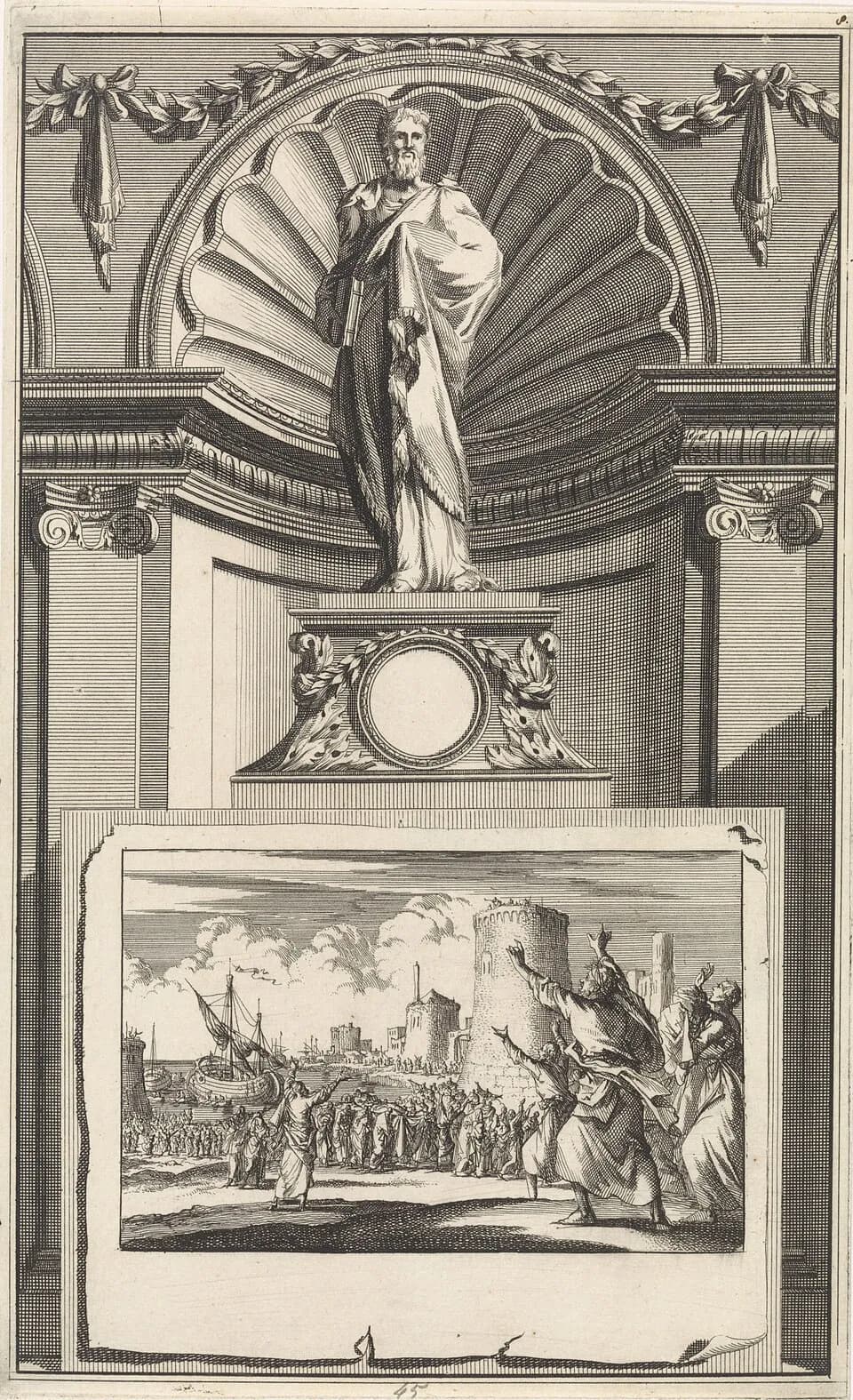
- Chief works
- The Ancoratus (374) and the Panarion (374-377) 1
Saint Epiphanius of Salamis was a Palestinian monk who became bishop of the chief city of Cyprus in 367 and spent the next thirty-odd years writing against every heresy he could name, eighty of them in a single book. 12 He preserved documents no one else kept, and late in life he pressed charges of heresy against two bishops, one of them Saint John Chrysostom, in a controversy the Catholic Encyclopedia calls unjust. 1 His feast is May 12. 35
A monk between Judea and Egypt
He was born near Eleutheropolis in Judea, at a village the Catholic Encyclopedia names as Besanduk. The encyclopedia says the year was after 310, Alban Butler says about 310, and Catholic News Agency says around 310 or 315. 123 Catholic News Agency alone adds that his parents were Greek-speaking Jews, and that he "is said to have been drawn to the Church after seeing a monk give away his clothing to a person in need." 3
He became a monk very young and went to Egypt to learn the life in its deserts. 12 About 333, by Butler's reckoning, he came home and built a monastery near his birthplace, and the encyclopedia adds that he was ordained a priest. 12 Some thought his austerities more than his strength could bear. Butler gives his reply: "God gives not the kingdom of heaven but on the condition that we labor; and all we can do bears no proportion to such a crown." 2
He studied as hard as he fasted. Butler says he learned Hebrew, Egyptian, Syriac, Greek and Latin in order to read the Scriptures, and that most of the books then in circulation passed through his hands. 2 For more than twenty years, from 333 to 356, he was the disciple and close friend of the hermit Saint Hilarion. 23 When the Arians had the upper hand under the emperor Constantius, he left his cell often to encourage Catholics, and broke communion with his own bishop for siding with them. 2
Bishop of Constantia
In 367 he was chosen bishop of Constantia, the old Salamis, the metropolitan see of Cyprus. 12 The encyclopedia puts it down to his reputation for asceticism and learning; Butler and Catholic News Agency think Hilarion's influence with the church of Salamis steered the choice. 123 He went on wearing the monk's habit and went on governing his monastery in Palestine, visiting it from time to time. 2
The sources count his years as bishop differently: nearly forty in the encyclopedia, thirty-six in Butler, thirty-five according to Benedict XVI. 124 Butler describes a bishop who would relax his own fasting for the sake of a guest and whom devout people trusted to give away their alms, and says that when the Arian emperor Valens moved against Catholic bishops in 371, Epiphanius was almost the only one in that part of the empire left alone. 2 The Roman Martyrology remembers him for the breadth of his learning, his knowledge of sacred literature, his generosity to the poor and his miracles. 5
The Well-Anchored and the Medicine Chest
He wrote because people asked him to. 1 The first book, in 374, was the Ancoratus, "The Well-Anchored," a picture of the Christian held firm against error, which treats the Trinity and the Resurrection and argues chiefly with Arians and Origenists. 1 It ends with two creeds, one of them the baptismal creed of his own church. 14 Benedict XVI quoted that creed to the Archbishop of Cyprus in 2007 for its confession of the "holy Spirit, the Spirit of God, the perfect Spirit. The Spirit Consoler, not created, who proceeds from the Father and comes from the Son, the object of our faith." 4
Readers wanted more than the list of heresies the Ancoratus gave, and between 374 and 377 he produced the Panarion, the "Medicine chest," which the encyclopedia glosses as a stock of remedies against the poisons of heresy. 1 It describes eighty of them, twenty older than Christ and sixty Christian. 1
The encyclopedia is frank about its unevenness. His "ardour prevents him from inquiring carefully into the doctrines he opposes," and he says himself that he wrote about one group from hearsay. 1 It is just as plain about what the book saves. Epiphanius copied out letters of Arius, a letter of Marcellus of Ancyra to Pope Julius, and the text of a sermon preached at Antioch, and he used earlier writers whose works have since been lost. 1 Two shorter works survive as well, one on weights and measures that is really an introduction to Scripture, and one on the twelve stones of the high priest's breastplate. 1
His own theology was that of the Catholic writers of his time. The encyclopedia calls him one of the most explicit of the Greek theologians on the primacy of Saint Peter, and one of the chief fourth-century witnesses to devotion to the Blessed Virgin, which he discusses while answering one sect that diminished it and another that exaggerated it. 1 Catholic News Agency notes that his writings are cited in the Catechism of the Catholic Church. 3
Zeal that overreached
His authority reached well past Cyprus, and he was asked into quarrels on the mainland. He went to Antioch, probably in 376, to look into the teaching of Apollinaris and the schism there, and sided with Bishop Paulinus, whom Rome supported. 1 In 382 he traveled to Rome with Paulinus for a council. 12 Butler says they stayed in the house of Saint Paula, and that Epiphanius later had her as his guest for ten days in Cyprus. 2
Then came Origen. Epiphanius thought Origen's writings were the root of the heresies of his day, Arianism above all, and he came to suspect bishops and monks who read them. 1 About 394 he went to Jerusalem and preached against Origenism in front of its bishop, John. 12 He persuaded Saint Jerome at Bethlehem to break with John, and he ordained Jerome's brother Paulinian a priest by compulsion, which drew a complaint from John. 2 The encyclopedia also records, from his own letter to John, that he destroyed an image in a church at Bethel. 1
In 402 he was in Constantinople to press the same charge against monks whom John Chrysostom had sheltered, and against Chrysostom for sheltering them. 12 Both the encyclopedia and Butler say he was being used by Theophilus of Alexandria, Chrysostom's enemy. 12 Faced with the monks themselves, he had to admit that he knew neither their school nor their books and spoke only from hearsay. 1
The encyclopedia does not soften its verdict. The controversies showed "his disinterested zeal but also his quickness to suspect heresy, a good faith which was easily taken advantage of by the intriguing, and an ardour of conviction which caused him to forget the rules of canon law and to commit real abuses of power." 1 Butler is gentler, calling the mistakes the fruit of "zeal and simplicity," and says a mild word from Chrysostom "opened his eyes." 2
Death at sea
He left Constantinople for home and died on the voyage, in 403. 123 Catholic News Agency says he had distanced himself from the attempt to depose Chrysostom before he sailed, and that he left his disciples two pieces of advice: to keep God's commandments and to guard their thoughts against temptation. 3 He was buried on May 12, after the ship reached Salamis. 3
Butler says his disciples built a church in his honor in Cyprus, and that Augustine, Ephrem and John Damascene, among others, called him a Catholic doctor. 2 Catholic News Agency adds that the Seventh Ecumenical Council in 787 confirmed his standing as a Father of the Church. 3
What is Saint Epiphanius of Salamis the patron saint of?
None of the sources consulted for this page names Saint Epiphanius as the patron of any place, group or cause, and the page does not supply one. 1235 Benedict XVI, welcoming the Archbishop of Cyprus, named him beside the apostle Barnabas as one of the saints of "the ancient and venerable Church of Cyprus," which is an honor and is not a patronage. 4
Saint Epiphanius of Salamis's feast day
Saint Epiphanius of Salamis is kept on May 12. Catholic News Agency writes that "On May 12 the Catholic Church honors Saint Epiphanius of Salamis," and the current Roman Martyrology enters him on that day at Salamis in Cyprus. 35 The same agency gives May 12 as the day he was buried. 3 The Catholic Encyclopedia article does not mention a feast. 1
Praying with Saint Epiphanius of Salamis
Epiphanius is a saint whose faults are on the record, written down by the same Catholic authors who honor him. He was learned, generous and personally austere, and he was also quick to believe the worst of a fellow bishop on someone else's word. 12
What the sources admire is the motive. Benedict XVI described him as a pastor who "pointed out to the flock entrusted to him by Christ, the truth in which to believe, the way to take and the pitfalls to avoid," and told his visitor that the Church now "finds herself facing challenges and problems not at all unlike those which Bishop Epiphanius had to tackle." 4 He cared whether the people in his charge were being told the truth, and he did the tedious work of finding out what the alternatives actually said, at least most of the time. 1
The moment at Constantinople is worth staying with. An old and famous bishop stood in front of the men he had crossed the sea to accuse and conceded that he had not read their books. 1 Butler and Catholic News Agency both say he drew back from the campaign after that. 23 He died on the way home. 1
His answer to those who thought he worked too hard gives the measure of the man better than his quarrels do: "all we can do bears no proportion to such a crown." 2
Saint Epiphanius of Salamis, pray for us.
Sources
- 1.Louis Saltet, "Epiphanius of Salamis," The Catholic Encyclopedia, vol. 13 (New York: Robert Appleton Company, 1912).
- 2.Alban Butler, "St. Epiphanius, Archbishop of Salamis, Confessor," from The Lives of the Fathers, Martyrs and Other Principal Saints, vol. V (D. & J. Sadlier, 1864), EWTN Library.
- 3."Bishop and author St. Epiphanius of Salamis celebrated May 12," Catholic News Agency, May 6, 2012.
- 4.Pope Benedict XVI, Address to His Beatitude Chrysostomos II, Archbishop of Nea Justiniana and All Cyprus, June 16, 2007.
- 5."Sant'Epifanio, vescovo," Santo del giorno, 12 maggio (Roman Martyrology entry, in Italian), Conferenza Episcopale Italiana.
Saints to turn to next
Others in this collection who are turned to for some of the same things.