Saint Irenaeus
Second century
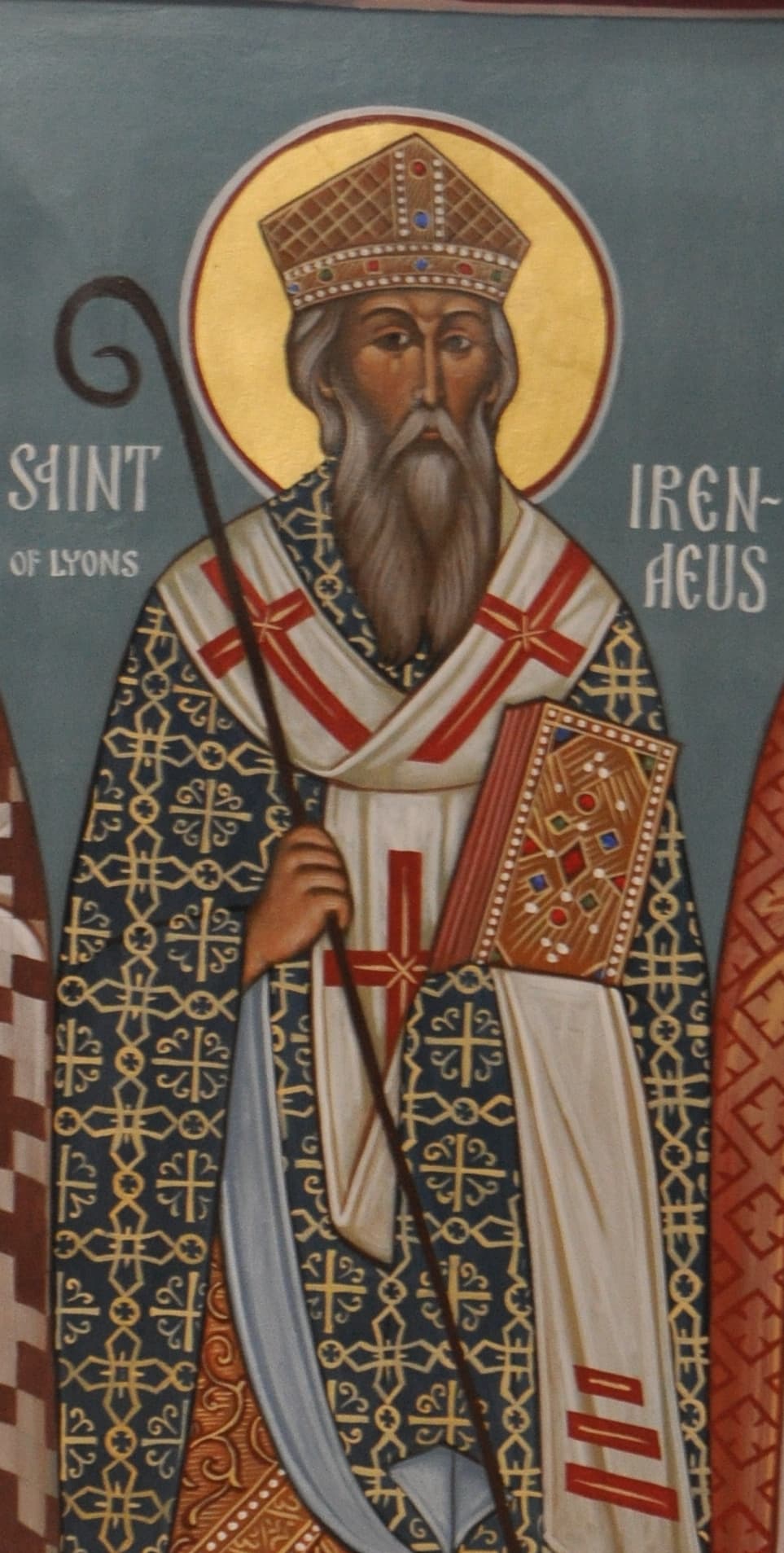
- Feast day
- June 28 in the Latin Church, August 23 in the Greek 1
- Born
- In Asia Minor. The date is disputed - between 115 and 125, or between 130 and 142 1
- Heard
- Polycarp preach at Smyrna while still very young 1
- Was
- Bishop of Lyons, succeeding the martyr Pothinus 1
- Probably was not
- A martyr. The encyclopedia calls the testimony "isolated and later" and improbable 1
- Was named
- A Doctor of the Church by Pope Francis in 2022 2
Saint Irenaeus heard Polycarp preach when he was a boy, which made him a living link to the apostles, and he spent his life using that link to argue. 1 He wrote five books taking the Gnostic systems apart - not, Franciscan Media says, out of a desire to prove opponents wrong, but "prompted more by a desire to win over his opponents." 2 When a pope excommunicated the churches of Asia Minor over the date of Easter, Irenaeus talked him out of it. 1 Pope Francis named him a Doctor of the Church in 2022. 2
What is not known
Poncelet opens by limiting his own article: "Information as to his life is scarce, and in some measure inexact." 1 The birth date is not merely unknown but contested in two different directions - "between the years 115 and 125, according to some, or, according to others, between 130 and 142." 1 Franciscan Media agrees: the details of "his birth and early life in Asia Minor, are not at all clear." 2
One thing is certain. "It is certain that, while still very young, Irenaeus had seen and heard the holy Bishop Polycarp (d. 155) at Smyrna." 1 Polycarp had known John. That is two steps from the apostles to a man writing in Gaul at the end of the second century, and it is the whole basis of his authority.
He was a priest at Lyons during the persecution under Marcus Aurelius, and the local clergy - "many of whom were suffering imprisonment for the Faith" - sent him to Rome in 177 or 178 with a letter to the pope about Montanism, and "bore emphatic testimony to his merits." 1 A church whose leaders were in prison chose him to speak for them.
He came back to find the bishop dead and took his place: he "succeeded the martyr Saint Pothinus as Bishop of Lyons." 1
Taking the Gnostics seriously enough to refute them
Franciscan Media explains what he was up against and why it was dangerous rather than absurd. The Gnostics "took their name from the Greek word for 'knowledge'", and were "claiming access to secret knowledge imparted by Jesus to only a few disciples". The result was that "their teaching was attracting and confusing many Christians." 2
His method was research before argument. "After thoroughly investigating the various Gnostic sects and their 'secret,' Saint Irenaeus showed to what logical conclusions their tenets led. These he contrasted with the teaching of the apostles and the text of Holy Scripture, giving us, in five books, a system of theology of great importance to subsequent times." 2 He learned the systems properly first, which is why the refutation worked.
And Franciscan Media is specific about his temper, which is unusual in a controversialist: he was "tremendously protective of apostolic teaching, but prompted more by a desire to win over his opponents than to prove them in error." 2
The book's real title is better than the one it is known by. Poncelet notes that "Adversus haereses" is the common name, but the true title is the "Detection and Overthrow of the False Knowledge". 1 He calls it "the chief work of Irenaeus and truly of the highest importance", and points out the accidental service it does: in describing the systems he is refuting, Irenaeus preserved them. It "constitutes an invaluable source of information on the most ancient ecclesiastical literature from its beginnings to the end of the second century." 1
Franciscan Media records the outcome: the work, "widely used and translated into Latin and Armenian, gradually ended the influence of the Gnostics." 2
Stopping an excommunication
The churches of Asia Minor kept Easter on a different day from everybody else, and in 190 or 191 Pope Victor excommunicated them over it. 1
Irenaeus intervened. Poncelet states it plainly: "he interceded with Pope Victor to lift the sentence of excommunication laid by that pontiff upon the Christian communities of Asia Minor which persevered in the practice of the Quartodecimans in regard to the celebration of Easter." 1
It is the same argument Polycarp had taken to Rome forty years earlier and failed to settle, parting from that pope in peace instead. 1 Irenaeus had heard Polycarp as a child. When it came round again, harder, he was the one who told a pope to stand down - and the pope did.
A man whose entire reputation rests on defending apostolic teaching against innovation spent his most consequential intervention arguing that a difference of practice was not worth a schism.
What survives, and one forgery
He wrote in Greek and none of it survives in Greek. "None of these writings has come down to us in the original text, though a great many fragments of them are extant as citations in later writers." 1
Two works survive whole, in other languages. The five books against the heresies exist in "a very ancient Latin translation, the scrupulous fidelity of which is beyond doubt". 1 The second, the "Proof of the Apostolic Preaching", survives in Armenian, and its purpose is different: "The author's aim here is not to confute heretics, but to confirm the faithful". 1
The rest is a list of titles known only because somebody else mentioned them - a treatise on knowledge, a letter on how God is not the cause of evil, a work on schism, letters to a pope, a book of homilies. 1
And one item is not his at all. "The four fragments which Pfaff published in 1715, ostensibly from a Turin manuscript, have been proven by Funk to be apocryphal, and Harnack has established the fact that Pfaff himself fabricated them." 1 The editor forged them. Poncelet prints the finding without comment, which is the correct way to handle it.
What is Saint Irenaeus the patron saint of?
Neither source cited here gives him a patronage. 12 Poncelet's article is a survey of his writings and Franciscan Media's entry ends with the doctorate; neither names a cause he is invoked for, and this page does not supply one.
The title he does have is recent. "However in 2022, Pope Francis named Saint Irenaeus a Doctor of the Church." 2 Poncelet, writing in 1910, could only call him a Father of the Church, which is what he does in his opening line. 1
Saint Irenaeus's feast day
The feast of Saint Irenaeus is June 28. The encyclopedia states it outright and gives the Eastern date alongside: "His feast is celebrated on 28 June in the Latin Church, and on 23 August in the Greek." 1
It is not the anniversary of his death, because nobody knows when he died. "Nothing is known of the date of his death, which must have occurred at the end of the second or the beginning of the third century." 1
Praying with Saint Irenaeus
He is the saint for arguing well. The distinction Franciscan Media draws is the one that matters and is almost never observed: he was "prompted more by a desire to win over his opponents than to prove them in error." 2 Those are different goals and they produce different books. Wanting to be right produces a demolition; wanting to bring somebody back produces five volumes in which you first learn their position properly enough to state it - which is why his opponents' ideas survive only because he wrote them down. 1
The other half of him is knowing when not to fight. He had spent his life defending apostolic teaching, and when a pope excommunicated an entire region over the date of a feast, Irenaeus was the one who went and argued for leaving them alone. 1 The question was not doctrine and he could tell the difference. Polycarp, whom he had heard as a boy, had reached the same conclusion a generation earlier and had had to settle for parting in peace. 1
He is also a good saint for the uncertainty of records. His birth date is contested by fifteen years, nothing is known of his death, his own encyclopedia thinks the martyrdom is probably a later embellishment, and not one word he wrote survives in the language he wrote it in. 1 What survives is the argument, in translation, because people kept copying it.
And in 2022, eighteen centuries after he died, somebody decided he should be called a Doctor of the Church. 2 Some work takes a while to be recognized.
Saint Irenaeus, pray for us.
Sources
Saints to turn to next
Others in this collection who are turned to for some of the same things.