Saint Engelbert of Cologne
c. 1185 - November 7, 1225
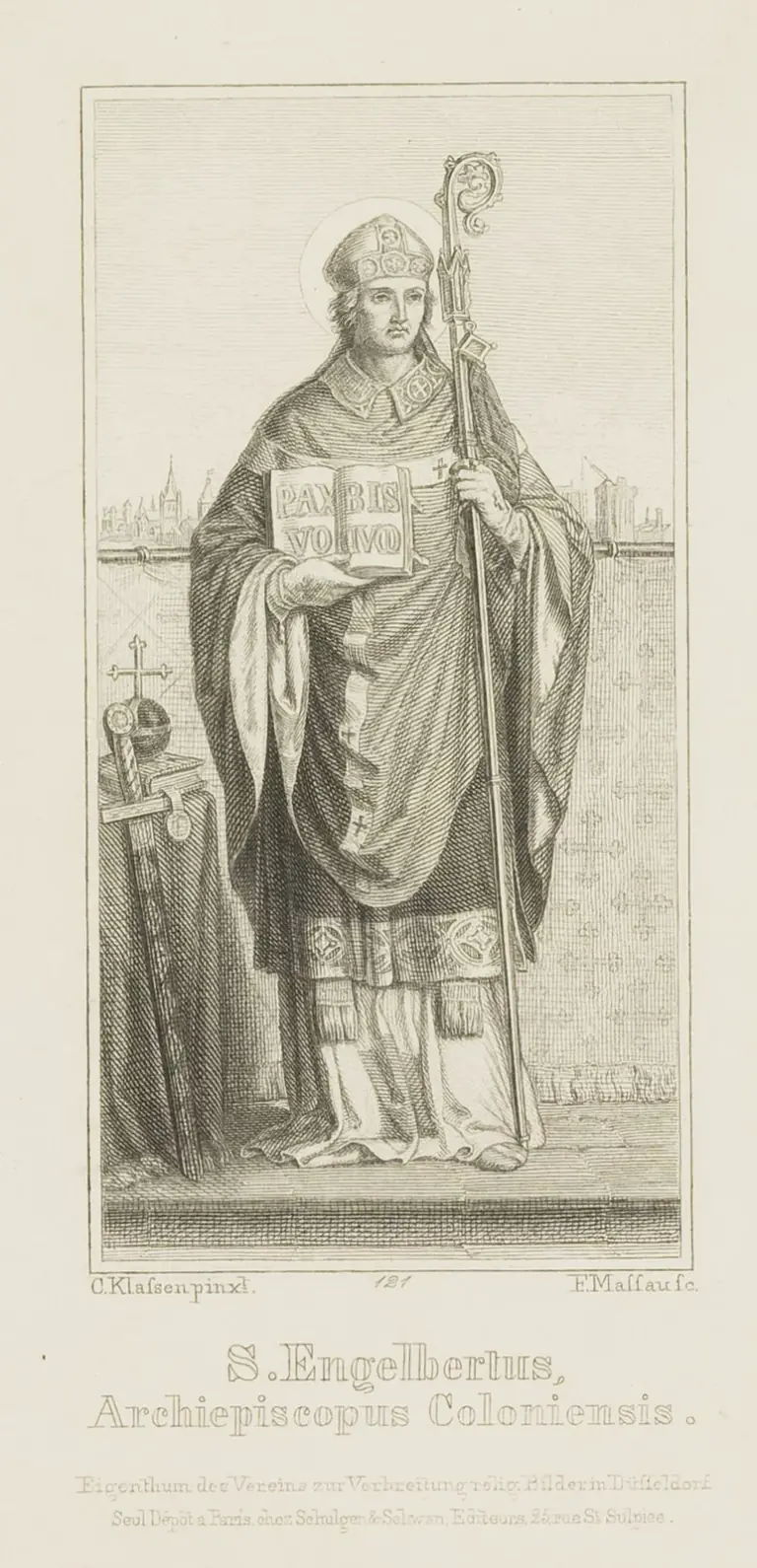
Saint Engelbert of Cologne was a count's son who was made a cathedral provost as a boy, was excommunicated in his twenties for fighting on the wrong side of a civil war, and became archbishop of Cologne and regent of Germany. 12 On November 7, 1225, he was ambushed and killed by men led by his own kinsman, Count Frederick of Isenberg, after he took up the cause of the nuns of Essen against him, and the papal legate declared him a martyr at his funeral. 13 His feast is November 7. 4
A worldly young churchman
He was born about 1185, the son of Count Engelbert of Berg and of Margaret, daughter of the count of Gelderland, and he was educated at the cathedral school of Cologne. 13 His family had already given Cologne several archbishops. katolsk.no lists five of them, among them his cousin Adolf I. 2
The family's connections brought him church offices early. The Catholic Encyclopedia says that "while still a boy" he was made provost of the churches of Saint George and Saint Severin at Cologne and of Saint Mary's at Aachen, "according to an abuse of that time," and that he was elected provost of Cologne cathedral in 1199. 1 katolsk.no puts him in charge of Saint George at thirteen and at the head of the cathedral chapter at fourteen, while he was still at school, adding that he refused election as bishop of Münster in 1203 because he was too young. 2 Del Re, on santiebeati, gives 1203 for the cathedral provostship. 3
His life was a worldly one. In the struggle over the German crown that followed the death of Henry VI, he sided with his cousin, Archbishop Adolf, and took up arms. 12 In 1206 he was deposed and excommunicated with his cousin. 123 katolsk.no says he went through the lands of the other party burning and plundering. 2 He submitted and was restored in 1208, and in 1212, the encyclopedia says, "to atone for his sin," he joined the crusade against the Albigenses. 13
Archbishop and regent
On February 29, 1216, the cathedral chapter elected him archbishop of Cologne unanimously. 123 He was consecrated on September 24, 1217, and received the pallium the next year. 23 katolsk.no observes that from then on his own manner of life seems to have been blameless. 2
The encyclopedia describes him as tall and handsome, with "a penetrating mind and keen discernment," kind, a lover of justice and peace, "but he was also ambitious and self willed." 1 He found the see in disorder after years of war and restored it by force where he had to, defeating the duke of Limburg and the count of Cleves, building strongholds and, the encyclopedia says, not sparing even his own relations when they were in the wrong. 13 He was blamed by devout people for looking more like a prince than a bishop. 1
He held synods, insisted on observance in the monasteries, and brought the new mendicant orders to Cologne: the Franciscans in 1219 and the Dominicans in 1221. 12 The encyclopedia calls him "a friend of the clergy and a helper of the poor." 1
The emperor Frederick II, who lived in Sicily, made him guardian of his young son Henry and administrator of the empire, in 1221 according to the encyclopedia and in 1220 according to both santiebeati biographies. 13 On May 8, 1222, Engelbert crowned the boy king at Aachen. 12 He concluded a treaty with Denmark at the diet of Nordhausen on September 24, 1223. 12 The poet Walther von der Vogelweide called him "Master of sovereigns" and "True guardian of the king." 1
The nuns of Essen
The quarrel that killed him was inside his own family. Count Frederick of Isenberg, the son of a cousin, held the office of protector of the noble abbey of nuns at Essen, and was oppressing it, taking its revenues and lands. 123 Pope Honorius III and the emperor urged Engelbert to protect the nuns. 13 katolsk.no says he first offered to pay Frederick out of his own fortune instead, and when Frederick refused, removed him. 2
The encyclopedia says that Frederick's wife urged him to murder, and that his two brothers, the bishops of Münster and Osnabrück, were suspected of knowing about it. 1 Engelbert was warned. He commended himself to God and, in tears, made a confession of his whole life to the bishop of Minden. 1
On the evening of November 7, 1225, he was riding from Soest to Schwelm to consecrate a church when Frederick and his men attacked him in a narrow pass. 13 He was wounded, dragged from his horse and killed. 1 The encyclopedia counts forty-seven wounds; Cattini, on santiebeati, writes that the medieval witnesses disagree, some giving forty-eight, and that it is still debated whether the attackers meant at first to kill the archbishop or to take him prisoner. 13 santiebeati places the ambush near Gevelsberg, by Schwelm. 3
What happened to his body is told two ways. The encyclopedia says it was laid on a dung-cart and brought to Cologne on the fourth day. 1 katolsk.no says the priest of Schwelm, afraid of the killers, would not keep it in his church, so a soldier took it on a dung-cart to the Cistercian abbey of Altenberg, where his heart has been kept ever since, and the rest was carried to Cologne. 2
Martyr without a canonization
On February 24, 1226, Cardinal Conrad of Urach, the papal legate, buried him in the old cathedral of Cologne and declared him a martyr. 123 Del Re writes that the legate called him "a martyr and a second Thomas Becket." 3 King Henry wept over the body and put the murderer under the ban of the empire. 1 Frederick was broken on the wheel at Cologne, a year later according to the encyclopedia and on November 18, 1226, according to katolsk.no. 12 The encyclopedia adds that he died contrite, having confessed his guilt. 1
Engelbert's successor had the Cistercian Caesarius of Heisterbach write his Life, which he finished in 1226 in two books, with a third on his miracles. 123 Cattini values it as close to the events and cautions that it was written to present him as a martyr and model bishop. 3
No formal canonization ever took place, which the encyclopedia, katolsk.no and Cattini all state. 123 katolsk.no says no one knows why. 2 His relics were solemnly raised in 1622 and rest in a silver-gilt baroque shrine of 1633 by Konrad Duisbergh, kept in the treasury of Cologne cathedral. 12 katolsk.no says he is shown in art as a bishop with palm and sword, or with pallium and book, often with a boy at his side for the king he raised, and under the words of Luke 23:34, "Forgive them, for they know not what they do," which he is said to have prayed as he died. 2
What is Saint Engelbert the patron saint of?
Saint Engelbert's feast day
Saint Engelbert's feast day is November 7, the day he was killed. The current Roman Martyrology, as the Italian bishops print it, enters him that day as a bishop who, ambushed on the road by assassins and cruelly beaten, died for defending justice and the freedom of the Church. 4
The encyclopedia, katolsk.no and Cattini say that Archbishop Ferdinand of Cologne ordered the feast kept on November 7 in 1618. 123 Del Re says his name was entered in the Roman Martyrology in 1583 and that Ferdinand gave him a proper Office in 1657. 3 katolsk.no's heading gives November 21, though its own text gives November 7. 2
Praying with Saint Engelbert
He did not begin as a saint. He took benefices he was too young to hold, fought in a civil war, was excommunicated, and went on crusade, as the encyclopedia puts it, to atone. 12 The sources set all of it down plainly. 123
As archbishop he was hard, rich and powerful, and the sources do not pretend otherwise: devout people blamed him for it in his lifetime, and a modern historian on santiebeati reads his death partly as a quarrel over power and property. 13 The cause that brought him to the pass near Schwelm was nonetheless a community of women whose protector had become their robber. 12
He knew he might be killed and went anyway, after confessing his whole life. 1 The man who killed him was family. 12
In art he is often shown under the words from the cross, "Forgive them, for they know not what they do." 2 That is the line a reader is left with.
Saint Engelbert of Cologne, pray for us.
Sources
- 1.Gabriel Meier, "St. Engelbert of Cologne," The Catholic Encyclopedia, Vol. 5 (New York: Robert Appleton Company, 1909).
- 2.Per Einar Odden, "Den hellige Engelbert I av Köln (~1185-1225)," Den katolske kirke (Catholic Church in Norway), katolsk.no (in Norwegian).
- 3.Giampietro Cattini and Niccolò Del Re, "Sant' Engelberto di Colonia, Vescovo," Santi e Beati, santiebeati.it (in Italian).
- 4.Roman Martyrology, entries for November 7, Santo del giorno, Conferenza Episcopale Italiana (in Italian).
Saints to turn to next
Others in this collection who are turned to for some of the same things.