Saint Emygdius of Ascoli
Traditionally 273 - 303
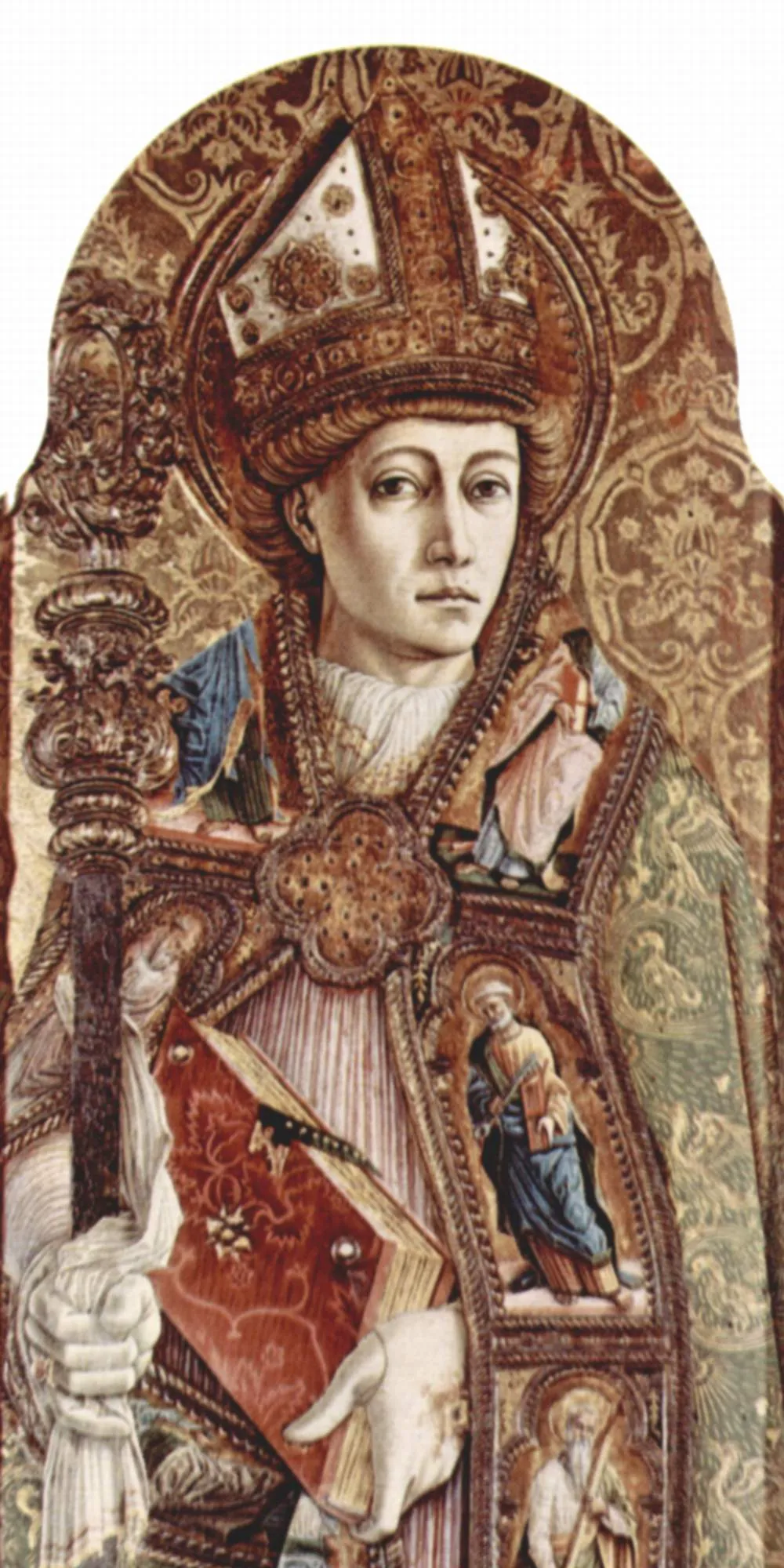
- Born
- Trier, to a pagan family, in 273, according to the diocese of Ascoli 1
- Office
- Celebrated as the first bishop of Ascoli Piceno 2
Saint Emygdius is the first bishop of Ascoli Piceno, in Italy, and a martyr of the persecution under Diocletian. 23 Ascoli's own tradition makes him a convert from Trier, at the edge of the Roman Empire, who was consecrated in Rome, sent to a battered Christian community that wanted a pastor, and beheaded in 303. 1 He is best known now as the saint invoked against earthquakes, a devotion his own diocese dates only to 1703; it remembers him first, and far longer, as the man who brought it the Gospel. 4
What the Church records
The official entry is a single line. The Roman Martyrology, under August 5, says that at Ascoli Piceno Saint Emygdius is celebrated as the first bishop of the city and as a martyr. 2 The choice of words is careful: it records how he is honored and leaves the details of his life to others.
The Catholic Encyclopedia of 1907 is just as brief, and more interesting about the background. Its article on the diocese quotes the historian Adolf von Harnack, who thought Ascoli important enough that "we may believe" it had a Christian community and a bishop from the middle of the third century. 3 The traces, it goes on, "do not appear until the fourth century," and the first is "St. Emidius, martyred under Diocletian," followed by a Bishop Claudius at the Synod of Rimini in 359. 3 Its bibliography includes an 1832 life of the saint by Appiani whose title names Saint Valentine, his deacon, as the first writer of his deeds. 3
From Trier to Ascoli
The fuller story is the one the Diocese of Ascoli tells, and it tells it twice on the same page. The first version is an extract from Pietro Capponi's historical memoir of the Church of Ascoli. In it, Christianity had reached the region long before, through a line of missionary bishops sent by the popes, but the persecutions of the later third century had thinned the Christians of Ascoli badly. 1 Emygdius was born at Trier in 273 to pagan parents. In 296, at twenty-three, he grasped the truth of the faith and was baptized, and the same year, to escape his relatives' hostility, he left for Italy with three Christian companions, Euplus, Germanus and Valentine. 1 They stopped at Milan, where two years later Bishop Maternus ordained him a priest. The next year the four went on to Rome, and in December Pope Marcellinus consecrated him Bishop of Ascoli; he set out for his see that same month and became its first resident bishop. 1
The diocese's own sketch of its patron agrees on the outline and differs in the details. It has him born to a noble family of Trier and baptized at twenty-seven, after coming to know the faith through Christian friends his own age. 1 It adds that he worked surprising wonders in Rome before Marcellinus judged him fit to be a bishop. 1 And it gives the journey a detour. On the road he learned that persecution had flared again at Ascoli, so he turned aside into the Abruzzo and won the town of Pitino and others for the faith, going on to Ascoli only when things had calmed. 1
Capponi sets the scene at the other end too. In 285, he writes, Diocletian sent a young prefect of equestrian rank, C. Polimius, to govern Picenum from Ascoli, with orders to root out the Christians there. Within two years Polimius had a daughter, Polisia. 1
Three years in Picenum
By the diocese's account his arrival was a joy to a battered community, and he set to work at once: preaching, instructing, comforting the suffering, converting and baptizing, and reaching beyond Ascoli to places such as Fermo, where he joined an existing Christian community and opened a small pagan temple to the worship of God. 1 Among his converts was Polisia, the prefect's daughter. 1
Archbishop Gianpiero Palmieri imagined the reaction of the Romanized local elite, in a homily on the feast in 2024: what could this foreigner from Trier possibly have to tell them? 8 Bishop Domenico Pompili, preaching on the same feast in 2021, went further and called him a barbarian. 9 Palmieri's point was that God tends to change history through people from the margins rather than through the notables at the center, and he called Emygdius the greatest revolutionary Picenum has known, because he brought it the Gospel. 8
His death, and the walk to the Grotte
After barely three years of work, in 303, he was arrested, condemned to death and beheaded at the place where the little church of Sant'Emidio Rosso later stood. 1 The diocese's sketch tells this of him alone. Archbishop Palmieri's message for the 2025 feast speaks of the companions with whom he was martyred. 14
What follows is marked plainly as tradition. Having fallen to the ground in a pool of blood, the martyr picked up his own head, rose, and walked as far as the oratory at the Grotte, where he used to gather the faithful for worship, and there lay down. 1 Pious hands buried him in a rough tomb cut in the rock, and the people of Ascoli later moved his body to the crypt of the cathedral, where he is still venerated. 1
A second tradition belongs to the tomb. Archbishop Palmieri's letter for the 2026 feast recalls that the place where he was buried was recognized by the basil growing over it, and that this is why basil plants are blessed every year on his day. 5 The blessing takes place in front of the cathedral at 5:45 in the morning. 67 Palmieri explains the hour himself: blessing it at dawn evokes the passage from darkness to light, from death to life, and so it is an Easter gesture as well as a practical one. 5
Protector against earthquakes
Ascoli calls him its patron and its protector against earthquakes, and the diocese's program for his feast puts both in its first sentence. 6 The bishop is frank that the second title is the younger one. In his 2025 message Palmieri dated it to 1703, the year a terrible earthquake devastated central Italy and spared Ascoli, and set against it the far older and original tradition of Emygdius as the evangelizer of Picenum. 4 For centuries, he wrote, Ascoli honored him first because, with his companions, he brought it the Gospel, and with it faith and baptism. 4
The year before, preaching to the crowds in the crypt and the cathedral, he made the same point from the other direction: yes, Emygdius is the protector against earthquakes, but a devotion this large is not explained by fear of earthquakes alone. 8 His 2026 prayer to the saint asks for help in the hardest moments, when everything goes dark and the earth seems to tremble underfoot, and asks him to teach people to hold on to one another when life gives way. 5 The 2026 letter also notes that cities and church communities far from Ascoli turn to him. 5
What is Saint Emygdius the patron saint of?
Saint Emygdius is the patron of the city and Diocese of Ascoli Piceno, and he is invoked as protector against earthquakes. 156 When Pope John XXIII proclaimed Our Lady of Graces patroness of the city and diocese in 1961, the diocese records, he did so alongside Emygdius, who had held that title for a long time. 1
Saint Emygdius's feast day
His feast is August 5, the date given both by the Diocese of Ascoli and by the Roman Martyrology. 12 In Ascoli it is a solemnity and the center of twelve days of celebration, from July 26 to August 6. 67 The relic of his arm is exposed in the cathedral on the first evening, and each morning there are Mass, prayer to the saint and a blessing with his relic in the crypt, with the parishes of the diocese taking turns on pilgrimage to his tomb. 6 On the eve a different town each year offers the oil for the votive lamp at his tomb: Valle Castellana in 2025, Venarotta in 2026. 67
The Sestieri, the quarters of the city that compete in the Quintana joust, are blessed by the archbishop and offer candles. 67 On August 5 itself the basil is blessed at dawn, Masses follow every hour through the morning, a cardinal presides at the solemn Pontifical with the Papal Blessing at 11, and in the evening his statue is carried in procession through the old city. 67
Praying with Saint Emygdius
The prayer the diocese wrote for 2026 opens with a detail anyone can check: he is always shown with the Gospel in his hands. 5 It is a good place to start. The Ascoli tradition remembers a convert who left home under pressure from his own family, went where he was sent, and spent his three years preaching and baptizing among people who had reason to distrust a stranger. 18
The feast-day messages keep coming back to starting over. Palmieri, writing about the cathedral baptistery, whose font dates from the fifth century, spoke of the people of Ascoli being reborn from it for seventeen hundred years, beginning with Emygdius and Polisia, both of them young. 10 The Gospel, he wrote, is the one force that lets people truly start again, whether after a war, an earthquake or a pandemic. 10
That is the honest shape of a devotion to a saint against earthquakes. It does not promise that the ground will hold. It asks for courage when it does not, and that no one be left alone and abandoned at the moment they need help. 5 Pompili, preaching in 2021, compared faith to the basil of the feast: a small evergreen plant that can be grown on any windowsill and changes the taste of whatever it touches. 9
Saint Emygdius of Ascoli, pray for us.
Sources
- 1."Storia e Santi Patroni," Diocesi di Ascoli Piceno, including Pietro Capponi, "Memorie storiche della Chiesa ascolana."
- 2."Santo del giorno: 5 agosto," Roman Martyrology, Chiesacattolica.it, Conferenza Episcopale Italiana.
- 3.Ernesto Buonaiuti, "Ascoli-Piceno," The Catholic Encyclopedia, Vol. 1 (New York: Robert Appleton Company, 1907).
- 4.Gianpiero Palmieri, "Solennità di Sant'Emidio 2025: il messaggio del Vescovo Gianpiero," Diocesi di Ascoli Piceno, 2025.
- 5.Gianpiero Palmieri, "Sant'Emidio 2026: la lettera del Vescovo e la preghiera," Diocesi di Ascoli Piceno, 2026.
- 6."Festività di Sant'Emidio 2026," program of celebrations, Diocesi di Ascoli Piceno, 2026.
- 7."Festività di Sant'Emidio 2025: il programma religioso e civile completo," Diocesi di Ascoli Piceno, 2025.
- 8.Gianpiero Palmieri, "Solennità di Sant'Emidio 2024: l'omelia del Vescovo Gianpiero," Diocesi di Ascoli Piceno, August 5, 2024.
- 9.Domenico Pompili, "Omelia del Vescovo Domenico nella Solennità di Sant'Emidio," Diocesi di Ascoli Piceno, August 5, 2021.
- 10.Gianpiero Palmieri, "Rigenerati dal Vangelo annunciato da Sant'Emidio," message to the diocese for the solemnity, Diocesi di Ascoli Piceno, 2022.
Saints to turn to next
Others in this collection who are turned to for some of the same things.